
Pest Prevention and Control: How to Keep Pests Out of Your Home
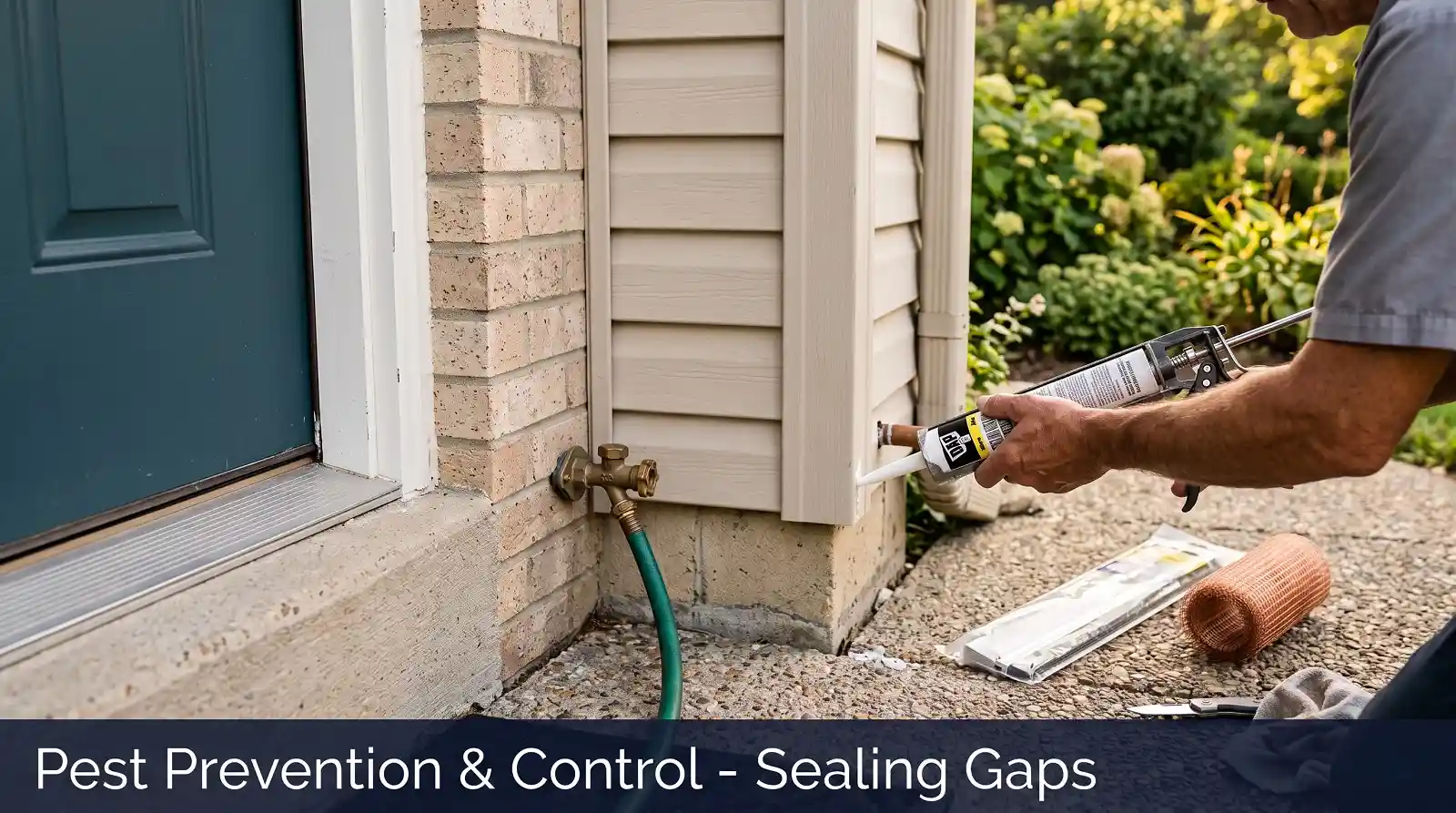
I spent two years treating the same ant trail every spring. New bait every March, same ants every April. The problem was never the bait.
The gap was a quarter-inch of missing mortar behind my hose bib. Once I sealed it, the ants stopped. That is what real pest prevention and control means: fixing the reason pests get in, not just killing the ones you can see.
On this page
- Why pest prevention and control starts outside
- Seal them out
- Take away food and water
- Choose the right method
- Find the guide for your pest
- Use products safely
- Know whether it worked
- Room-by-room checklist
- Browse the full Pest Library
Why pest prevention and control starts outside
Good pest prevention and control starts with one idea: pests are not random. They come in for three things, and the EPA frames it simply in its Preventing Pests at Home guide: food, water, and shelter. Take away all three and most problems never start.
That framing matters because it changes the order of your work. Most people reach for a spray first. Sealing and cleaning come first, and spraying comes last, if it comes at all.
There is a fourth entry route people forget. Exterior lights pull moths, beetles, roaches, and flies toward the house at night, and they slip inside when a door opens. Swapping porch bulbs to warm yellow LEDs is one of the cheapest fixes on this page.
Seal them out
This is the step that does the most and gets the least attention. Every guide says seal cracks. Almost none of them tell you what size, what material, or where to look.
Start with the gaps that matter most:
- Under exterior doors. A quarter-inch is enough for a mouse. Install a door sweep and check it touches the threshold along its full width.
- Window and door screens. Use 20-mesh or finer. Anything coarser lets small flies and gnats straight through.
- Utility penetrations. Where pipes, cables, and dryer vents pass through the wall. These are the most common oversight.
- Weep holes and mortar joints. Small gaps in brickwork are highways for ants and roaches.
- Attic vents and soffits. Go up during the day with the lights off. Any daylight you see is an entry point.
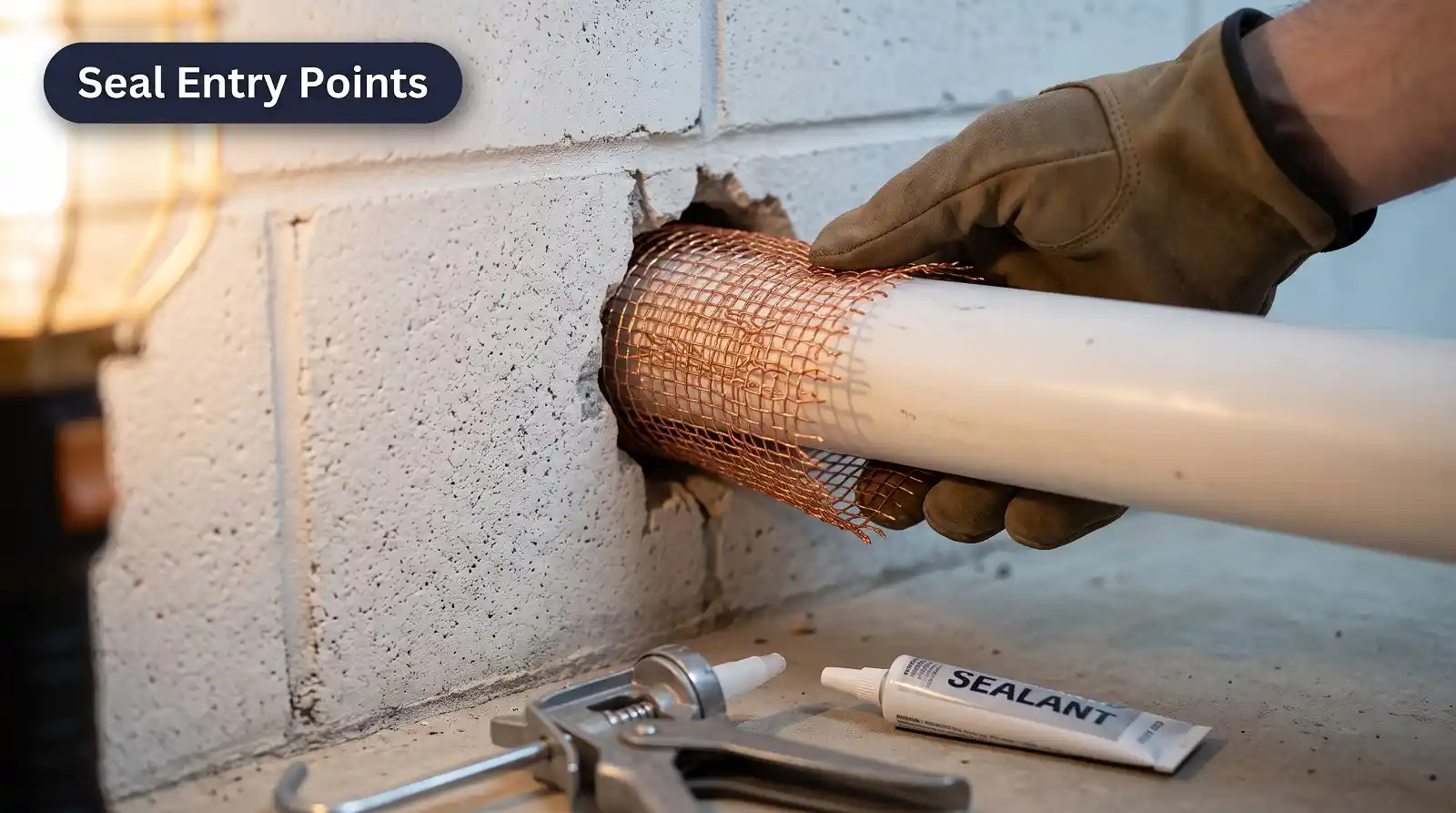
Match the material to the gap. Caulk works for cracks under a quarter-inch. For bigger holes, use copper mesh or steel wool packed tight, then seal over it. Mice chew through expanding foam alone, so never use foam by itself on a rodent gap.
Then work outward from the walls. Trim branches and shrubs so nothing touches the house, because plants against a wall give pests a ladder. Keep mulch and pine straw pulled back from the foundation too, since roaches breed in it.
On firewood: keep it off the ground and well away from the house. Twenty feet is the usual insect recommendation. If your concern is mice or rats, put it as far from the building as your yard allows.
Rodent-proofing has the tightest tolerances of any pest, and our guide to getting rid of mice covers the gap sizes and materials in detail. For wood-destroying pests, sealing is only half the job, and termite signs and prevention explains what to check on the foundation.
Take away food and water
Sealing keeps out the pests that are trying to get in. This step stops them from wanting to.
Food sources people miss:
- Pet food left down overnight, and the bag it came from
- Dry goods in original cardboard and paper packaging
- Crumbs under and behind appliances, not just on the floor
- Recycling bins with unrinsed cans and bottles
- Fruit bowls, especially in late summer

Move flour, cereal, rice, sugar, and pet food into sealed containers. Cardboard is not a barrier. Roaches climb into boxes easily, and pantry beetles chew through paper.
Water is the one people overlook. Roaches can go about a month without food but only around a week without water. That makes a slow drip under the sink more of a draw than a dirty counter.
Check for these:
- Leaking traps and supply lines under sinks
- Condensation on cold water pipes in the basement
- Standing water in gutters, saucers, and outdoor containers
- Damp crawl spaces and unventilated attics
- Slow drains, where the film inside the pipe feeds drain flies
Standing water outside is a separate problem, because mosquitoes breed in it. Our mosquito larvae guide covers how little water they need, and it is less than most people think.
Clutter counts as shelter. Stacked newspaper, cardboard, and paper bags give pests somewhere to hide and breed. Silverfish in particular live on paper and starch, which our silverfish identification guide explains.
Choose the right method
This is where most DIY attempts go wrong. The method has to match how the pest behaves, and a lot of people pick a spray because it feels like doing something.
Baits work on social insects and rodents that share food. The insect eats and carries it back to the nest, so members that never touched the bait still die. That is why a gel bait clears a roach or ant problem when a spray will not.
Sprays kill what they touch and leave residue on a surface. They are fine for a visible wasp nest or a perimeter barrier. Used indoors on ants or roaches, they often make things worse, because the repellent effect scatters the colony and splits it into new nests.
Traps catch what walks into them. They work when you know the travel route, which is why placement matters more than quantity. They also let you see what you actually have.
Dusts go into voids, wall cavities, and behind outlets where liquids cannot reach. They last a long time in dry places and do nothing if applied thickly, since insects avoid heavy deposits.
A short version: bait for anything that lives in a colony, trap for anything that travels a route, dust for anything hiding in a void, spray for anything you can see and reach.

Roaches are the clearest example of method choice mattering. Our cockroach gel bait guide walks through why bait plus dust beats spraying, and what happens when you get the order backwards.
The EPA’s Do’s and Don’ts of Pest Control lands in the same place. It advises using baits as the first chemical step, applying to targeted spots rather than whole rooms, and treating foggers as a last option rather than a starting point.
Find the guide for your pest
Match what you are seeing to the method that works, then read the full guide.
| What you’re seeing | Method that works | Full guide |
|---|---|---|
| Fast brown bugs in the kitchen at night | Gel bait plus void dust | Cockroach control |
| Not sure which roach you have | Identify before treating | Roach types and lookalikes |
| Itchy welts in a line after sleeping | Heat, encasements, inspection | Bed bug bites |
| Small dark spots on the mattress seam | Early detection and monitoring | Early signs of bed bugs |
| Dark pellets along skirting or in cupboards | Exclusion plus snap traps | Getting rid of mice |
| Hollow-sounding wood or mud tubes | Professional inspection | Termite signs |
| Confirmed termites and choosing treatment | Soil barrier or bait system | Termite treatment |
| Large black ants and fine sawdust | Bait plus moisture repair | Carpenter ants |
| Tiny ants that smell when crushed | Liquid sugar bait | Odorous house ants |
| A spider and you want to know if it’s dangerous | Identify first, do not handle | Dangerous house spiders |
| Large spiders indoors, mostly harmless | Exclusion and web removal | Big spiders by state |
| A nest under the eaves | Aerosol at dusk, or call a pro | Paper wasps |
| Mosquitoes taking over the yard | Remove water, then barrier treat | Mosquito yard control |
| Wriggling larvae in standing water | Source removal and larvicide | Mosquito larvae |
| Silver insects in the bathroom at night | Dehumidify plus dust | Silverfish |
| Jumping crickets in the basement | Moisture control and glue boards | Camel crickets |
| Pincered bugs near drains and damp areas | Dry out, then seal | Earwigs |
| Black and orange bugs on sunny walls in fall | Exclusion before they enter | Boxelder bugs |
| Droppings in the attic or on the deck | Identify, then clean up safely | Raccoon droppings |
| A raccoon acting strangely in daylight | Do not approach, call animal control | Rabid raccoon signs |
| You do not know what the bug is | Start with identification | House bugs ID guide |
Pest pressure shifts through the year, and timing your prevention work to the season saves effort. Our seasonal pest guide shows what to expect month by month.
Use products safely
Most pest control accidents come from using a product the wrong way, not from the product itself.
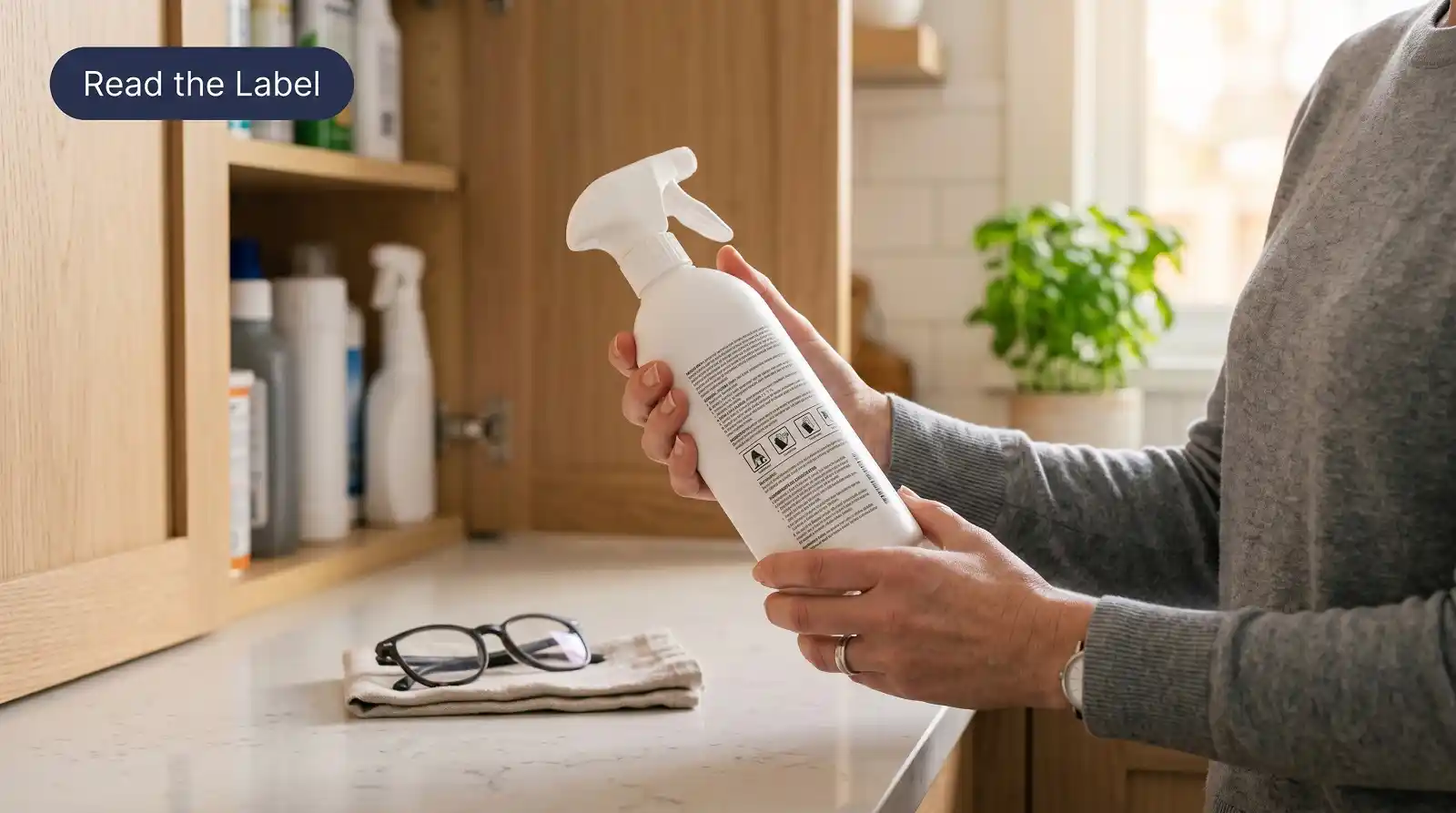
Read the label before you buy. The label tells you which pests it covers, where it can legally be used, and how long to stay out of the area. If your pest is not on the label, the product is the wrong one.
Never use an outdoor product indoors. This is the most common serious mistake. Michigan State University Extension has covered a CDC health advisory about exactly this, driven largely by people fighting bed bugs with lawn and garden products. Concentrations meant for open air do not disperse in a bedroom.
Children and pets need more caution than adults. They are closer to treated surfaces, they touch more, and they put their hands in their mouths. Keep them out of treated rooms until surfaces dry, and store everything in a locked cabinet in its original container.
Prefer contained formulations indoors. Baits in tamper-resistant stations expose far less than open sprays. Dusts placed in wall voids stay where you put them.
Know when to stop. Call a licensed professional when you find structural termite damage, a wasp nest inside a wall, a rodent problem with droppings needing containment, or a bed bug infestation past a single room. These are not stubborn DIY jobs; they are jobs where DIY tends to spread the problem.
Know whether it worked
Here is the part almost nobody explains, and it causes more wasted money than any other gap.
Seeing more bugs right after treatment is normal. Treatments push insects out of wall voids and floor cavities into the open. Activity looks worse for a few days precisely because the product is reaching where they live. Retreating at this point is the wrong move.
Slow-acting products are slow on purpose. A bait that killed instantly would never reach the nest. With ants and roaches, delayed action is the mechanism, not a defect.
Eggs survive the first pass. Roach egg cases, flea pupae, and bed bug eggs often come through an initial treatment. New pests appear a week or two later. That is a lifecycle problem, and it needs a second application timed to the hatch rather than a stronger product.
How to actually judge it:
- Set out monitors or glue boards before you treat, so you have a baseline
- Check the same spots at the same time of day
- Count activity weekly rather than reacting to single sightings
- Expect a real decline by week two, and near zero by week four for most insects
If nothing improves after four weeks, the usual causes are wrong pest identification, an entry point you have not found, or a nest outside the treated zone. Re-identify before you re-treat.
Room-by-room checklist
Kitchen. Sealed dry goods, clean under appliances, rinsed recycling, no dishes overnight, drains cleaned monthly.
Bathroom. Fix drips, run the extractor, keep humidity down, check under the vanity.
Basement. Dehumidify, clear cardboard storage, seal sill plate gaps, check for condensation.
Attic. Look for daylight, check vent screens, look for droppings and nesting material.
Garage. Store pet food in sealed bins, check the door seal, keep everything off the floor.
Yard. Trim back from walls, clear standing water, move firewood away, clean gutters twice a year.
Browse the full Pest Library
Every prevention step above works better when you know what you are dealing with. Start with the pest.
Bed Bugs · Cockroaches · Termites · Rodents · Mosquitoes · Spiders · Ants · Silverfish · Wasps · Crickets · Occasional Invaders · Nuisance Wildlife
Or start from what you saw, with our house bugs identification guide.
A note on regional differences: pest pressure and timing vary widely across the United States. Gulf Coast and Southwest homes face year-round activity, while northern states get a real winter break. Your local university extension office publishes state-specific guidance and is the best source for timing.
The short version
Sealing beats spraying. Most of the pests in your house got in through a gap you can find in an afternoon.
Match the method to the pest. Bait for colonies, traps for travel routes, dust for voids, spray last.
Give treatment time before you judge it. More bugs in week one usually means it is working.
And when the problem is structural, stinging, or spreading room to room, stop and call someone licensed. Knowing that line is part of doing this well.