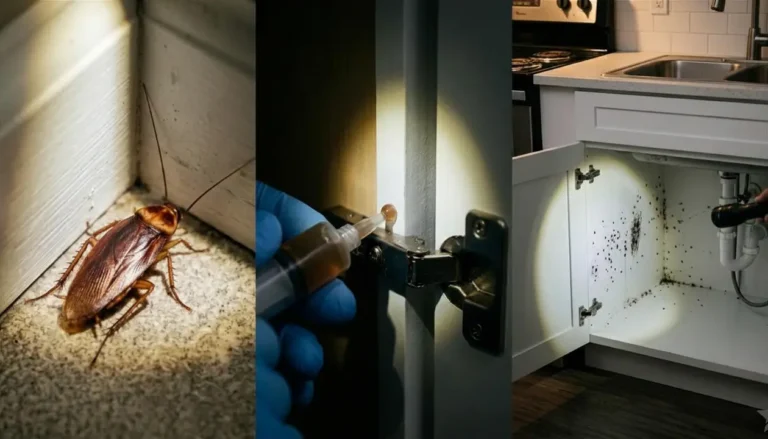
Types of Cockroaches in Homes: German, American, Oriental, and Common Lookalikes
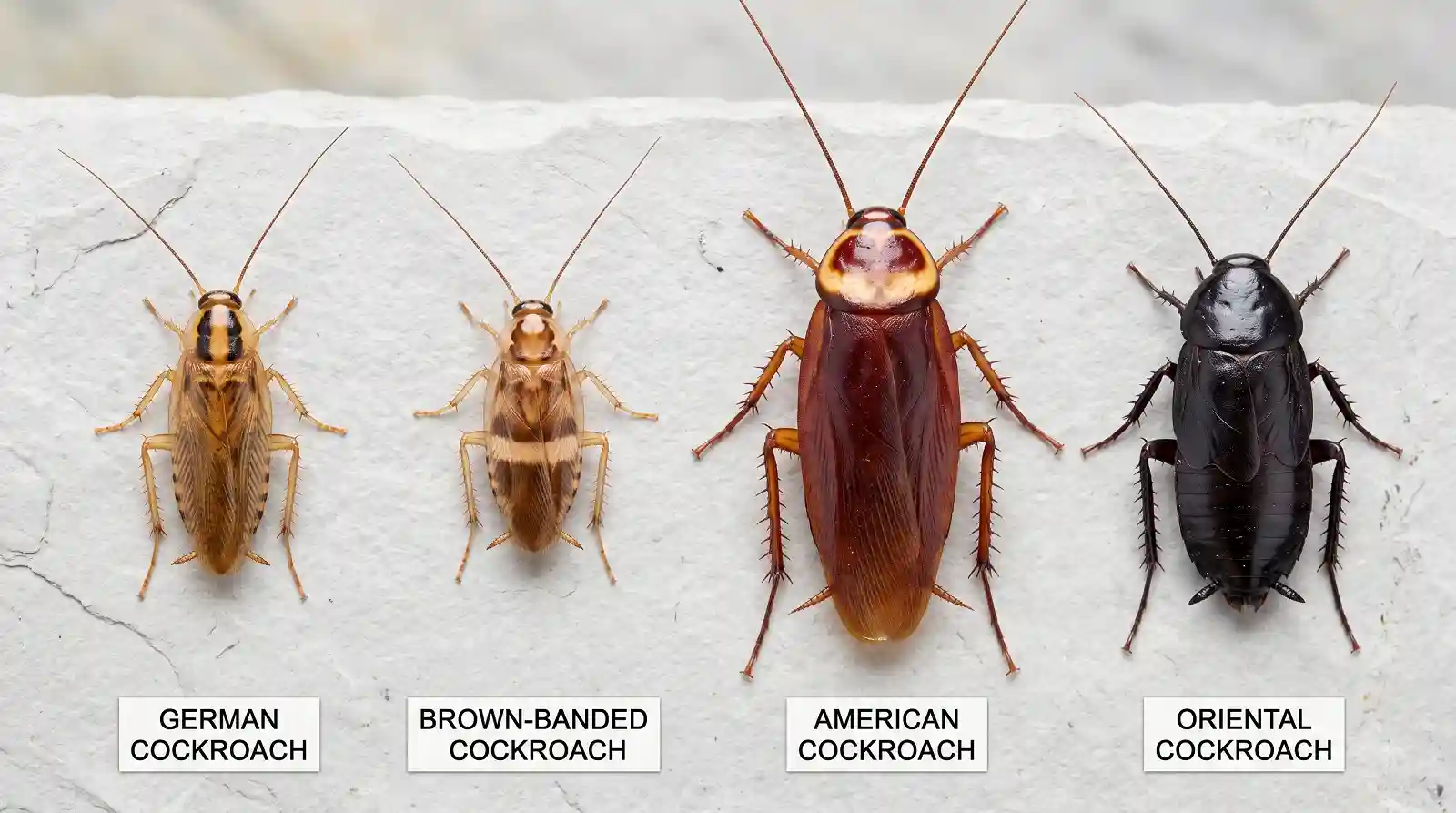
Most people meet their first German cockroach in a blurry phone photo taken at midnight, captioned “What is this?” I have worked through a lot of those photos, and size and color fool almost everyone the first time.
Get the species wrong, and you either panic over a harmless wood roach or shrug off something breeding inside your walls. Four questions settle it: how long, what color, what markings, and exactly where you found it.
Table of Contents
Start Here: The Cockroach ID Table
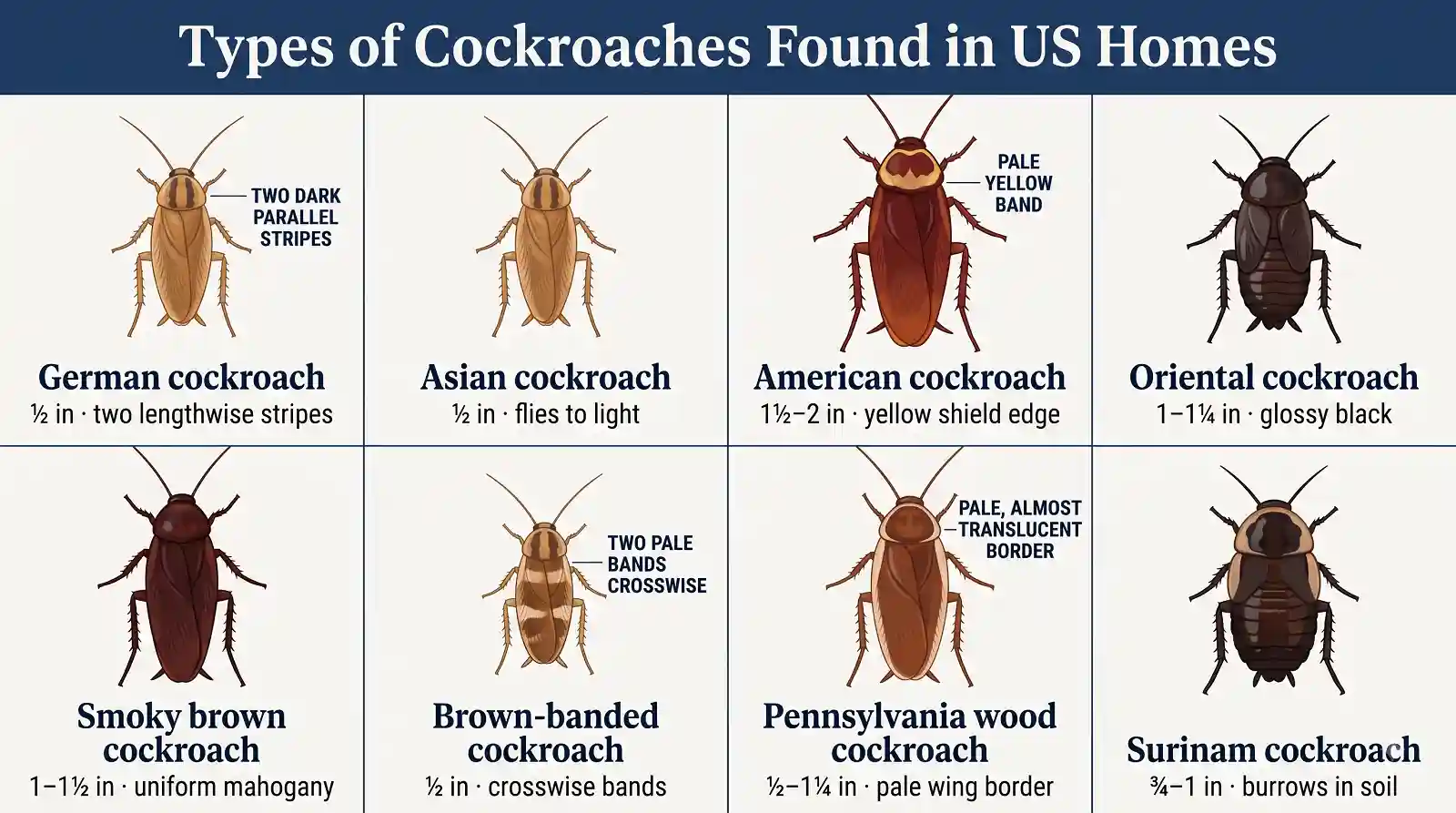
If you only read one thing on this page, read this. Find the row that matches what you saw.
| What you saw | Length | Color and markings | Flies? | Where you found it | Species |
|---|---|---|---|---|---|
| Small, tan, fast, two dark stripes | ½ to ⅝ in (13 to 16 mm) | Light brown to tan, two dark parallel stripes on the shield behind the head | Barely, glides at most | Kitchen, bathroom, inside appliances | German cockroach |
| Small, tan, two stripes, but it flew | ½ to ⅝ in | Nearly identical to German | Yes, readily | Lawn, leaf litter, flying to lights, Southeast US | Asian cockroach |
| Very large, reddish brown | 1⅜ to 2⅛ in (34 to 54 mm) | Reddish brown, pale yellow band edging the shield | Yes, glides well | Sewers, drains, basements, crawl spaces | American cockroach |
| Large, glossy, almost black | 1 to 1¼ in | Shiny dark brown to black, no markings | No | Basements, drains, mulch, floor level | Oriental cockroach |
| Large, uniform dark mahogany | 1 to 1½ in | Evenly colored, no pale edging anywhere | Yes, strong flier | Attics, soffits, trees, Southeast US | Smoky brown cockroach |
| Small, tan, bands across the back | 10 to 14 mm | Two pale bands across wings and abdomen | Males only | High shelves, electronics, picture frames, bedrooms | Brown-banded cockroach |
| Medium, chestnut, pale edge on the wings | ½ to 1¼ in, males larger | Chestnut brown with a translucent pale border on the shield and wing edges | Males yes, females no | Firewood, porch lights, near woods | Pennsylvania wood cockroach |
| Dark, shiny, dug into potted soil | ¾ to 1 in (18 to 25 mm) | Dark body, lighter tan margin on the shield | Rarely | Greenhouses, potted plants, Gulf states | Surinam cockroach |
Most people searching for a house cockroach are looking for one of the first four rows in that table. The term “house cockroach” is not a species; it is shorthand for whatever roach turned up indoors, and in US homes that is nearly always German, American, Oriental, or brown-banded. Everything below the fourth row generally came in from outside and is not breeding in your walls.
Four questions get you to the answer almost every time: How long? What color? Any stripes or pale edges? Where exactly was it?
That last one carries the most weight. A roach in a kitchen cabinet and a roach on a porch column are usually different insects living entirely different lives.
The German Cockroach: The One That Actually Moves In
What a German cockroach looks like
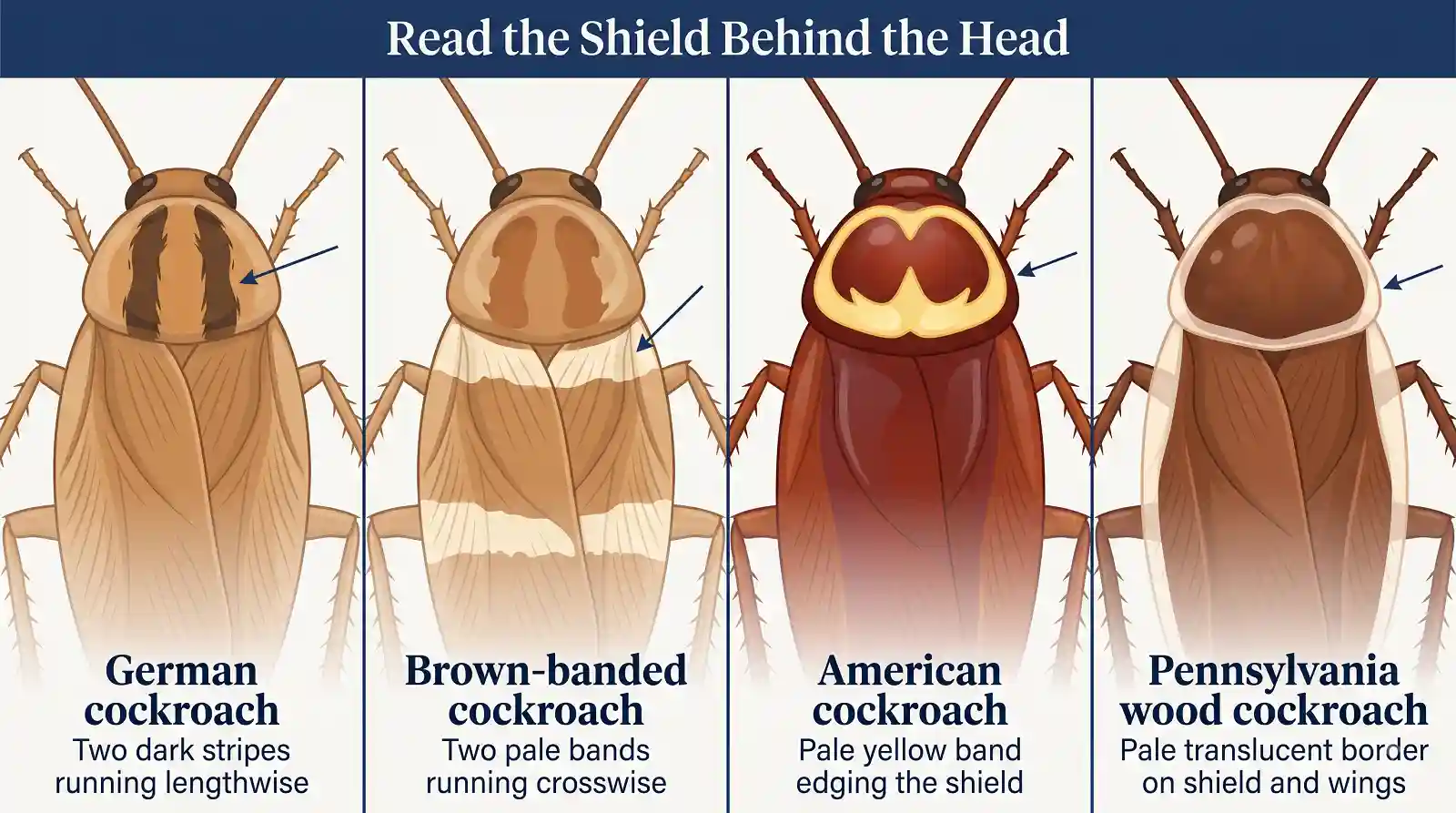
The German cockroach (Blattella germanica) is small, and that is the first thing to understand about it. Adults run 13 to 16 mm, which is about half an inch to five-eighths of an inch. Rutgers Cooperative Extension puts adults in that same band and describes the color as brown to dark brown, though tan is what most people see under kitchen light.
According to the University of Florida’s entomology profile, the identifying feature is two dark parallel stripes running down the pronotum, the shield-shaped plate covering the back of the head. They run front to back, not side to side. If you see bands running crosswise instead, you are probably looking at a brown-banded cockroach.
- Adults: 13 to 16 mm, tan to dark brown, two dark lengthwise stripes on the pronotum
- Males: narrower, lighter, abdomen tapers to a point
- Females: broader and thicker, abdomen rounded at the end
- Nymphs: wingless, much darker, nearly black, but they carry the same two stripes from the first instar
Nymph sizes are worth memorizing because they explain why people think they have baby roaches of a different kind. NC State Extension measured them stage by stage: roughly 3 mm at first instar, then 4.5, 5.6, 7, 9, and 12.5 mm as they molt. A 3 mm black speck with two stripes and a 15 mm tan adult with two stripes are the same insect at different ages.
Can German cockroaches fly?
Not really, and this is where a lot of published information gets it wrong. Adults have fully formed wings. They do not use them for flight. The reference literature describes them as barely able to fly, though they may glide when disturbed.
You will see national pest control sites state flatly that the German cockroach cannot fly. That is close enough for practical purposes, but it is not accurate. If one drops off a cabinet and appears to steer on the way down, that is a glide, not a fall. It is also not an Asian cockroach unless it actually took off and flew.
Where they hide
The German cockroach is thigmotactic, meaning they want physical contact on as many sides of their bodies as possible. A crack that touches their back and belly at once is good. This is why they end up in places that seem absurd:
- Under and behind the refrigerator, especially the warm motor housing
- Inside the stove, including the insulation layer and the clock housing
- Cabinet door hinges and the corners of drawer boxes
- Under the kitchen sink, particularly where the drain penetrates the wall
- Inside microwaves, dishwashers, coffee makers, and toaster ovens
- Behind loose baseboard trim and around plumbing penetrations
- Inside electronics with warm transformers
German cockroaches spend the vast majority of their time hidden in cracks and voids, coming out mostly after dark to feed. Rutgers found the largest concentrations specifically around the stove and refrigerator.
The appliance thing is real. It comes up constantly in homeowner forums and social groups, and people are always shocked by it. They should not be. A running appliance offers warmth, tight spaces, and food residue in the same object. It is the best real estate in the house from a German cockroach’s point of view.
Start with the refrigerator. Pull it out and check the drip pan and the motor housing before anything else. The pan holds standing water at floor level, and the motor keeps the space warm and dark, which is close to ideal for this species. It is the most productive five minutes of inspection available in most kitchens.
Is one German cockroach a problem?
Yes, and here is the number that explains why.
Rutgers reports that actively growing populations run about 80 percent nymphs and 20 percent adults. That ratio changes how you read a single sighting. If you saw one adult in the open, the arithmetic suggests a hidden population several times larger, mostly juveniles sitting in cracks you cannot see.
There is a second layer to it. This species is nocturnal and avoids open space. Daytime sightings, or sightings out in the middle of a floor, generally mean the harborage is crowded enough to push individuals out into worse territory.
One wood roach on your porch means nothing. One German cockroach in your kitchen means you should start looking properly. Those are not the same sighting, and they should not produce the same reaction.
What to do next: put three or four sticky traps out tonight, one beside the stove, one under the sink, one behind the fridge, one behind the toilet. Rutgers recommends exactly this as the first step in any cockroach program, and a small piece of bread dampened with beer in the center of the trap raises the catch rate substantially. Check them in the morning. Traps tell you where and how many. Guessing does not.
How fast they multiply
The female carries her egg case, called an ootheca, protruding from the tip of her abdomen until roughly a day before hatching. Most other cockroach species drop theirs and walk away. This one difference is the reason German cockroaches are so hard to eliminate because the eggs stay mobile, protected, and away from any surface treatment.
Here are the numbers, and I am giving you the range rather than a single tidy figure because the sources genuinely differ:
| Measure | Figure | Source |
|---|---|---|
| Eggs per case | 18 to 50, averaging about 32 | Rust, Owens & Reierson |
| Eggs per case (commonly cited) | About 40 | Rutgers, NC State |
| Egg case dimensions | About 8 × 3 × 2 mm | Rutgers |
| Egg cases per female lifetime | 5 to 8 | Rutgers and NC State, independently |
| Total eggs per female | 200 to 250 | Rutgers, NC State |
| Egg to adult | 70 to 100 days | NC State |
| Full cycle | About 100 days | Rutgers |
| Female lifespan | 140 to 280 days | Rutgers, NC State |
| Male lifespan | 90 to 140 days | Rutgers, NC State |
| Instars before adulthood | 5 to 7 depending on source and conditions | Rutgers, NC State, Ebeling |
You will find pest control pages claiming a single female produces 30,000 offspring in a year. Treat that number carefully. It assumes every egg hatches, every nymph survives, and every daughter breeds on schedule. In reality, molting is dangerous enough that roughly half of the nymphs die of natural causes before reaching adulthood. The real reproductive rate is alarming without inflating it.
One detail from the NC State work that most homeowners never hear: physical contact with other roaches speeds up nymphal development. Crowding does not slow this species down. It accelerates it.
Why it is called the German cockroach when it is not from Germany
The first scientific record came from central Europe roughly 250 years ago, which is where the name stuck. For most of the last century, the assumption was European origin, later revised to Northeast Africa. In 2024, a genomic study published in the Proceedings of the National Academy of Sciences settled it. The species originated in South or Southeast Asia and split from its closest relative, the Asian cockroach Blattella asahinai, a little over 2,000 years ago. NC State Extension puts the divergence at roughly 2,100 years ago and describes the spread as following human migration and trade routes, then accelerating with intercontinental travel.
That single fact explains something practical. German and Asian cockroaches look nearly identical to a casual observer because they are sister species that separated recently in evolutionary terms.
Nobody wanted to claim this insect. Linnaeus formally named it Blattella germanica in 1767, working from European specimens, and the geographic label stuck for the next two and a half centuries. Meanwhile in Germany, it was commonly called the French cockroach, and in Russia it was the Prussian cockroach. Every country named it after a neighbor.
There is an American nickname too. In New York City, German cockroaches became known as Croton bugs in the nineteenth century, after the Croton Aqueduct opened in 1842 and the new water pipes running between apartments gave the insects a highway from kitchen to kitchen. Entomologist William Robinson notes that the electric refrigerator finished the job in the 1920s and 1930s by adding a permanent water source and a warm motor at floor level. If someone in an older New York building calls them croton bugs, they mean German cockroaches.
Why German cockroaches are the hardest species to get rid of
People ask this constantly, and it deserves a real answer rather than “they’re resilient.” Six specific things stack up:
- They live almost nowhere else. This species is not found in the wild in any meaningful sense. NC State Extension describes it as occurring only near human dwellings, and while individuals can survive outdoors in warm conditions, there are no established wild populations. Two thousand years of evolution went into living in buildings.
- Reproduction rate. Roughly 100 days from egg to breeding adult, with overlapping generations running at once.
- Egg protection. The carried ootheca stays with a mobile female and away from treated surfaces.
- Insecticide resistance. Documented resistance spans 42 active ingredients across most major synthetic classes, including organophosphates, carbamates, pyrethroids, neonicotinoids, oxadiazines, and phenyl pyrazoles. The first resistant strain was recorded in 1952.
- Glucose aversion. A 2013 study in Science by Wada-Katsumata, Silverman, and Schal documented a strain whose taste neurons register glucose as bitter. Those roaches refuse sweet baits outright, which is a problem given how many baits use glucose.
- The genome. The 2018 genome publication found an unusually large gene set with a very high number of chemoreceptors, which is the biological basis for both their food flexibility and their capacity to evolve around chemicals.
Add one more that is behavioral rather than biological. Newly hatched nymphs feed on the droppings and shed skins of adults inside the harborage. They can complete early development without ever crossing a treated surface or touching a bait.
The health side
This matters more than most people realize, and it is not mainly about disease.
German cockroaches produce two major allergens, BlaG 1 and BlaG 2, present in saliva, feces, eggs, and shed cuticles. NC State reports a single female can produce up to 1,000 units of BlaG 1 per day. In a heavily infested home, that accumulates in the air, in cabinets, on counters, and in the pantry the way pollen would in a house with the windows permanently open.
The connection to asthma is well established, particularly in children. The encouraging part is that eliminating the infestation measurably reduces allergen load in the home.
They also mechanically carry bacteria picked up from drains, trash, and decaying material, with Salmonella the most documented example. They do not bite in any meaningful sense.
What causes German cockroaches in a house
There are only two routes, and neither one is about how clean you are.
- Hitchhiking. They arrive inside something. Used furniture, grocery bags, cardboard boxes, appliance deliveries, produce crates, luggage. Small nymphs are easy to miss even on careful inspection.
- Transfer between units. In apartments, condos, and townhouses, they move through shared walls, plumbing chases, and utility penetrations. Rutgers specifically identifies multi-unit buildings as higher risk because of these shared structural features.
NC State makes a point of this that I think is worth repeating in spirit: when roaches show up, blame is both unhelpful and usually misplaced. If you live in a building with shared walls, identifying the unit of origin is generally impossible, and treating one unit while neighbors go untreated rarely works.
If you rent, this is a building problem, and it should be documented in writing to your landlord early.
The American Cockroach: The Big One
Identification
Periplaneta americana is the largest cockroach commonly found in US homes. UF/IFAS gives adult length as 34 to 54 mm, which is 1⅜ to 2⅛ inches, averaging about an inch and a half. The color is reddish brown, and the giveaway is a pale yellow band edging the pronotum, often described as a figure-eight or horseshoe outline behind the head.
- Reddish brown, glossy
- Pale yellowish margin around the shield behind the head
- Wings extend past the abdomen in males, roughly to the tip in females
- Both sexes can fly, or more accurately glide with purpose
- Long antennae, often as long as the body or longer
- Males have two short stylets between the cerci at the abdomen tip; females do not
You will also see this species called simply an American roach, and in commercial pest control that is the standard shorthand. UF/IFAS ranks American roaches second only to German cockroaches in overall abundance, but with an important qualifier: they are far more common in commercial and institutional buildings than in houses. In the northern United States, they turn up mainly in steam tunnels and large institutional buildings rather than in residential kitchens.
The population figures explain why they seem to arrive from nowhere. Researchers have recorded more than 5,000 American cockroaches in a single sewer manhole. When one appears in a bathroom, it did not come from a nest under your sink. It came up a pipe.
Reproduction, for context:
- 14 to 16 eggs per egg case
- 9 to 10 egg cases per female over her lifetime, roughly 150 offspring total
- Nymphs molt 10 to 13 times
- Egg to adult can take 168 to 786 days, averaging around 600 days at ordinary room temperature.
Compare that to the German cockroach’s 100-day cycle and 200 to 250 eggs, and the difference in infestation speed becomes obvious.
Where they live
This is a peridomestic species, meaning it lives both outside and inside rather than exclusively indoors. That distinction matters for control and for how worried you should be.
- Sewer systems and storm drains
- Basements, crawl spaces, sub-slab voids
- Steam tunnels and utility corridors
- Mulch beds, palm trees, tree holes, woodpiles
- Grease traps and dumpster areas
- Laundry rooms and boiler rooms
They come indoors under doors, through floor drains, up sewer laterals, and through basement windows. In the Gulf states and Florida, they live outdoors year-round and come in when it gets too dry or too wet outside. UF/IFAS notes infestations often follow heavy rain.
The name is wrong too.
Despite the name, this species is not native to the Americas. Neither is any Periplaneta, and the genus contains 47 species, none endemic to the US. Current understanding traces the American cockroach to Africa, with introduction to the Americas as early as 1625 through shipping and commerce.
It has picked up more nicknames than any other roach: waterbug, ship cockroach, kakerlac, Bombay canary, and most commonly in the South, palmetto bug.
German vs American Cockroach: Side by Side
These two get confused constantly, mostly because people compare a photo without a size reference. In person, they are not remotely similar.
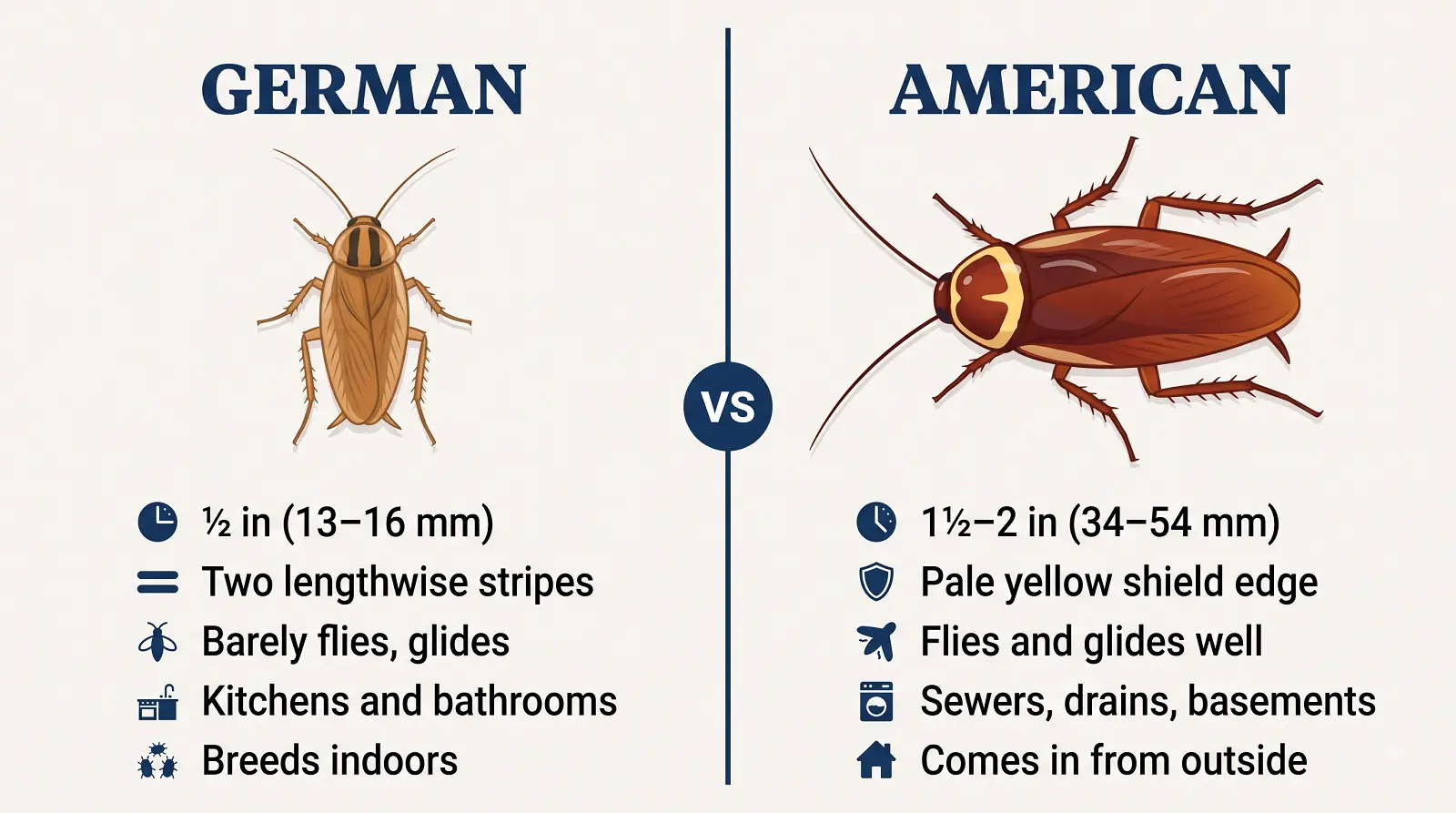
| Feature | German cockroach | American cockroach |
|---|---|---|
| Scientific name | Blattella germanica | Periplaneta americana |
| Adult length | ½ to ⅝ in (13 to 16 mm) | 1⅜ to 2⅛ in (34 to 54 mm) |
| Color | Light brown to tan | Reddish brown, glossy |
| Head marking | Two dark parallel stripes | Pale yellow band edging the shield |
| Flight | Barely glides when disturbed | Yes, glides well |
| Primary habitat | Indoors only, kitchens and bathrooms | Indoors and out, sewers, drains, mulch |
| Type | Domestic | Peridomestic |
| Egg case | Carried by female until hatching | Deposited within hours to 4 days |
| Eggs per case | 18 to 50, averaging about 32 | 14 to 16 |
| Egg cases per female | 5 to 8 | 9 to 10 |
| Egg to adult | About 100 days | About 600 days at room temperature |
| Lifespan | 100 to 280 days depending on sex | Often over a year |
| Droppings | Pepper specks, ground-coffee texture | Larger, blunt-ended, rice-grain size with ridges |
| Odor | Musty smell in larger infestations | Less pronounced |
| Nickname | Croton bug | Palmetto bug, waterbug |
| Real risk level | High. Breeds indoors, produces major allergens | Moderate. Usually an entry problem, not a breeding problem |
If you want the one-line version: a German vs American cockroach question is almost always answered by size alone. Half an inch means German. Two inches means American. There is nothing in between that either species could be confused for.
The fastest field test: hold the sighting against a US penny, which is 19 mm across. A German cockroach is shorter than a penny is wide. An American cockroach is two to three times that.
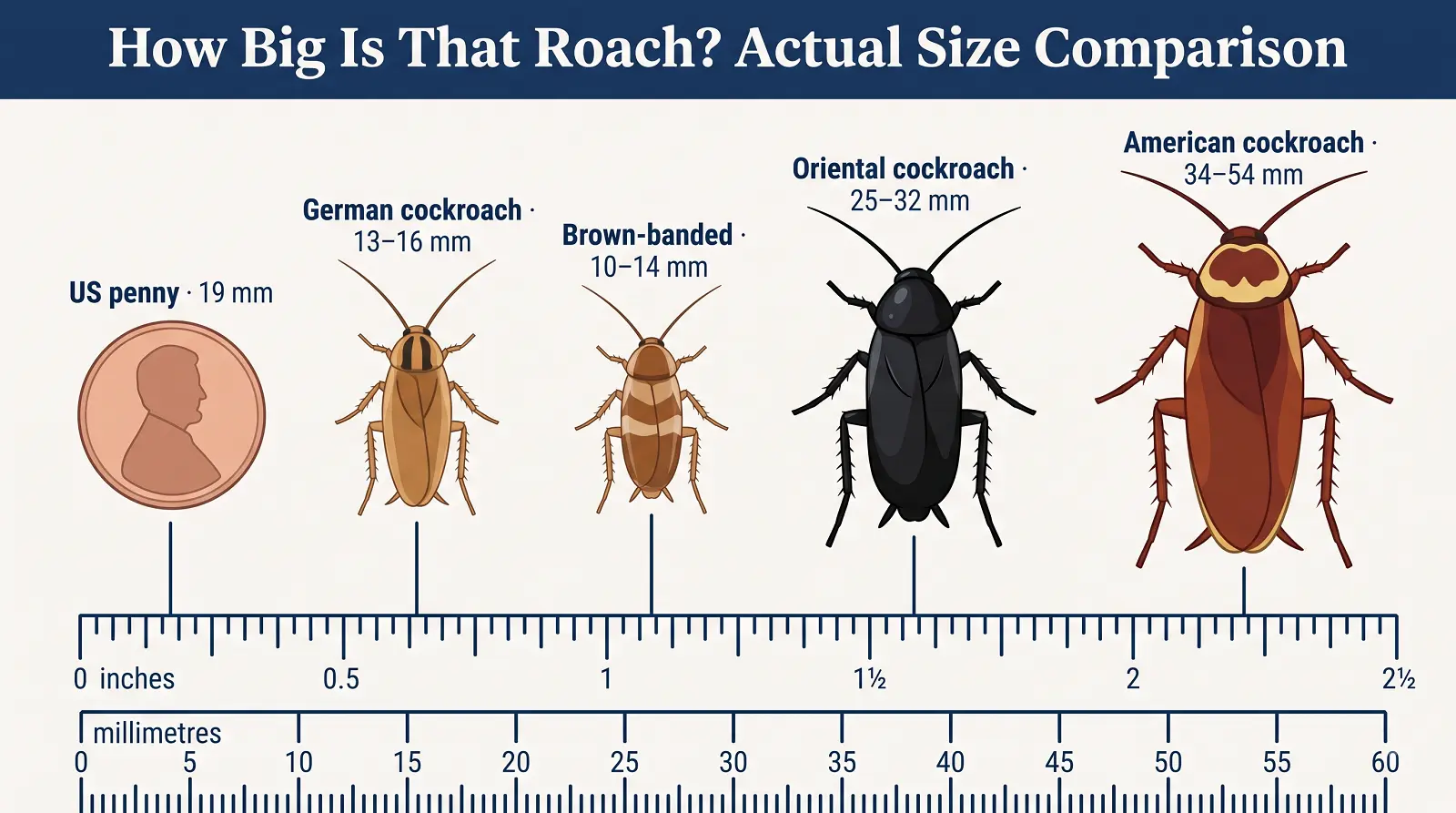
The most useful difference: German cockroaches breed indoors, and their population is inside your walls. American cockroaches usually breed outdoors or in a sewer and wander in. Finding one American cockroach in a basement is an entry point problem. Finding one German cockroach in a kitchen is a population problem.
German vs Asian Cockroach: The Hardest Call in the Room
This pair is genuinely difficult, and it is worth its own section because getting it wrong sends you down the wrong path entirely.
Blattella asahinai, the Asian cockroach, is the German cockroach’s closest relative. To a casual observer, the two are nearly identical. It was first identified in the United States in 1986, when a pest control operator collected them in Lakeland, Polk County, Florida, and reported that they behaved unlike any German cockroaches he had seen. The species itself had only been described five years earlier, in 1981, from specimens on Okinawa Island, Japan.
UF/IFAS now reports it across much of Florida and into Alabama, Georgia, South Carolina, Louisiana, Mississippi and Texas.
You cannot reliably separate them by appearance. You separate them by behavior and location:
| Feature | German cockroach | Asian cockroach |
|---|---|---|
| Flight | Barely, glides at most | Flies readily and often |
| Attracted to light | No, avoids it | Yes, strongly. Flies to lit windows and TVs at dusk |
| Habitat | Indoors, structural | Outdoors, leaf litter, mulch, lawns |
| Activity peak | Night, hidden | Dusk, active flight |
| Indoors? | Permanently | Occasional, comes in through lit doorways |
| Region | Nationwide | Southeastern US, especially Florida and the Gulf Coast |
Density is what makes this species so noticeable. UF/IFAS reports outdoor populations of 30,000 to 250,000 per acre in damp mulched areas across parts of Florida. Extension agents also note a seasonal pattern worth knowing: homeowners frequently start having problems right after mulching flower beds in spring.
When they fly, people often mistake them for small moths rather than roaches. If something small fluttered up out of a landscape bed while you were watering, that is the most likely explanation.
The practical rule: if a small striped roach flew across your living room toward the television at dusk in Florida, Georgia, or Alabama, you are almost certainly looking at an Asian cockroach that came in through a door. If a small striped roach ran from the light when you flipped the kitchen switch at midnight, it is German.
This matters for money. Asian cockroaches are an exterior lighting and landscape problem. German cockroaches are an interior problem that can run for weeks.
Oriental Cockroaches and the “Big Black Cockroach” Question
If you searched for a big black roach, read this first
“Black cockroach” and “big black cockroach” are not species names. They are what people type when they see something dark and are trying to describe it. Three insects account for nearly all of those searches:
| What you actually saw | Most likely species |
|---|---|
| Glossy black, about 1 inch, slow, on the floor, near a drain or basement | Oriental cockroach |
| Dark reddish brown that looked black in low light, very large, ran fast | American cockroach |
| Uniformly dark mahogany, large, flew at you, in the Southeast | Smoky brown cockroach |
| Small, nearly black, under half an inch, with two faint stripes | German cockroach nymph |
That last row catches people out constantly. German nymphs are much darker than adults, and a parent who finds tiny black specks moving in a cabinet often assumes a different species. Look for the two stripes. They are present from the first instar.
The Oriental cockroach proper
Oriental roaches go by several names depending on where you live. In the Northeast and Midwest, Oriental roaches are what most people mean when they say water bug. In the pest control trade, they are sometimes called black beetles, which is unhelpful given how often people confuse them with actual beetles.
Blatta orientalis is the roach that most deserves the “black cockroach” description. Adults run about 1 to 1¼ inches with a glossy, almost oily dark brown to black finish and no markings at all.
- Cannot fly. Wings are reduced. Females have short wing pads; males have wings that do not cover the abdomen.
- Slow. Noticeably sluggish compared to German or American cockroaches
- Poor climbers. They stay at floor level and are much less likely to be found on walls or countertops
- Cold-tolerant. Handles cooler conditions better than most house-infesting roaches
- Prefers damp and cool: basements, crawl spaces, floor drains, sump areas, under mulch, in leaf litter, around foundation plantings
UF/IFAS reports that females produce an average of eight egg capsules, each holding about 16 eggs stacked two by two, and that the species is seasonal, with adults appearing in spring and summer. Females often deposit egg cases deep in cracks where insecticide cannot reach, which is a large part of why treatment tends to fail on the first attempt.
They are found across the entire United States. In the Northeast and Midwest, Oriental roaches are the most common source of “there is a big black bug in my basement” calls, and they show up in numbers when outdoor conditions dry out in late summer or cool sharply in fall.
They are also the species most often called a water bug in northern states, which brings us to the lookalikes.
Wood Roaches: The One That Is a Cockroach But Not a Pest
First, the premise correction
Searching “wood roach vs cockroach” assumes they are two different things. They are not. A wood roach is a cockroach, in the genus Parcoblatta. The useful comparison is wood roach versus the roaches that actually infest homes.
Identifying a Pennsylvania wood cockroach
Parcoblatta pensylvanica, sometimes spelled pennsylvanica, is found throughout the United States and southern Canada.
The most reliable tell is a pale, almost translucent border running along the edge of the pronotum and along the front edge of the wings. No indoor pest cockroach has that pale edging. If you see it, you can stop looking.
- Size: roughly ½ to 1¼ inches depending on sex and source, with males noticeably larger than females
- Males: fully winged, strong fliers, drawn to porch lights and security lighting
- Females: shorter, with reduced wings that leave part of the abdomen exposed. They cannot fly.
- Color: chestnut to dark brown, darker than a German cockroach
- No dark stripes on the pronotum, which separates them from German cockroaches immediately
- Movement is slower, and they often do not bolt when disturbed, unlike indoor species
Related species you may run into: the Virginia wood cockroach (Parcoblatta virginica) and the fulvous wood cockroach (Parcoblatta fulvescens), which follow the same general rules.
Why finding one indoors is not an infestation
Wood roaches live under loose bark, in fallen logs, in leaf litter, and in stacked firewood, feeding on decaying plant material. They need high humidity. Indoors, they dehydrate quickly.
Extension services across multiple states are consistent on this: wood roaches are accidental invaders that cannot establish indoor populations. Even if a male flies in and finds a female, the offspring do not survive normal indoor conditions.
How they get in:
- Carried in on firewood, which is the number one route
- Flying to porch lights, security lights, and lit windows during the late spring and early summer mating season
- Through gaps under doors near wooded property lines
What to do:
- Stack firewood away from the house and off the ground
- Bring in only what you will burn that day
- Switch exterior lights to yellow bug bulbs or move fixtures away from doors
- Seal door sweeps and window screens
No treatment, no exterminator, no panic. If you are finding them year-round rather than seasonally, or finding them in the kitchen rather than near doors and firewood, take a second look. That is not a wood roach pattern.
One honest caveat. LSU AgCenter notes that where unpackaged stored food is available, wood roach numbers can build up indoors enough to need treatment. That is uncommon in a normal house and far more likely in a garage, barn, shed, or outbuilding with open feed or grain.
What Cockroach Droppings Tell You
Most people find the evidence before they find the insect. Droppings are the most reliable species clue available, and they differ enough to identify what you are dealing with without ever seeing one alive.
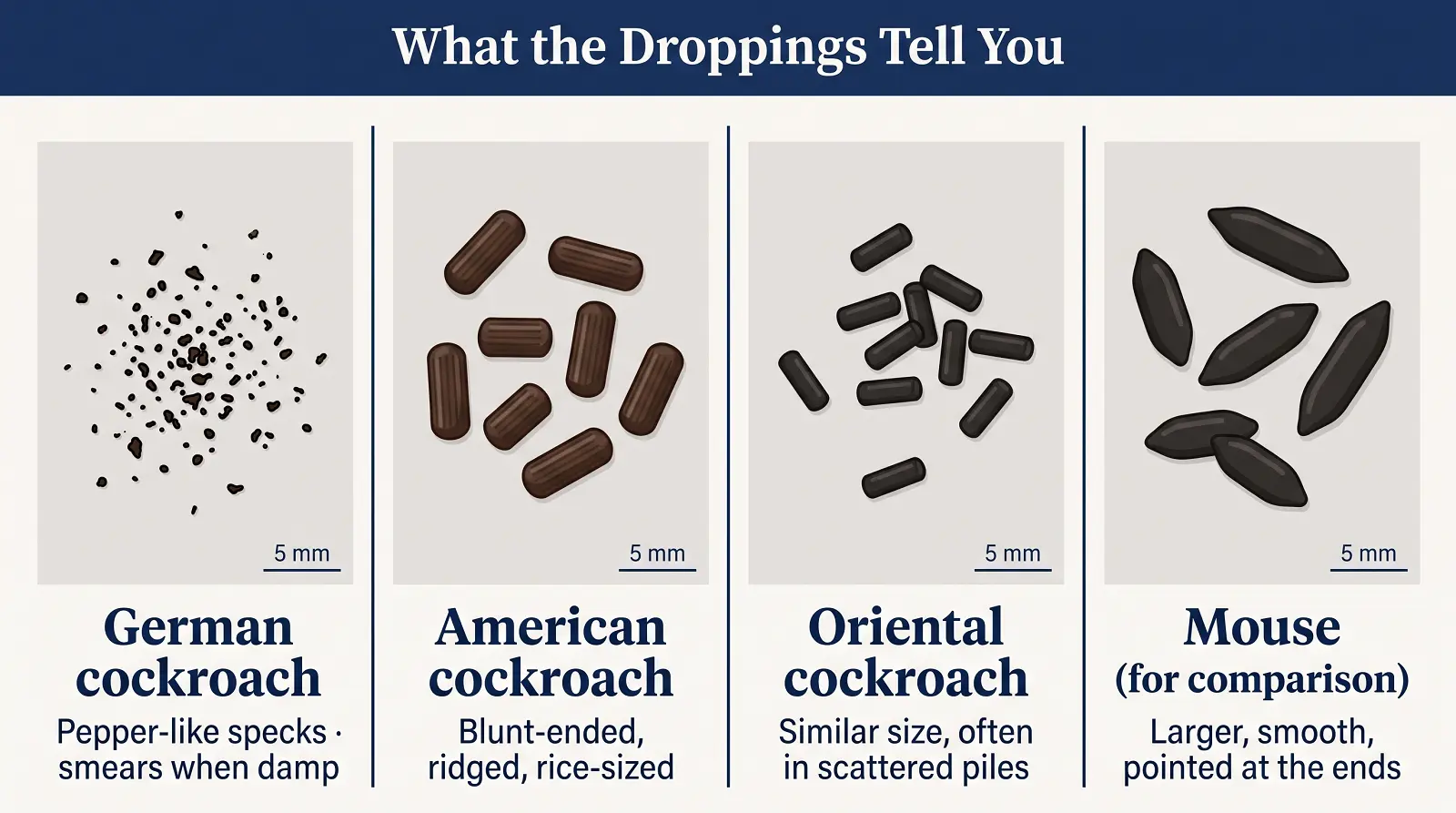
| Species | What the droppings look like | Where you find them |
|---|---|---|
| German cockroach | Tiny dark specks like ground pepper or coffee grounds. Smear when wet | Inside drawers, cabinet corners, along the tops of doors, in appliance seams |
| American cockroach | Larger, blunt at both ends, about the size of a grain of rice, with ridges down the sides | Basements, garages, near drains, behind appliances |
| Oriental cockroach | Similar size to American, dark, often in scattered piles | Floor level, basements, near sumps and floor drains |
| Brown-banded cockroach | Small dark specks, often stuck to vertical or overhead surfaces | Ceiling corners, upper cabinets, behind wall clocks and picture frames |
| Wood roach | Rarely leaves any, because it does not stay long enough | Not applicable |
Two things separate German cockroach droppings from mouse droppings, which is a common mix-up. Roach droppings are much smaller, and they smear when damp, where mouse droppings stay solid and taper to a point at one end.
Other Cockroaches You May Find in US Homes
Smoky brown cockroach
Periplaneta fuliginosa is a Southeastern species, roughly 1 to 1½ inches, and the smoky brown cockroach is identified by what it lacks: it is uniformly dark mahogany with no pale edging, no yellow band, no contrast anywhere. American cockroaches have that pale rim behind the head. Smoky browns do not.
- Strong flier, actively attracted to light.
- Wings extend well past the abdomen.
- Dehydrates faster than almost any other pest roach, which is why it stays in humid pockets and ends up in gutters, soffits, and attics rather than open living space
- Lives in tree canopies, attics, soffits, gutters, mulch, wood piles
- Enters homes through attic vents, soffit gaps, and open doors at night
If you are in Georgia, the Carolinas, Alabama, Mississippi, Louisiana, or Florida and something large flew in and landed on the wall, smoky brown is the first guess.
Brown-banded cockroach
Supella longipalpa, about 10 to 14 mm, is the other small indoor species, and it gets mistaken for German cockroaches constantly. The difference is the direction of the markings. German cockroaches have two stripes running front to back on the shield. Brown-banded roaches have two pale bands running crosswise across the wings and abdomen.
- Prefers warm and dry, the opposite of German cockroaches
- Found higher up: ceiling corners, upper cabinets, picture frames, behind wall clocks
- Common inside electronics, TVs, and appliance housings
- Spreads into bedrooms and living rooms rather than staying in kitchens
- Females glue egg cases to surfaces rather than carrying them
- Males fly, females do not
Like the German cockroach, this species completes its entire life cycle indoors and is adapted to the indoor environment. It differs in what it wants once it gets there: warmer, drier, and higher up. That is why brown-banded roaches show up in bedrooms and behind electronics while German cockroaches stay near water.
If you are finding small roaches in a bedroom or behind a television rather than under the sink, check for bands before assuming German.
Brown cockroach
Periplaneta brunnea is a Gulf and Southeast species closely related to the American cockroach and routinely misidentified as one. UF/IFAS notes directly that the American cockroach resembles and is often confused with the brown cockroach. It is slightly smaller and darker, and the pale marking behind the head is more solid and less patterned than the American cockroach’s outlined band.
Surinam cockroach
Pycnoscelus surinamensis is a burrowing species found in Florida, Texas, Louisiana, and other warm states, and in heated greenhouses further north. It lives in soil, mulch, and potted plants rather than in structures, and it arrives inside on houseplants. Adults run 18 to 25 mm, dark brown to black with a lighter tan margin on the shield.
Its reproduction is unusual. In the United States, males have never been found, and the species reproduces by obligate parthenogenesis, meaning females produce female clones from unfertilized eggs. Roughly one percent of known animal species reproduce this way.
They also give live birth. The female retains the egg case internally until the nymphs hatch, then expels the empty case, which the newly hatched young often eat.
It is not a kitchen pest. If you find one, check what came in with the last plant you bought.
Insects Mistaken for Cockroaches
Palmetto bug vs cockroach
There is no such insect as a palmetto bug. It is a regional nickname, most common in the coastal Southeast: Florida, South Carolina, Georgia, Alabama, Mississippi and Louisiana. You will also hear it in Mid-Atlantic port cities like Norfolk and Baltimore, usually from people who moved north.
When someone in Charleston or Savannah says palmetto bug, they mean one of three roaches:
| Species | How often | Tell |
|---|---|---|
| American cockroach | The large majority of the time | Pale yellow band edging the shield, reddish brown |
| Smoky brown cockroach | Sometimes | Uniformly dark mahogany, no pale edging |
| Florida woods cockroach | Occasionally, Deep South | Very dark, flightless, releases a foul defensive spray |
UF/IFAS states plainly that the American cockroach is often called a palmetto bug. The nickname exists for a social reason. Saying you saw a palmetto bug on the porch is more comfortable than saying you have cockroaches. That is the entire origin of the term.
What it means for you: a palmetto bug is a cockroach, but it is usually a peridomestic one. It came in from outside. Treat it as an exclusion and exterior problem rather than an indoor infestation, unless you are finding them repeatedly and indoors.
Water bug vs cockroach
Two different things share this name, and only one of them is real.
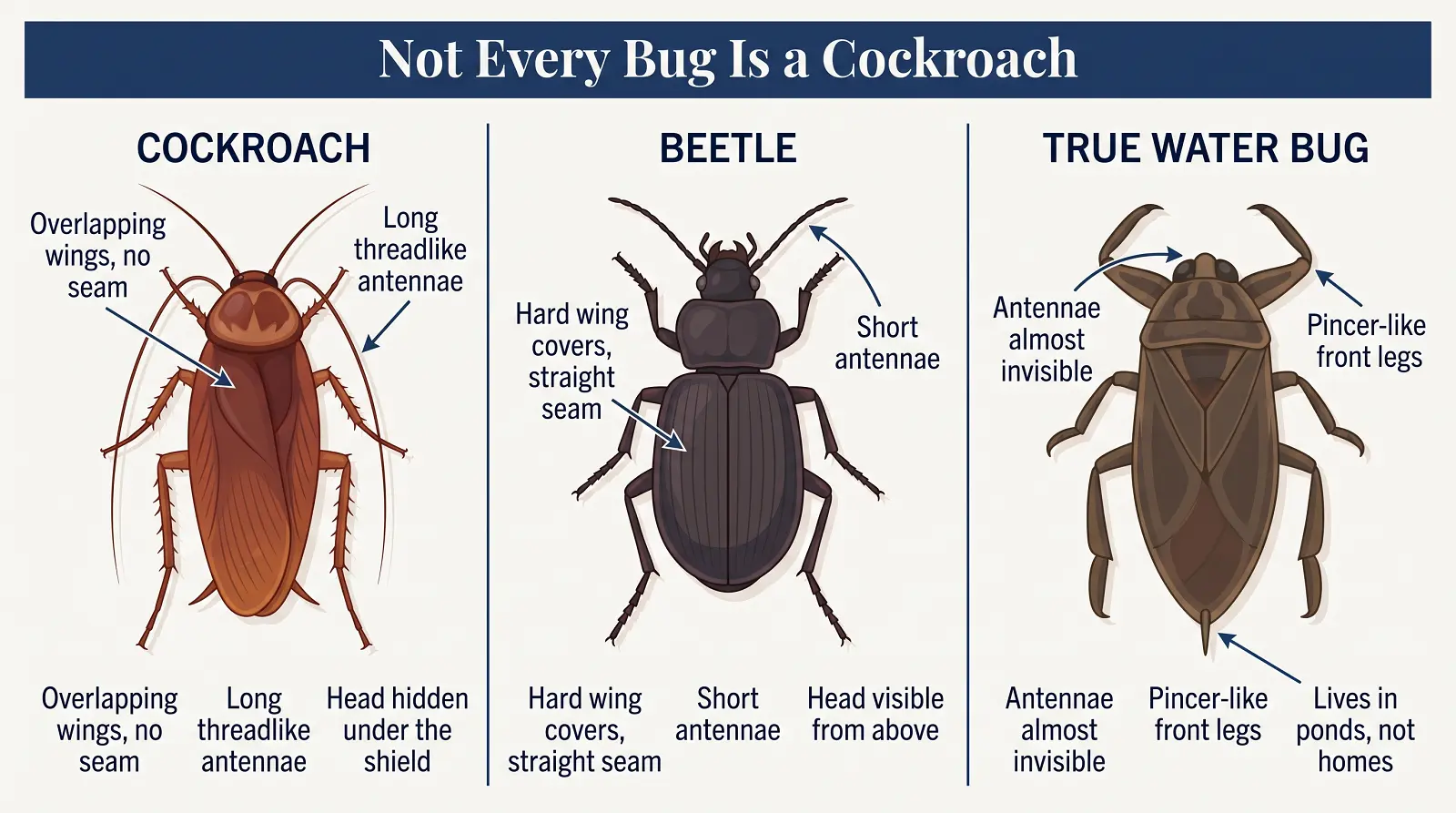
True water bugs are aquatic insects in the family Belostomatidae, order Hemiptera. Giant water bugs such as Lethocerus americanus reach three to four inches, live in ponds and slow streams, and hunt tadpoles, small fish, and large invertebrates. They are sometimes called toe-biters, for good reason.
| Feature | True water bug (Belostomatidae) | Cockroach (Blattodea) |
|---|---|---|
| Order | Hemiptera | Blattodea |
| Habitat | In water. Ponds, streams, pools | Land. Buildings, drains, mulch |
| Antennae | Very short and hidden | Long, threadlike, often body length |
| Front legs | Thick pincer-like grasping legs | Ordinary walking legs |
| Feeding | Predator with a piercing beak | Scavenger with chewing mouthparts |
| Breathing | Snorkel-like appendage at the abdomen tip | Spiracles along the body |
| In your kitchen? | Essentially never | Yes |
When people say water bug indoors, they almost always mean a cockroach. In northern states it usually means the Oriental cockroach. In the South it often means the American cockroach. Both get the name because they come up through floor drains, sewer lines, and toilet bases, which is exactly why drain covers and sewer entry treatment matter for those species.
If it was in your bathroom, it was a cockroach. If it was in a pond, it was a water bug.
Beetle vs cockroach
This is the most common misidentification I see in photo requests, and there are four reliable tells.
| Feature | Cockroach | Beetle |
|---|---|---|
| Wing covers | Leathery, overlapping, no straight center line | Hard shells meeting in a straight line down the back |
| Antennae | Long and threadlike, often as long as the body | Short, often clubbed, elbowed or beaded |
| Head | Hidden beneath the pronotum shield | Usually visible from above |
| Body shape | Flattened top to bottom, oval | Often domed or rounded in profile |
| Movement | Fast, darting, runs for cover | Generally slower, more deliberate |
The single fastest check is the straight line. Look down the insect’s back. A beetle’s two elytra meet in a clean seam running from the shoulders to the tail. A cockroach’s wings overlap like folded paper, and there is no straight line.
Frequent culprits: ground beetles (dark, fast, often on basement floors), June beetles, and water scavenger beetles that fly to lights.
The cockroach vs beetle question also runs the other way. Plenty of people find a ground beetle in a basement and assume the worst. If it has hard shells meeting in a straight line, short antennae, and a visible head, you have a beetle, and beetles in a basement are a moisture and entry issue rather than an infestation.
Crickets and other confusions
Crickets get mistaken for roaches often enough to be worth mentioning. Long jumping hind legs and chirping settle that one in seconds. Camel crickets in particular turn up in basements and crawl spaces and cause a lot of unnecessary alarm.
How to Identify What You Found: The Decision Path
Work through this in order.
Step 1. Straight line down the back?
Yes, it is a beetle. No, keep going.
Step 2. How long is it?
Under ¾ inch:
- Two dark stripes running front to back on the shield → German cockroach (or Asian if it flew to a light in the Southeast)
- Two pale bands running crosswise → Brown-banded cockroach
- Tiny, dark, under ½ inch, with faint stripes → German cockroach nymph
¾ to 1¼ inches:
- Pale translucent edging on shield and wing fronts, found near firewood or a porch light → Pennsylvania wood cockroach
- Glossy black, slow, floor level, near a drain or basement → Oriental cockroach
- Dark, dug into potting soil → Surinam cockroach
Over 1¼ inches:
- Pale yellow band edging the shield, reddish brown → American cockroach
- Uniformly dark mahogany, no edging, flew in, Southeast → Smoky brown cockroach
Step 3. Where exactly was it?
Kitchen or bathroom, at night, ran from light → indoor breeding species. Basement, drain, garage, or outdoors near a light → peridomestic or accidental.
Step 4. Is it repeating?
One sighting near a door in June is different from four sightings in a kitchen over two weeks. Frequency and location tell you more than the insect ever will.
What Region You Are In Changes the Answer
| Region | Most likely indoor breeder | Common outdoor and seasonal | Local naming |
|---|---|---|---|
| Southeast and Gulf (FL, GA, AL, MS, LA, SC) | German | American, smoky brown, Asian, Florida woods, brown cockroach | Palmetto bug |
| Texas and South Central (Austin, Houston, San Antonio) | German | American, smoky brown, Asian | Water bug, palmetto bug |
| Northeast (NY, NJ, MA, PA) | German | Oriental, American, Pennsylvania wood cockroach | Croton bug, water bug |
| Midwest (IL, OH, MI, MO) | German | Oriental, wood roaches | Water bug |
| Southwest (AZ, NV, NM, southern CA) | German | American, Oriental | Water bug, sewer roach |
| Pacific Northwest (WA, OR) | German | Oriental, wood roaches | Water bug |
Regional context matters more than most identification guides admit. Apartment-heavy metros with older housing stock and shared walls, Austin and much of the Northeast Corridor among them, see disproportionate German cockroach activity for structural reasons rather than climate ones. Warm humid coastal areas see far more peridomestic species wandering in. Cold-winter regions see a fall push as Oriental cockroaches move indoors when outdoor temperatures drop.
Rutgers notes that below 59°F, German cockroaches survive but stop developing from nymph to adult. That is why they concentrate in heated buildings in cold climates and why they have been recorded in human buildings as far north as Alert, Nunavut, and as far south as southern Patagonia. Where people heat buildings, this species follows.
When to Handle It Yourself and When to Call Someone
Handle it yourself:
- Wood roaches near firewood or a porch light. Move the wood, change the bulb, done
- A single American cockroach in a basement after heavy rain. Seal the entry point and cover the floor drain
- Asian cockroaches outdoors. Adjust mulch depth and exterior lighting
- Surinam cockroaches in potted plants. Check what came in with the plant.
Get professional help:
- Confirmed German cockroaches anywhere in the home. Rutgers is direct about this: the goal has to be elimination, not reduction, and the common DIY failure is relying on sprays and stopping too early.
- Any roach activity in an apartment or condo with shared walls. Treating one unit while neighbors go untreated usually fails.
- Repeat sightings after you have already treated, which often signals resistance or an untreated harborage.
- Anyone in the home with asthma. Allergen load is the real risk, and reducing it means removing the population, not just the visible insects.
The most expensive mistake people make is buying the wrong product first and driving the population deeper into wall voids. Identify the species before you spend anything.
The Bottom Line
Identification is not academic. It decides whether you spend a Saturday moving firewood away from the house or the next six weeks running a bait program in your kitchen.
The mistake runs one direction almost every time. People panic over a wood roach on a porch and shrug off a single small striped roach under the sink. It should be the other way around.
If you keep one thing from this page, keep the four questions. Length, color, markings, and exact location answer nearly every roach identification anyone brings me.
And if you are dealing with German cockroaches in an apartment, stop blaming yourself. NC State Extension is direct about this. They arrive by hitchhiking or through shared walls, and in a multi-unit building the source is usually impossible to trace.
Set sticky traps tonight and check them in the morning. That single step tells you more than another hour of searching will.
Frequently Asked Questions
Is one German cockroach a sign of an infestation?
Treat it as one until traps say otherwise. Because active populations are roughly four-fifths nymphs, the insect you saw is statistically the visible fraction of something larger sitting in cracks. A single sighting out in the open, particularly during daylight, often means the harborage is crowded. Two nights of sticky traps will tell you whether you are looking at a stray or a colony.
How harmful are German roaches?
The real risk is allergens rather than disease. This species produces two major allergens, BlaG 1 and BlaG 2, found in its saliva, droppings, eggs and shed skins, and NC State reports a single female can generate up to 1,000 units of BlaG 1 per day. Exposure is linked to asthma, especially in children. They also carry bacteria mechanically from drains and trash, with Salmonella the most documented. Removing the population measurably lowers allergen levels in the home.
What kills German roaches instantly?
Nothing, and chasing an instant kill is how most infestations get worse. Contact aerosols kill the individuals they hit and push the rest deeper into wall voids where you cannot reach them. Rutgers is blunt that total release foggers and ultrasonic repellers do not work at all, and that relying on sprays is the most common do-it-yourself failure. Gel bait applied thoroughly in the right places is what actually eliminates a population.
What is the difference between an Oriental roach and an American cockroach?
Oriental roaches are glossy black, about an inch, flightless, slow, and stay at floor level near drains and basements. American cockroaches are reddish brown, up to two inches, carry a pale yellow band edging the shield behind the head, and can glide. Both get called water bugs, which is where most of the confusion starts.
Are German cockroach nymphs a different species?
No. Nymphs are much darker than adults, close to black, and start at roughly 3 mm. They carry the same two lengthwise stripes from the first instar onward. If you are finding tiny dark specks with faint stripes, those are juveniles of the population already in your home, not a second insect.
Do cockroaches bite?
Rarely, and not in a way worth worrying about. In severe infestations with little available food, they may nibble at skin or fingernails, but this is uncommon and not the reason to act. The health concern is allergen load and bacterial contamination.
Why do I only see roaches at night?
Every common house-infesting species is nocturnal, and German cockroaches in particular avoid open space and light. Daytime sightings usually indicate crowding, meaning the hidden population has outgrown its harborage and individuals are being pushed into worse territory. A roach walking across a kitchen floor at noon is a worse sign than one that scatters when you flip the light at midnight.