How to Get Rid of Mosquito Bites Overnight: What They Look Like, When to Worry, and How to Stop the Itch
It’s past eleven, you’re lying there with one hand clamped over your forearm so you don’t scratch, and you’re searching for ‘how to get rid of mosquito bites overnight’. I’ve walked enough backyards from the Gulf Coast up to Minnesota to know that’s exactly when people go looking for answers, and rarely a moment sooner.
So I’ll be straight with you, the way I am with homeowners standing over a gutter full of water. You can’t erase a bite by morning. You can stop the itch, flatten the swelling, and sleep through the night. Everything below is checked against CDC and Mayo Clinic guidance.
Table of Contents
Quick answer: Can you get rid of a mosquito bite overnight?
Not completely. A mosquito bite is an immune reaction, and that reaction takes a few days to settle. What you can do overnight is stop the itch, cut the swelling, and prevent scratching damage. Wash the bite, ice it for 10 minutes, apply hydrocortisone, and take an oral antihistamine before bed. Most bites look noticeably smaller by morning.
That’s the honest version. Now here’s how to do it.
What does a mosquito bite look like?
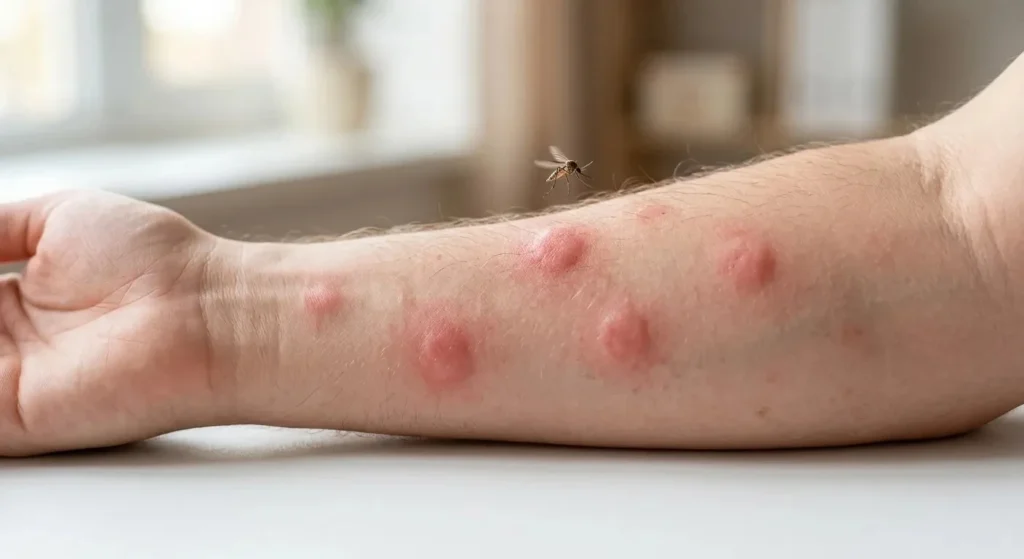
A mosquito bite reads differently depending on your skin tone. On lighter skin, it’s usually pink or red. On deeper skin tones, it often shows as brown, purple, or simply darker than the surrounding area, which is why so many bite photos online are useless to half the people looking at them.
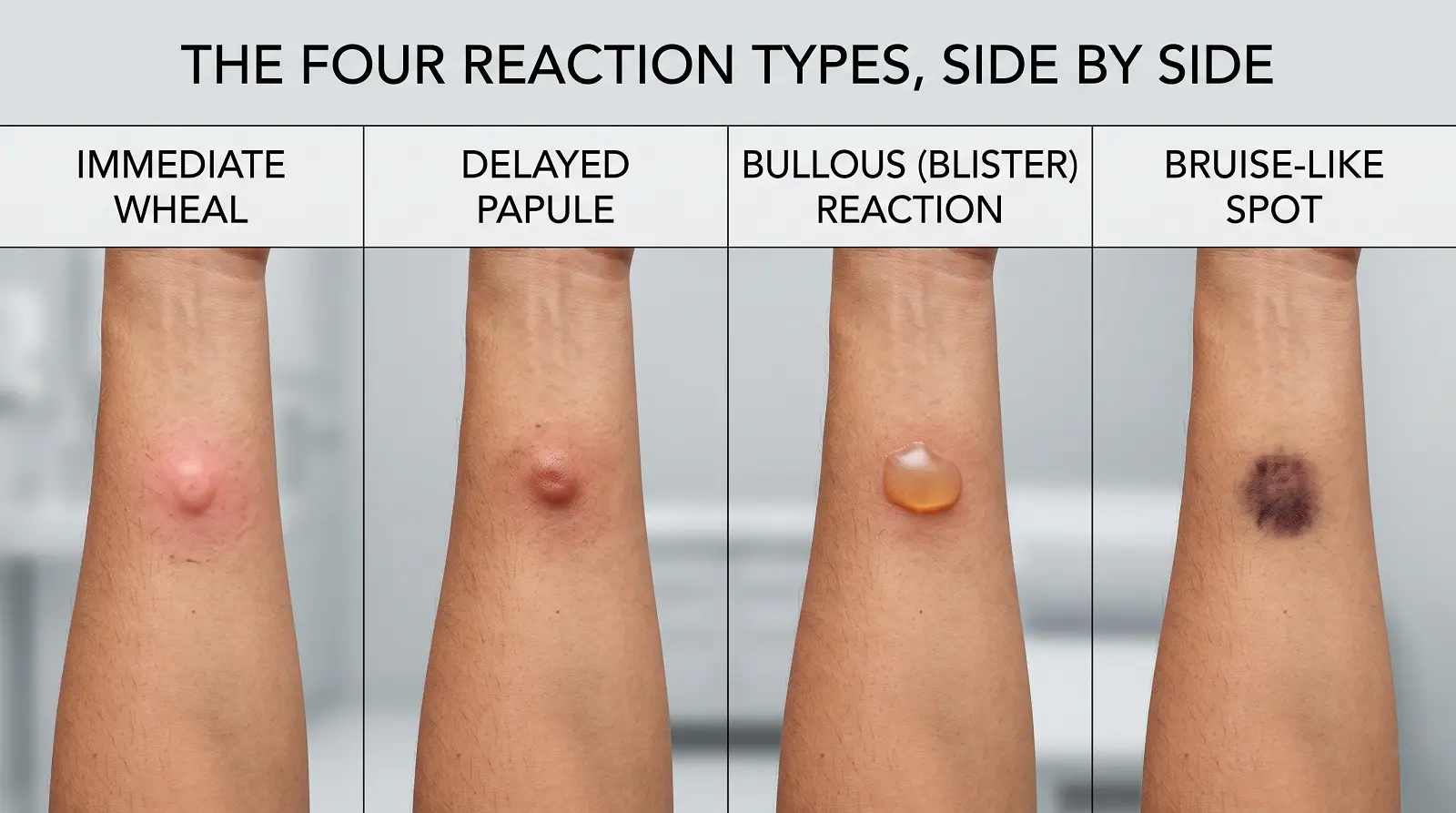
The CDC lists four presentations: a puffy, reddish bump appearing a few minutes after the bite; a hard, itchy, reddish-brown bump (or several) appearing a day or so later; small blisters instead of hard bumps; and dark spots that look like bruises.
That last one surprises people. A bite can absolutely look like a bruise, especially on the shins and forearms.
The four reaction types, side by side
When a mosquito bite blisters
A blistered bite worries people more than any other type, and it’s usually harmless. Blisters form when the immune response is strong enough to pull fluid into the upper skin layers. Kids get them more often because their immune systems haven’t been exposed to that mosquito species before.
Leave the blister alone. Don’t pop it. That intact roof is a sterile bandage, and breaking it is how a nuisance bite becomes an infection. Cover it with a loose adhesive bandage if it’s somewhere it might rub.
Get it looked at if the blister is larger than a dime, if several blisters merge, if the fluid turns cloudy or yellow, or if the skin around it turns hot and redness spreads.
Mosquito bite rash: one bite or many?
People search for “mosquito bite rash” for two different reasons.
The first is a cluster of bites that blend into a patchy red area. That happens when you sit still outdoors, and one mosquito feeds several times. Culex species, the main West Nile carriers in the US, feed at dusk and through the night and will return to the same limb repeatedly. Aedes species, which now dominate much of the Southeast and Mid-Atlantic, are aggressive daytime biters that go for ankles and feet.
The second is a single bite that spreads outward into a wide red patch. That’s a large local reaction, and if it comes with heat, hives, or a low fever, it belongs in the “when to worry” section below.
Mosquito bite on the eyelid, ankle, and other tricky spots
Where you get bitten changes how bad it looks. Loose tissue swells dramatically. Thin skin over bone barely swells, but it itches intensely.
An eyelid bite that swells the eye shut looks like an emergency and usually isn’t one. But if the eye itself hurts, if vision blurs, or if the swelling keeps growing past 24 hours, that’s a same-day call to a doctor.
How long does a mosquito bite last?
Here’s the realistic timeline, built from CDC symptom descriptions and Mayo Clinic’s guidance that most mosquito bites stop itching and heal on their own within a few days.
If a bite is still growing after day three, still hot after day four, or hasn’t started fading after a week, stop treating it as a bite and get it checked.
Why mosquito bites itch in the first place
Only female mosquitoes bite. They need protein from blood to develop eggs. They pierce your skin with a needle-like mouthpart called a proboscis and inject saliva that keeps your blood from clotting while she feeds.
According to the CDC, your body reacts to that saliva, and the reaction is what produces the bump and the itch. Your immune system reads the saliva proteins as foreign and releases histamine, which widens local blood vessels and fires up the nerve endings that signal itch.
That matters practically. It means the itch is coming from histamine and inflammation, not from anything left behind in the skin. So the treatments that work are the ones that block histamine, calm inflammation, or interrupt the nerve signal. Everything else is theater.
How to stop a mosquito bite from itching fast
Here’s what works, ranked by how quickly you’ll feel it. Use this as your triage table.
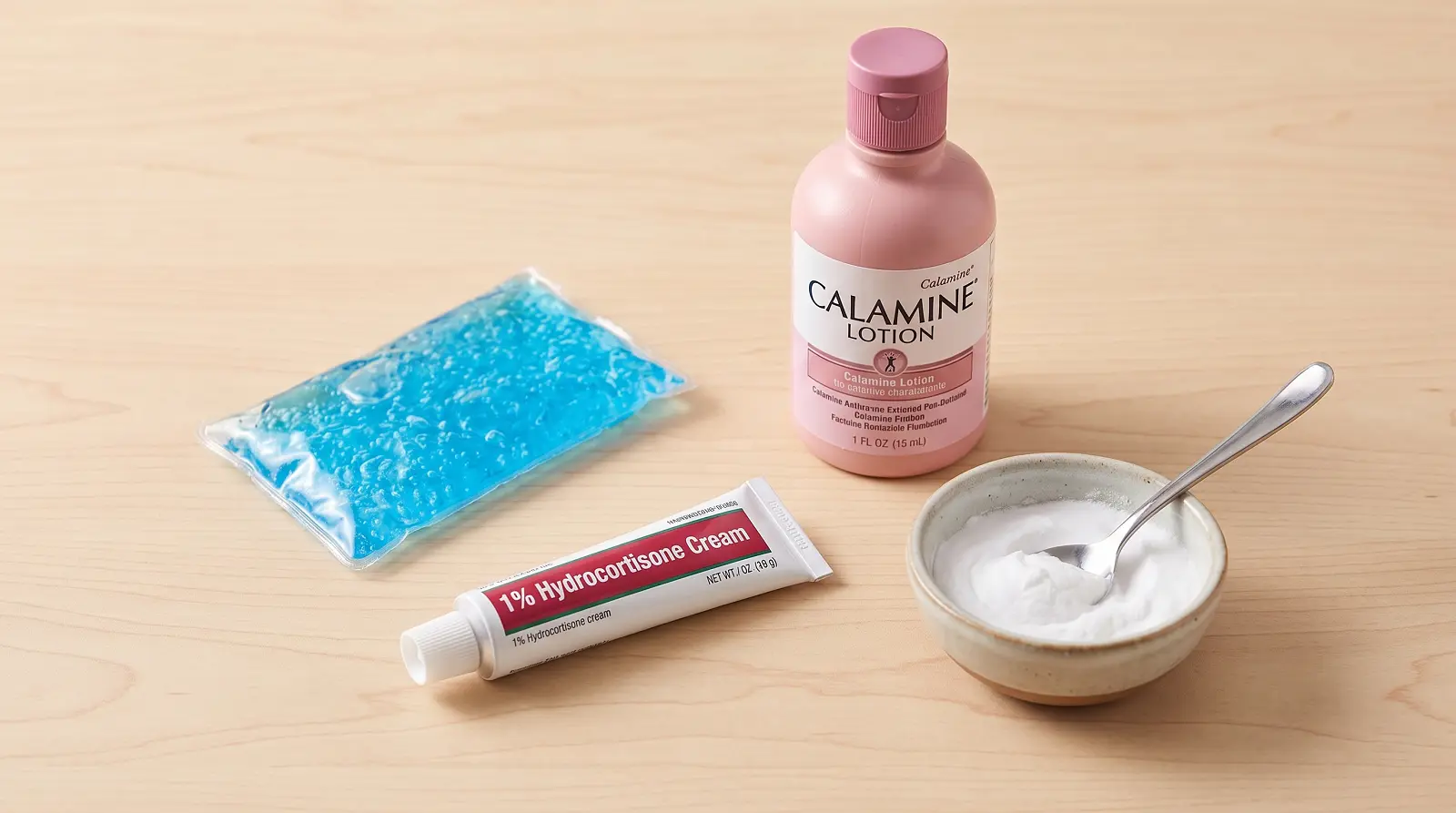
The CDC baking soda method, since it comes up constantly: mix one tablespoon of baking soda with just enough water to make a paste, apply it to the bite, wait 10 minutes, then wash it off.
One thing worth knowing about antihistamines is that oral antihistamines work better than topical antihistamine creams for bite itch. Cetirizine (Zyrtec) performs well for itching specifically and is far less sedating than older antihistamines, though a minority of people do feel drowsy on it. Loratadine (Claritin) is the least sedating of the common options. Diphenhydramine (Benadryl) does cause sleepiness, which makes it a nighttime choice rather than a daytime one. Follow the label, and check with a pharmacist if you take other medications.
How to get rid of mosquito bites overnight: the evening protocol
The sequence matters more than any single product in it.
Step 1: Wash it (2 minutes)
Soap and water, gentle, no scrubbing. The CDC lists washing the bite and surrounding area as the first treatment step.
Step 2: Ice it (10 minutes)
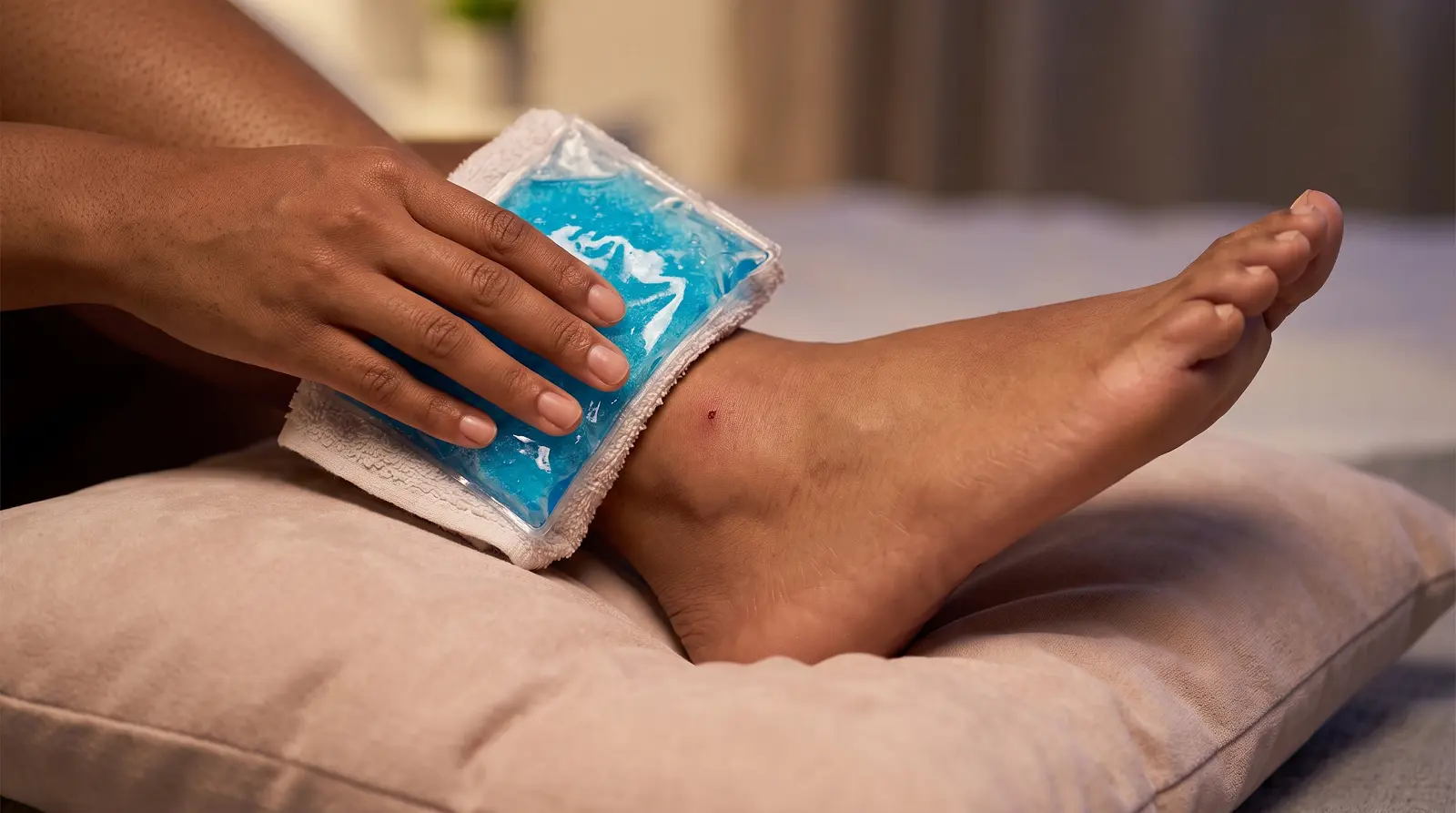
Wrap the ice pack in a thin towel. Never put ice directly on skin. Cold shrinks the blood vessels feeding the swelling and numbs the itch nerves at the same time.
Step 3: Treat the inflammation (1 minute)
Apply a thin layer of 1% hydrocortisone cream. Don’t use it for more than a week straight, and keep it off the eyelids and off broken skin. If the bite is already open from scratching, use plain petroleum jelly and a bandage instead.
Step 4: Take an oral antihistamine (1 minute)
This is the step most people skip and the one that carries you through the night.
Step 5: Cover it (1 minute)
Put a bandage over the bite. Not for healing, but to stop your sleeping hands.
Step 6: Elevate if it’s on a limb (overnight)
A pillow under the calf or forearm keeps fluid from pooling. Ankle and foot bites respond noticeably to this.
What to expect by morning: itch mostly gone, swelling down by roughly half, redness faded, bump still visible but flatter. Full clearance takes two to four more days.
Home remedies for mosquito bites: what works and what doesn’t
The speed table above already covers the ones with the best support, including several you probably have in the kitchen. Two more worth adding:
- Aloe vera gel. Cooling, mildly anti-inflammatory, safe on almost everyone. Use pure gel, not a scented after-sun product with alcohol and fragrance.
- Witch hazel. An astringent containing tannins that calm inflammation. Dab with a cotton ball.
Skip these
Treating mosquito bites on babies and young children
Kids react harder than adults. Their immune systems haven’t met the local mosquito species before, and the CDC specifically names children among those more likely to have severe reactions. A bite that gives you a pea-sized bump can give a toddler a golf-ball-sized one.
What to do:
- Cool compress first. Safe at any age, and it’s the fastest relief for a child who won’t sit still.
- Trim fingernails. Do it that night. This prevents more damage than any cream.
- Calamine lotion is generally used for children over 2. Keep the bottle out of reach, since the pink color appeals to kids. If a child swallows any, call Poison Control at 1-800-222-1222.
- Check with your pediatrician before using hydrocortisone or any oral antihistamine on a child under 2, and before using essential oils at any age.
- Cotton pajamas and long sleeves at bedtime give them one more barrier between fingernails and skin.
When to call the pediatrician: a bite that swells an eye shut, spreading redness with fever, a bite that looks infected, or any breathing difficulty. That last one is a 911 call, not an office call.
When to worry about a mosquito bite
Most bites are a nuisance. A small number aren’t. Here’s how to tell them apart.
How many mosquito bites are dangerous?
Rarely a matter of quantity. A rough calculation that circulates online estimates it would take somewhere between 200,000 and 2 million bites to cause fatal blood loss in an adult, based on the tiny volume a mosquito takes per feed. Treat that as a thought experiment, not a medical figure. It isn’t from a clinical study, and nobody has ever tested it.
What actually determines whether a bite becomes a problem is disease exposure, your own immune response, and whether you scratched it open. None of those three scale with how many bites you have. A single infected mosquito is enough for the first, and one badly scratched bite is enough for the third.
A large number of bites at once still matters, but for a different reason. It means high mosquito pressure where you were standing. Thirty bites in a backyard is a breeding site problem, and over a full season that raises your exposure.
Which mosquito-borne diseases occur in the US
The CDC identifies West Nile virus as the leading cause of mosquito-spread disease in the contiguous United States. It’s the one that matters most for domestic bites.
Dengue is common in Puerto Rico, American Samoa, and the US Virgin Islands. In the States, the CDC reports locally acquired cases have been detected in Florida, Texas, Hawaii, Arizona, and California, while assessing the risk of widespread transmission in the continental US as low. For Zika, the CDC states there is no current local transmission in the continental United States, and no confirmed cases reported from US territories since 2019. Cases now are travel-related, and chikungunya follows the same pattern.
Most people infected never feel sick. But see a doctor if, within two weeks of being bitten, you develop:
- Fever with headache
- Body aches or joint pain
- A rash spreading beyond the bite areas
- Neck stiffness, confusion, or unusual sleepiness
That last group is urgent.
The 2026 season is unusual, and that changes the math
Most years, the honest answer to “Should I worry about this bite?” is no. 2026 is worth a closer look.
In a July 2026 statement, the CDC reported the earliest start to a West Nile virus season since 2004, with the highest case count by that point in the year in more than two decades. At least 48 cases were confirmed as of June 30, 2026, against a historical average of about 10 by the end of June. Thirty-eight of those were the severe neuroinvasive form, and 23 states reported activity, the most in ten years.
This doesn’t mean your bite is a problem. The CDC notes that most people infected with West Nile never develop symptoms at all, and roughly one in five get a fever with headache, body aches, joint pain, or rash. Fewer than one percent develop severe neurologic disease, and that risk is concentrated in adults over 60 and people with certain underlying conditions.
What it does mean: if you’re in a state with reported activity and you develop a fever with a headache after being bitten, mention the mosquito bites to your doctor. That one sentence changes what they test for.
Current case counts by state are published through the CDC’s ArboNET surveillance system, updated every one to two weeks. Check it rather than relying on last season’s numbers.
Infected mosquito bite vs. normal reaction
This is the comparison that sends people to urgent care unnecessarily, or keeps them home when they shouldn’t be.
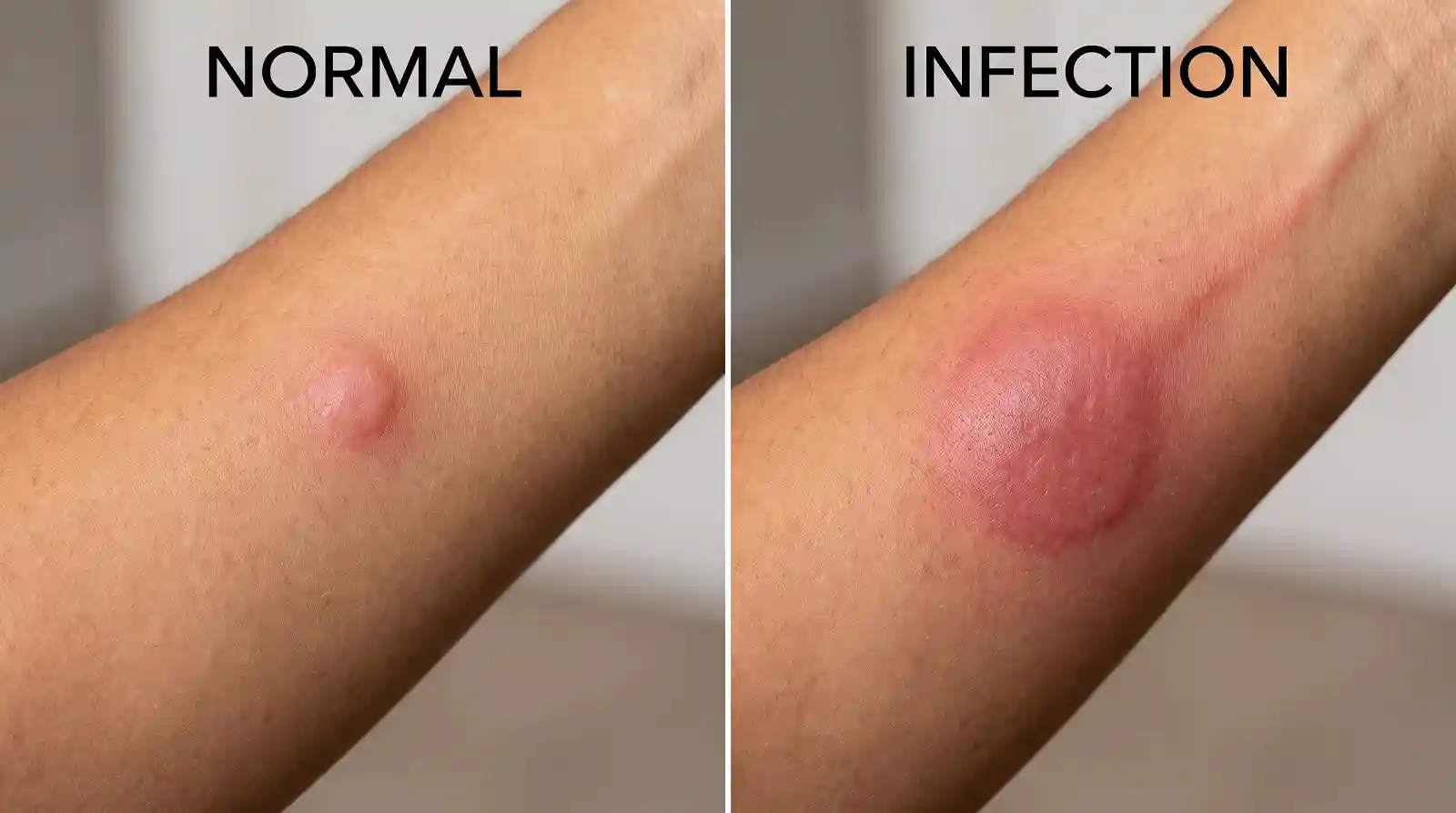
The CDC’s own marker is straightforward: an infected bite may look red, feel warm, or show a red streak spreading outward, and you should see a healthcare provider if symptoms get worse.
Cellulitis is a bacterial skin infection that needs antibiotics. It doesn’t resolve on its own, and it spreads. If your bite matches the right-hand column, don’t wait it out.
Skeeter syndrome
Skeeter syndrome is a strong local allergic reaction to proteins in mosquito saliva. It produces heavy swelling, heat, soreness, and sometimes a low fever within hours of a bite. Mayo Clinic notes it’s sometimes mistaken for a bacterial infection, and that there’s no simple blood test for it. Diagnosis comes from establishing that the large swelling and itching followed mosquito bites.
It’s most common in young children, in people newly exposed to a mosquito species, which is why it hits travelers and new movers, and in people with immune conditions. It’s uncomfortable but not dangerous on its own. Oral antihistamines and cold compresses are the mainstay. Talk to a doctor if it happens every summer, because there are prescription options.
Get emergency help right away
Call 911 if you see any sign of anaphylaxis after a bite:
- Trouble breathing or wheezing
- Swelling of the mouth, tongue, or throat
- Trouble swallowing
- Widespread hives
- Abdominal pain and vomiting
- Dizziness or fainting
What to tell the doctor
Bring these four things. They’re what shape the decision.
- When you were bitten, at least to the day. Disease incubation windows are measured from exposure.
- Where you were. Your own yard, a lake trip, a work site, another state, another country. Travel history changes the differential completely.
- A photo of the bite from day one, if you have one. Whether the redness has spread is the most useful piece of information for ruling cellulitis in or out, and a photo settles it better than memory.
- What you’ve already put on it. Some reactions to topical treatments look a lot like an infected bite.
Take a photo of any bite that’s giving you concern, with something for scale next to it, and take another one 24 hours later. It costs you ten seconds, and it’s the best diagnostic tool you have at home.
Mosquito bite scars: how to fade the marks
The dark spots left behind aren’t true scars in most cases. They’re post-inflammatory hyperpigmentation, which is extra pigment your skin produced during the inflammation. They fade on their own, but slowly.
How to speed up fading:
- Stop the scratching cycle. Every re-scratch restarts the pigment response. This is 80% of the outcome.
- Sunscreen on the marks. UV exposure darkens them and stalls the fading. This matters most on legs and ankles.
- Keep the area moisturized. Simple, fragrance-free lotion supports skin repair.
- Give it time. Legs and ankles fade slowest because circulation is poorer there. Several months is normal.
Marks that are raised, firm, and growing rather than flat and fading may be keloid or hypertrophic scars, which need a dermatologist rather than a drugstore product.
Why do mosquitoes bite me so much? The regional picture
Bite frequency isn’t random, and it isn’t really about your blood.
Mosquitoes find you in stages. Research from Michael Dickinson’s lab at Caltech, published in Current Biology, modeled the sequence: from roughly 10 to 50 meters out, she picks up the carbon dioxide plume from your breath. Between about 5 and 15 meters, she starts to see you. Body heat only comes into play at under a meter, right before she lands.
That sequence explains a lot. The people who get bitten most are the ones breathing hardest and running warmest. Kids playing, adults gardening, anyone who just finished working in the yard.
Where you live changes the species and the schedule:
Seasons shift with the weather and vary by county. Your state health department and local mosquito abatement district publish the real dates for where you live, and those are more reliable than any national average.
The environmental trigger is almost always standing water within 150 feet of where you got bitten. Aedes mosquitoes, the aggressive daytime ankle-biters, breed in containers holding as little as a bottle cap of water. Not the pond down the road. Your birdbath, plant saucer, tarp fold, kids’ toys, clogged gutter, or the tray under the AC unit.
That’s why two neighbors on the same street can have completely different mosquito problems. The breeding site is usually on the property with the problem.
What to do about it: walk your yard once a week and dump anything holding water. The CDC puts Culex and Aedes development at roughly 7 to 10 days from egg to flying adult, and Anopheles at 10 to 14 days. That’s why a weekly walk-around works. Dumping every seven days breaks the cycle before most of what’s in that water can finish developing.
For repellent on your skin, the EPA-registered actives with real data behind them are DEET, picaridin, and oil of lemon eucalyptus.
Final thoughts
Most of the bites I get asked about turn out to be ordinary. Swollen, angry, keeping somebody’s kid awake, but ordinary. The ones that go wrong almost always went wrong because somebody scratched them open.
So the order matters more than the product. Wash it, ice it, treat it, cover it, then leave it alone. The bandage is doing more work overnight than any cream in your cabinet.
I’d skip most of the kitchen remedies. When I’ve compared what people swear by against what the research supports, the gap is wide, and a few of them make the skin worse.
The other half of this is outside your back door. Every bite came from somewhere within about 150 feet of where you were standing, and it’s rarely the pond down the road. It’s a plant saucer.
Give it ten minutes tomorrow with a bucket. Tip out anything holding water, scrub the sides, do it again next week. That habit prevents more bites than any product I could recommend.
And if a bite is still growing on day three, hot to the touch, or you’ve got a fever with it, stop treating it at home. It’s time to call your doctor.
Frequently asked questions
Should I put heat or cold on a mosquito bite?
Cold, for the first 48 hours. It reduces swelling and numbs the itch nerves. Brief targeted heat helps some people, but it’s less reliable, and it’s not safe on broken skin.
Why do mosquito bites itch more at night?
The leading explanation is circadian rhythm. Your body’s cortisol, which has an anti-inflammatory effect, is at its lowest around midnight, and skin loses more water overnight. Both are thought to raise itch sensitivity, though this has been studied in chronic itch conditions more than in insect bites. The second reason is simpler: there’s nothing to distract you.
Why do some people get bitten and others don’t?
Body chemistry, mostly. Carbon dioxide output, skin temperature, and the bacteria living on your skin all vary between people, and mosquitoes read all three. That’s why the person who just finished mowing the lawn collects bites while someone sitting still nearby gets none. Pregnancy and exercise both raise carbon dioxide output, which is part of why pregnant women report more bites. You can’t change most of this, which is why repellent and standing water removal matter more than any of the folk theories about diet or vitamins.
Is it safe to pop a mosquito bite blister?
No. The blister roof is a sterile barrier over healing skin, and opening it gives bacteria a direct route in. If it bursts on its own, wash the area gently, apply a thin layer of petroleum jelly, and keep it covered until it closes.
Do mosquito bites need to be covered while they heal?
Only if you’re likely to scratch it or something will rub it. A bandage isn’t doing anything medical for an intact bite, but it’s the single most effective way to stop unconscious scratching overnight and to keep socks and waistbands off a raw spot. If the skin is already broken, keep it covered until it closes over. If it’s intact and somewhere you won’t touch, leave it open to the air.