Common House Ants: Odorous House Ants, Big Black Ants, and More
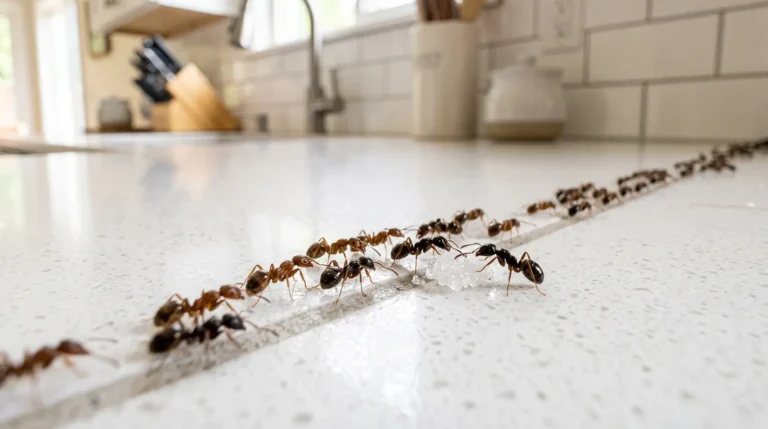
You walk into the kitchen at 6 a.m., flip on the light, and a dark line of tiny ants scatters along the countertop. Or maybe you spotted a single huge black ant crawling near a window frame and now you are wondering whether your walls are being hollowed out. Either way, you need answers — fast.
Most ants that get into American homes are not dangerous, but they are stubborn, and wiping up the ones you see does almost nothing to the colony hiding in your wall. This guide sorts the common house ants you find indoors, from the small smelly ones to the big black ones, and gives you the two-second test that tells you which is which.
You will learn how to identify exactly which ant you are dealing with, why it chose your house, and what actually works to get rid of it — based on entomology research and real-world treatment results, not pest company sales pitches.
How to Identify Common House Ants
Getting the species right is the single most important step. A treatment plan that works on odorous house ants can make a carpenter ant problem worse, and vice versa. Here is how to tell the five most common house-invading ant species apart.
Odorous House Ants (Tapinoma sessile)
Odorous house ants are the most common indoor ant across the United States. Workers are small — about 1/16 to 1/8 inch long — with a uniform dark brown to black body, a single flat node hidden beneath the abdomen, and 12-segmented antennae without a club.
The fastest way to confirm you have odorous house ants is the crush-smell test. Pick up one ant and press it between your fingers. If it releases a sharp, sickly-sweet smell often compared to rotten coconut or blue cheese, you have an odorous house ant. That distinctive odor comes from a chemical called methyl 6-methylsalicylate, and no other common household ant produces it.
Where you will find them: Kitchen counters, bathroom sinks, along baseboards, trailing in long lines near moisture sources. They prefer sweets but will feed on grease, meat, and even pet food.
Do they cause structural damage? No. Odorous house ants do not damage wood, insulation, or any building materials. They are a nuisance pest — annoying and persistent, but not destructive.
Black Carpenter Ants (Camponotus pennsylvanicus)
Carpenter ants are the largest common house ant in the eastern United States, with workers measuring 1/4 to 1/2 inch long. In the Pacific Northwest and western states, the western black carpenter ant (Camponotus modoc) fills the same role. Both species are jet black, though some carpenter ant species can have a reddish-brown midsection.
Key identification features include a single rounded node at the waist, a smooth and evenly curved thorax profile (when viewed from the side), and a heart-shaped head on larger workers. Carpenter ants are often found individually rather than in obvious trails.
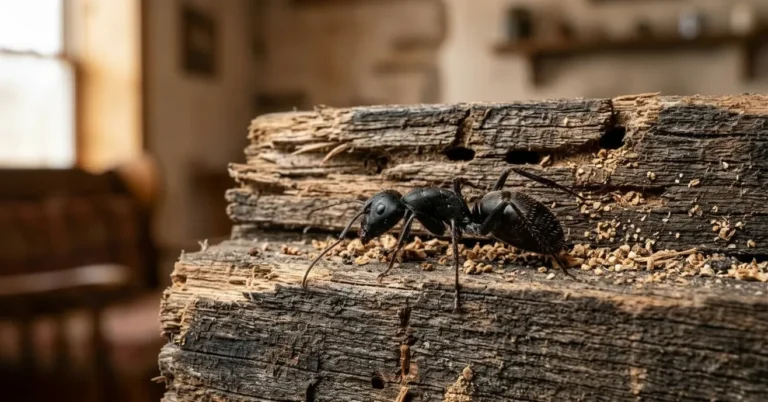
Here is something most homeowners do not realize: carpenter ants do not eat wood. They cannot digest cellulose. Instead, they excavate galleries inside moisture-damaged wood to build their nests. If you are finding large black ants indoors, they are essentially a free alarm system telling you there is a moisture problem somewhere in the structure.
Where you will find them: Near windows, around leaky pipes, in bathrooms, crawl spaces, and any area where wood has been softened by water. Outdoors, they nest in dead trees, stumps, and woodpiles within 100 yards of the house.
Do they cause structural damage? Yes — but only in wood that is already moisture-damaged. Look for small piles of coarse sawdust-like frass (wood shavings mixed with dead ant parts) beneath baseboards, window frames, or door headers. You might also hear a faint rustling sound inside walls during quiet evenings.
Pavement Ants (Tetramorium immigrans)
Pavement ants are a mid-sized species, around 1/8 inch long, with a dark brown to black body and a distinctive feature: fine parallel grooves running across the head and thorax, visible with a magnifying glass or phone camera macro mode. They have two nodes at the waist and a pair of small spines on the thorax.
Their most recognizable calling card is the small mounds of displaced sand or soil that appear in sidewalk cracks, driveway joints, and along foundation edges — especially in spring and early summer.
Where you will find them: Ground-floor rooms, garages, basements, and near exterior doors. They enter through expansion joints and cracks in concrete slabs.
Do they cause structural damage? No. They nest under pavement, stones, and slabs rather than inside wood.
Little Black Ants (Monomorium minimum)
Little black ants are tiny — just 1/16 inch (about 1.5 mm), making them the smallest common house ant. They are jet black with a two-segmented waist (two distinct nodes) and move in slow, well-defined trails.
They are easily confused with odorous house ants because both are small and dark. The quickest way to tell them apart: crush one. If there is no smell, you likely have little black ants. If you get the rotten coconut odor, they are odorous house ants.
Where you will find them: Along baseboards, in wall voids, near food sources. They are especially attracted to grease and oil-based foods, not just sweets.
Do they cause structural damage? No.
Acrobat Ants (Crematogaster spp.)
Acrobat ants get their name from a defensive behavior: when disturbed, they raise their heart-shaped abdomen up over their thorax and head, as if performing a tiny backbend. Workers are about 1/8 inch long, usually light brown to black, with two nodes at the waist.
Where you will find them: They often nest inside old carpenter ant or termite galleries, in foam insulation behind siding, or inside damp wood. Finding acrobat ants can indicate a prior or current wood-destroying insect issue.
Do they cause structural damage? Minor. They can strip insulation from electrical wires inside wall voids, which creates a potential fire hazard.
The fast way to tell what you have
Before anything else, size is your first clue. Group what you see into one of three buckets, then match it against the ladder below.
| Feature | Odorous House Ant | Carpenter Ant | Pavement Ant | Little Black Ant | Acrobat Ant |
| Scientific Name | Tapinoma sessile | Camponotus pennsylvanicus | Tetramorium immigrans | Monomorium minimum | Crematogaster spp. |
| Size | 1/16–1/8 in. | 1/4–1/2 in. | ~1/8 in. | ~1/16 in. | ~1/8 in. |
| Color | Dark brown to black | Black (sometimes red-black) | Dark brown to black | Jet black | Light brown to black |
| Waist Nodes | 1 (hidden) | 1 (rounded) | 2 (with spines) | 2 | 2 |
| Crush Smell | Rotten coconut / blue cheese | None | None | None | Faint odor |
| Structural Damage? | No | Yes (moisture-damaged wood) | No | No | Minor (wire insulation) |
| Typical Nesting | Wall voids, under slabs, potted plants | Damp wood, tree stumps | Under pavement, slabs | Wall voids, soil | Old galleries, foam insulation |
| Trailing Behavior | Long, defined trails | Individual scouts | Dense trails from mounds | Slow, defined trails | Moderate trails |
If your ant is small and gives off a weird smell when you squish it, read the odorous house ant section next. If it is big and black, skip down to the big black ant section, because your situation is different.
Why Are These Ants in Your House?
Ants do not invade your home randomly. There is always a reason, and understanding it makes treatment far more effective than just spraying whatever you see.
Moisture Drives Most Invasions
The number one attractant for indoor ant invasions is moisture — not food. Odorous house ants move indoors during heavy spring rains and again in fall when outdoor conditions dry out. Carpenter ants specifically target areas where water damage has softened wood, such as under leaky roofs, around shower surrounds, and behind dishwashers.
Check these moisture sources first: leaking faucets and pipes, condensation on cold-water lines, poor drainage around the foundation, clogged gutters dumping water against the house, and HVAC condensate lines that drain near the foundation.
Food Trails and Grease Films
A thin film of cooking grease on the stovetop backsplash, an unwashed pet food bowl left overnight, or a sticky juice spill under the fridge can sustain an ant colony for weeks. Odorous house ants prefer sugary foods and honeydew (the secretion from aphids on houseplants and garden plants). Carpenter ants are protein feeders — they go after meat scraps, dead insects, and pet food.
Seasonal Patterns: When Each Species Invades
Understanding when different ant species show up helps you prepare before they arrive.
- March through May: Odorous house ants begin their first major indoor push, driven by spring rains and saturated soil. Carpenter ant swarmers (winged reproductives) emerge for mating flights — finding winged ants near windows in spring is a strong indicator of a nearby colony.
- June through August: Pavement ant mounds peak along driveways, patios, and sidewalks. Carpenter ant worker activity is at its highest. Odorous house ant trails intensify during drought conditions as colonies seek indoor water sources.
- September through November: Second major odorous house ant invasion wave as temperatures drop and colonies move indoors for warmth. This is the heaviest trailing season in most of the U.S.
- December through February: Visible activity drops, but colonies nesting inside wall voids near heat sources remain active all winter. You may see occasional scouts in kitchens and bathrooms on warmer days.
Common Entry Points to Inspect
Ants do not need much space — a crack the width of a credit card is more than enough. Focus your inspection on these areas:
- Foundation cracks and expansion joints in concrete slabs
- Gaps around pipe and wire penetrations through exterior walls
- Window and door frames, especially where caulk has dried and cracked
- Where siding meets the foundation (check for mulch or soil piled against the house)
- Utility line entries (cable, gas, electrical conduit)
- Sliding glass door tracks
- Garage door seals and weatherstripping gaps
Why they keep coming back no matter what you do
This is the part that drives people to the edge, so it is worth understanding. Killing the ants you see does not fix the problem, and there are two reasons why.
First, scouts. A few ants are always out looking for food. You can wipe out a visible trail and feel like you won, but fresh scouts find the same food source within the hour and lay down a new trail. Wiping the counter only removes the ants you can see, while thousands wait behind them.
Second, budding. Odorous house ant colonies can hold many queens, not just one. When the colony feels threatened, it splits. A queen and a group of workers break off and start a new nest nearby. This is called budding, and it is why these ants are so hard to wipe out. If you spray a repellent insecticide at the trail, you can actually trigger budding and end up with more nests than you started with. Pest pros see this constantly, and it is the single most common mistake homeowners make.
So the goal is not to kill the ants in front of you. The goal is to get poison back to the queens.
How to get rid of odorous house ants
The approach that works is slow and a little boring, which is exactly why it works. You want the ants to carry bait home before anyone dies.
- Use sweet bait, not spray. Sweet liquid or gel baits are the proven method. A borax-and-sugar mix or a ready-made product like Terro works because the ants drink it, carry it back, and share it with the colony and the queens through feeding. It kills slowly enough that they do not die before they get home. To answer a question people ask a lot: yes, Terro works on odorous house ants, because it is borax-based sweet bait.
- Do not spray the trails. Repellent sprays scatter the colony and can set off budding. Resist the urge to blast the line of ants. Let the bait do the job.
- Erase the scent trails. After baiting, wipe down counters and trails with soap and water or a vinegar solution. This clears the chemical path so new scouts cannot follow it straight back to the same spot. Many homeowners swear by vinegar for exactly this reason.
- Cut off food and water. Seal sweets, wipe up crumbs and spills, fix dripping pipes, and store pet food in sealed containers. These ants are tolerant of a lot, but they still need food and moisture.
- Close the doors. Seal cracks in the foundation and gaps around windows and doors where they file in.
- Be patient through the seasons. Winter indoor problems can feel hopeless, and to a point they are, since the colony is warm and settled in your walls. The honest expectation is a bit of whack-a-mole with gel bait through the cold months, then a stronger push outdoors in summer when you can treat trails and nests at the source. Established colonies are genuinely difficult, and some homeowners do eventually call a professional. That is a fair choice, not a failure.
How to Get Rid of Common House Ants
Step 1: Identify the Species Before You Treat
This matters more than any product choice. Grab one ant and run through the identification section above. If it is small and smells like coconut when crushed, you need a baiting strategy. If it is large (over 1/4 inch) and black, you need a moisture inspection first and baiting second.
Step 2: For Odorous House Ants — Bait Strategically, Never Spray Indoors
Place liquid or gel bait stations directly in the ant trail path. Do not disturb the trail. Do not wipe it down. Do not spray around the bait. You want as many workers as possible to find the bait, feed on it, and carry it back to the colony to share with the queens through trophallaxis.
- Liquid bait stations (Terro, Optigard) for sweet-feeding ants — set them right on active trails
- Gel baits (Advion Ant Gel) applied as small dots along edges and cracks where ants travel
- Granular baits (Advion Ant Bait Arena) placed outdoors along foundation walls and near known entry points
Give each bait at least 7 to 14 days to work before switching. You should see an initial surge in ant activity at the bait (this is good — it means the colony found it), followed by a gradual decline over 5 to 10 days as the poison spreads through trophallaxis.
Step 3: For Carpenter Ants — Find the Moisture Source First
Killing carpenter ants without fixing the moisture problem that attracted them guarantees they will return. Before any treatment:
- Inspect for leaks around windows, pipes, and rooflines
- Check crawl spaces and basement headers for signs of water damage
- Look for frass piles (sawdust-like shavings) beneath baseboards and near window and door frames
- Tap exposed wood with a screwdriver handle — hollow sounds indicate gallery excavation
Once you address the moisture source, treat with a non-repellent dust (such as a product containing fipronil or diatomaceous earth) injected into wall voids through small drill holes near suspected nesting sites. Exterior perimeter sprays with a non-repellent formulation help intercept foraging workers.
Step 4: Seal Entry Points and Remove Attractants
This is the long-term fix that keeps ants from returning next season:
- Caulk cracks in the foundation, around windows, and where pipes or wires enter the house
- Fix all moisture issues — leaky faucets, condensation, poor grading around the foundation
- Store food in sealed containers; clean up grease films and crumbs nightly
- Move firewood and mulch at least 3 feet away from the house foundation
- Trim tree branches and shrubs that touch or overhang the siding — these serve as ant highways
- Empty and clean pet food bowls before nightfall
- Check houseplant pots — odorous house ants frequently nest in the moist soil of potted plants indoors
Big black ants in the house: should you worry?
Now for the other group. If the ant in your home is big and black, roughly a quarter inch to half an inch, you are probably not looking at an odorous house ant at all. You are most likely looking at a carpenter ant, and the concern is different.
People notice these the moment they appear. Online groups are full of the same post: a photo of one large black ant on a kitchen floor and a caption like “what is this giant ant?” The usual reply, half joking, is “carpenter ant, they’ll eat your wood.” The joke lands because it is basically true.
Why big black ants matter more
Carpenter ants do not eat wood the way termites do, but they tunnel through it to build their nests, especially wood that is already damp or soft. Over time that can mean real damage to your home. The warning signs are different from the odorous ant’s harmless trails:
- Piles of what looks like fine sawdust, called frass, near baseboards, window sills, or wood.
- A faint rustling sound inside walls on a quiet night.
- Winged ants, called swarmers, showing up indoors, which often points to a nest inside the structure.
One big ant versus a real problem
Finding a single large ant does not mean your house is full of them. People panic over one big ant, and usually it is just a lone forager or a wandering queen that lost her way. One ant is not an infestation. But if you see a steady run of big black ants indoors, or any of the sawdust and swarmer signs above, that is worth taking seriously.
Because carpenter ants are a bigger topic with their own treatment and inspection steps, we cover them fully on a separate page. If your ant is big and black, read our guide on how to identify carpenter ants and tell them apart from termites, linked from the Ants hub. That page walks through the inspection and what to do next.
Keeping ants out for good
Whichever ant you have, long-term prevention comes down to a few simple habits. These make your home a poor target so new colonies look elsewhere.
- Keep counters, floors, and sinks free of crumbs and sticky spots.
- Store sugar, honey, syrup, and pet food in sealed containers.
- Fix leaks and dry out damp spots under sinks and around the foundation.
- Clear gutters and keep mulch, firewood, and plant debris away from the walls.
- Trim branches and plants that touch the house, since they act as bridges.
- Seal cracks in the foundation and gaps around pipes, windows, and doors.
None of this is dramatic, but it removes the food, water, and shelter that ants need, and it is the part that keeps them from coming back after the baiting is done.
Final take
After dealing with these ants in my own kitchen, the lesson that stuck with me is this: the ants you see are the least important part of the problem. Match the size, do the smell test, and you will know in seconds whether you have a harmless odorous house ant or a big black ant worth a closer look.
For the small smelly ones, bait patiently, skip the spray, and wipe the trails. For the big black ones, check for sawdust and head to our carpenter ant guide. Identification details here draw on university extension programs including UC IPM, Washington State, Utah State, and Wisconsin, and the control advice lines up with what both those sources and working pest professionals recommend. Get the ID right first, and the rest gets a lot easier.
If you are still not sure what you are dealing with, start at our main Ants hub and work through the guides there. Your first step is always the same: look at the size, and trust your nose.
Frequently asked questions
Why do my ants smell like coconut when I crush them? That smell is the signature of the odorous house ant. When crushed, they release natural chemicals called methyl ketones that most people describe as rotten coconut, blue cheese, or rancid butter. It is a reliable way to confirm the species.
Do odorous house ants bite or sting? No. They do not sting and cannot bite hard enough to hurt you. They are a nuisance because they get into food, not a danger to people or pets.
Why do odorous house ants keep coming back? Two reasons. Scout ants constantly find new paths to food, so wiping a trail only clears it for an hour. And the colony can split into new nests when threatened, a process called budding. Spraying repellents can make budding worse, which is why bait works better than spray.
How do I get rid of odorous house ants fast? Place liquid or gel bait directly on active ant trails and give it 5 to 14 days. You will see more ants at first — that means they found the bait and are sharing it with the colony. Do not spray the trail or the ants, as this triggers budding and makes the problem worse. Clean up food residue and fix moisture issues at the same time to cut off the resources driving them indoors.
Will Terro work on odorous house ants? Yes. Terro is a borax-based sweet liquid bait, which is exactly the type that works on these ants. They drink it, carry it back to the nest, and share it with the queens. Give it time and avoid spraying the trails while the bait does its job.
How long do odorous house ants live? Worker ants live for a matter of months, while queens live much longer and keep the colony going. Because colonies hold multiple queens and keep producing workers, the colony itself can persist for years if it is not fully treated.
Are big black ants in my house carpenter ants? Usually, yes. Big black ants, roughly a quarter inch to half an inch long, are most often carpenter ants. Unlike the harmless odorous house ant, carpenter ants tunnel into wood to nest and can cause damage, so they are worth inspecting.
Why am I suddenly seeing large ants in my house? A sudden appearance of large ants often means a nearby carpenter ant nest has become active, or you are seeing swarmers, which are winged ants leaving to start new colonies. Swarmers indoors can signal a nest inside your home.
Do large black ants mean there is damaged wood in my home? If the large black ants are carpenter ants and you find them consistently (not just one or two scouts), there is a strong chance they have located moisture-damaged wood somewhere in the structure. Look for piles of coarse sawdust-like frass beneath walls, listen for rustling sounds inside walls at night, and tap exposed wood to check for hollow areas. A carpenter ant colony does not create the moisture damage — it moves in after the damage exists.
Are sugar ants the same as odorous house ants? Often, yes. “Sugar ants” is a casual nickname people use for any small ant drawn to sweets, and in much of the U.S. that ant is the odorous house ant. The little black ant also gets the same nickname. Both are treated the same way, with sweet bait and no spray.
Are winged ants the same as termites? No. Winged ants and winged termites are often confused because they swarm at similar times (spring and early summer) and are drawn to windows and light. The easiest way to tell them apart is the waist: ants have a narrow, pinched waist while termites have a thick, straight body with no waist constriction. Ant antennae are elbowed; termite antennae are straight. If you find winged termites, contact a pest professional immediately — termite swarmers indicate an established colony.
Does killing ants attract more ants? It can. When an ant is crushed, it releases alarm pheromones that can attract nearby workers to investigate. With odorous house ants specifically, the colony has so many workers that removing a few foragers has zero impact on the colony — the queen (or queens) simply produce replacements. This is why baiting is more effective than killing: baiting uses the colony’s own food-sharing behavior against it.
Why does Terro stop working after a few days? Two things usually happen. First, the colony is polygyne (multiple queens) with satellite nests. The initial baiting may eliminate the foragers and some queens, but surviving queens in other nest locations keep producing workers. Second, some odorous house ant populations develop bait aversion over time, meaning the colony learns to avoid a specific bait matrix. The solution is bait rotation — switch to a different active ingredient (fipronil, indoxacarb, or hydramethylnon) every 10 to 14 days until the colony collapses.
Refrences
University of California IPM. Odorous House Ant — Tapinoma sessile. UC IPM Pest Notes. https://ipm.ucanr.edu/PMG/PESTNOTES/pn74140.html
Washington State University Extension. Carpenter Ants — Identification and Management. WSU Puyallup. https://extension.wsu.edu/…
Purdue University Extension. Pavement Ants — Tetramorium immigrans. https://extension.entm.purdue.edu/publications/E-22.pdf
Texas A&M AgriLife Extension. Little Black Ant — Monomorium minimum. https://citybugs.tamu.edu/factsheets/biting-stinging/ants/little-black-ant/