Are Jumping Spiders Poisonous? Bites, Diet, Size, and Lifespan
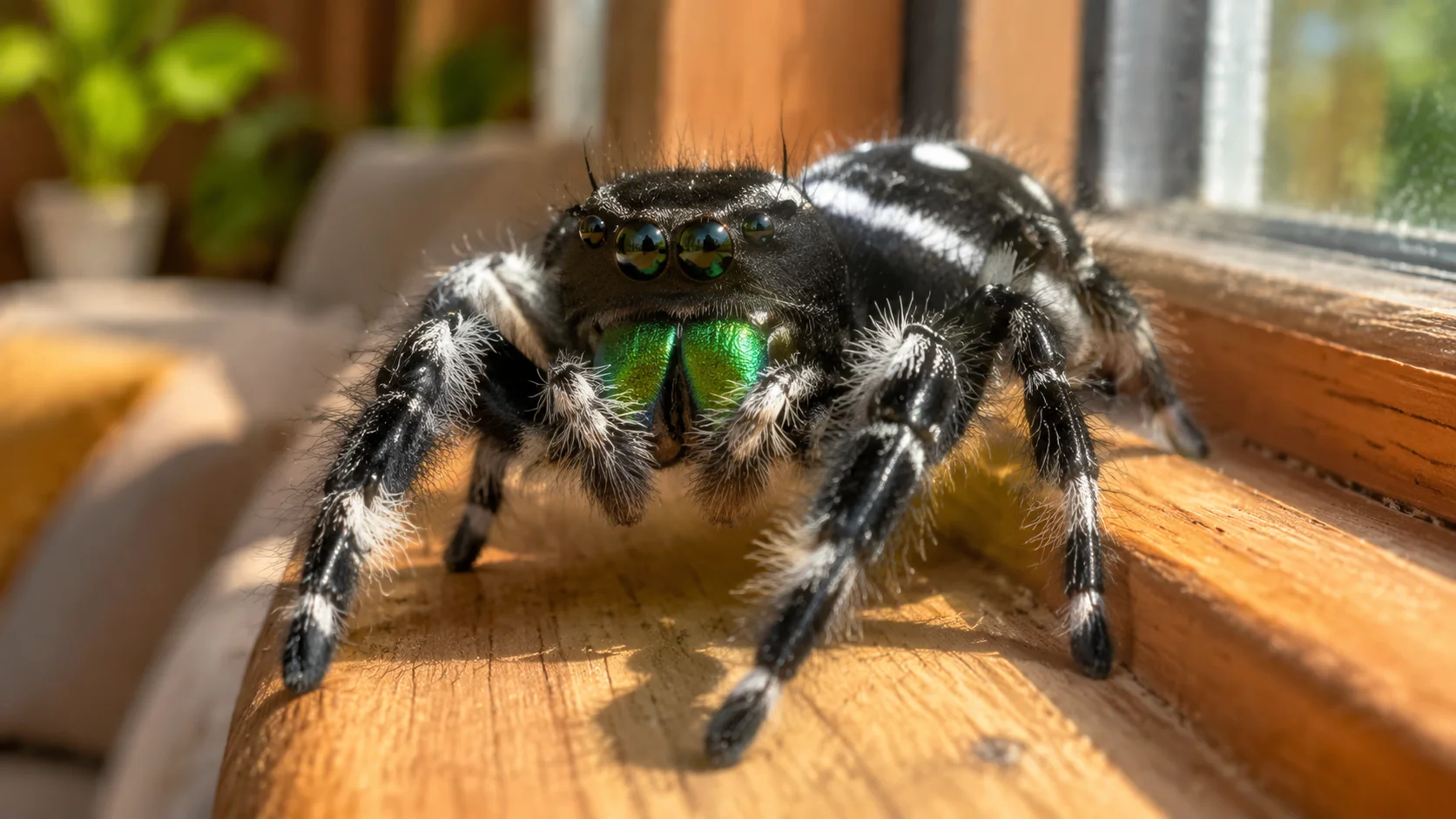
Table of Contents
That tiny spider watching you from the window frame, the one that turns to follow your hand and then hops sideways, is almost certainly a jumping spider. Most people meet one, flinch for a second, then wonder if it bites. I’ve scooped dozens off windowsills, porch rails, and garden fences over the years, and the honest answer is reassuring.
If you found one in your home and you are wondering what it is, whether jumping spiders are poisonous, whether they bite, or how big they get, you are in the right place. This guide gives you plain facts, no scare tactics, and what I have learned from years of watching these little hunters up close.
Quick facts about jumping spiders
- Family: Salticidae, the largest family of spiders, with more than 6,000 known species
- Bite risk: Low. Bites are rare and happen only in self-defense
- Venom: They are venomous but not poisonous, and the venom is harmless to people
- Size: Roughly 1 to 22 mm in body length, depending on species and sex
- Diet: Live insects like flies, mosquitoes, and gnats, caught by pouncing
- Lifespan: About 6 months to 2 years, sometimes up to 3 in captivity
- Behavior: Active by day, curious, and quick to flee rather than fight
How to recognize a jumping spider
A jumping spider is compact, often fuzzy, and moves in short bursts with sudden hops instead of the slow crawl you see from other house spiders. The giveaway is the eyes. Jumping spiders have eight of them, with two large forward-facing eyes in the middle that give them the sharpest vision of any spider. That is why one will swivel to look right at you. It is sizing up the scene, not stalking you.
Another clue is the setting. These spiders are diurnal, meaning they hunt in daylight, and they love warmth and sun. You will usually spot them on south-facing walls, windowsills, fence posts, porch railings, siding, and sunny patches in the garden. They do not spin a web to trap food. Instead they lay down a silk safety line when they jump and tuck into small silk retreats at night or in cold weather.
Common jumping spiders in US homes and yards
A few species turn up again and again across the country:
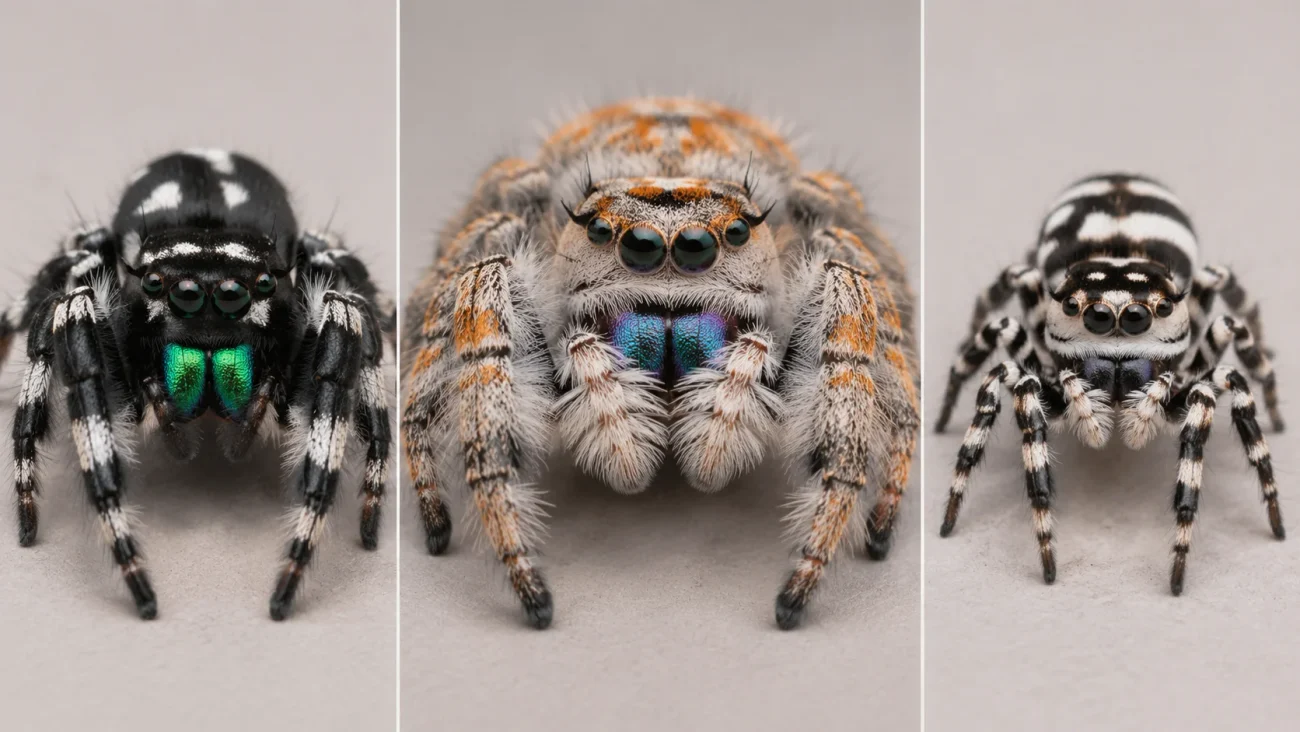
- Bold jumper (Phidippus audax): The classic black jumper with white or orange spots and shiny green or blue jaws. Found across most of North America.
- Regal jumper (Phidippus regius): One of the largest in the US, common in the Southeast and especially Florida and the Gulf Coast. Females are big and often grayish or orange.
- Zebra jumper (Salticus scenicus): A small black-and-white striped spider you will often see basking on sunny outdoor walls and window frames, widespread including the northern states.
Do jumping spiders bite? Can they bite you?
Yes, jumping spiders can bite, but they almost never do. Even on the rare occasion one nips, the venom does nothing to you. They bite only when they feel truly cornered, such as when one gets squashed against your skin or trapped inside clothing. They would far rather leap away than pick a fight with something thousands of times their size.
On the rare occasion a bite happens, it is mild. People describe it as similar to a mosquito welt or a light bee sting: a little redness, mild swelling, and some itching that fades within a day or two. In many cases the fangs do not even break the skin. I have handled plenty of them while moving them outside and have been nipped only a couple of times, and each time it was forgettable.
Will a jumping spider bite if you pick it up?
Usually not. A calm jumping spider placed on an open hand is more likely to explore or hop off than bite. Trouble comes from grabbing or pinching one, so the safe move is to let it walk onto your hand or a cup rather than closing your fingers around it.
Are jumping spiders poisonous or venomous?
So, are jumping spiders poisonous? Here is the distinction that trips people up. Jumping spiders are venomous, not poisonous. Poisonous means harmful to eat or touch. Venomous means it injects a toxin through a bite or sting. Like nearly all spiders, a jumping spider makes venom, but that venom is built to subdue tiny insects, not to harm a human.
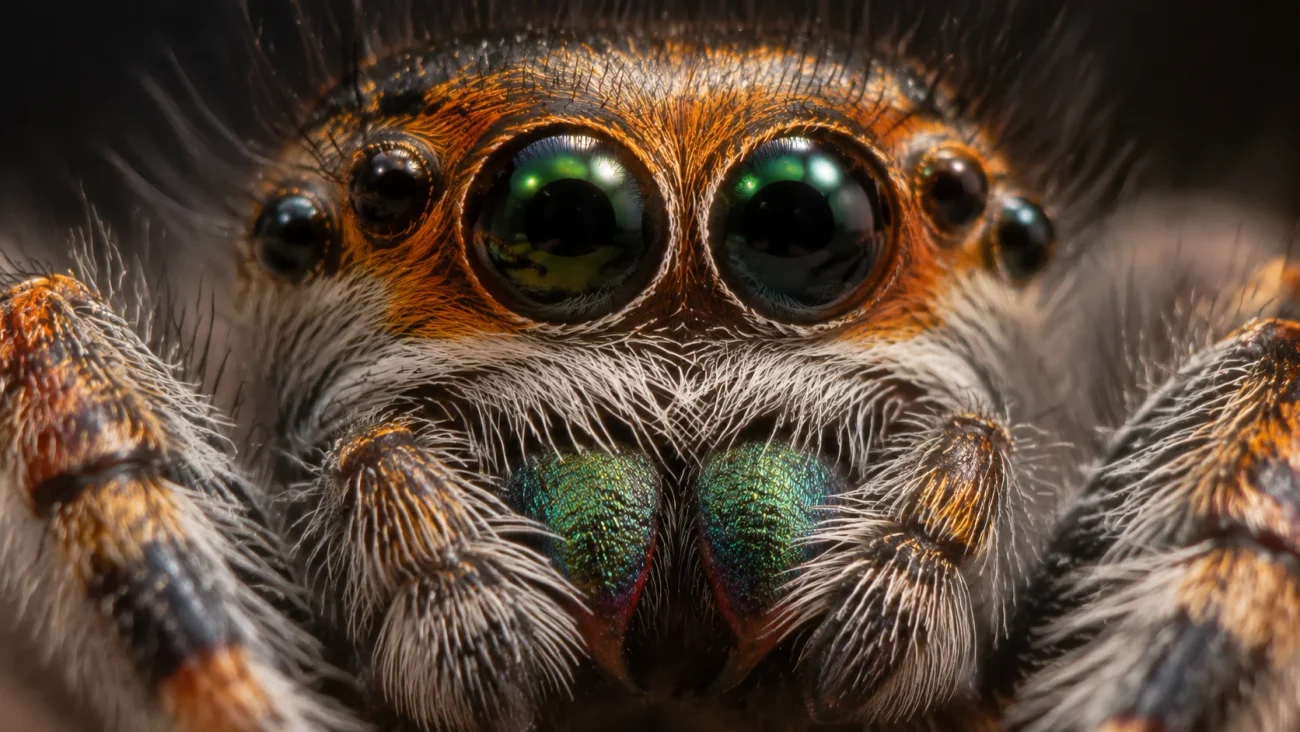
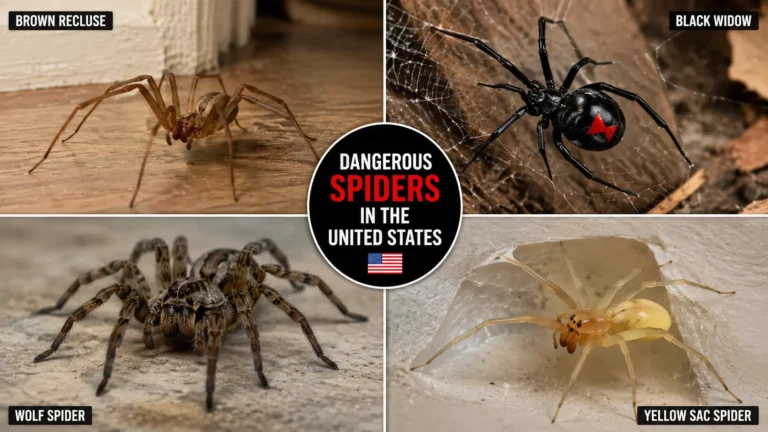
So when someone asks are jumping spiders poisonous or are jumping spiders venomous, the accurate answer is that their venom holds no real medical significance for people. University extension entomologists put jumping spiders firmly in the harmless-to-humans group. If you want the full picture on the spiders ” that do warrant caution, our guide to dangerous house spiders covers the brown recluse and others worth knowing.
Are jumping spiders dangerous?
No. Jumping spiders are not dangerous to healthy adults, children, or pets. They do not carry disease, they do not damage your home, and their bite does not cause the tissue damage linked to medically serious spiders. For the vast majority of people, a jumping spider in the room is a non-event.
If a bite does happen, basic care is all you need:
- Wash the spot with soap and water
- Apply a cold compress if there is any swelling
- Use a dab of antibiotic ointment and avoid scratching
- Keep an eye on it for a day or two
See a doctor only if you have a known spider or insect allergy, if the area spreads, blisters, or shows signs of infection, or if you feel unwell. Those reactions are uncommon with jumping spiders, but it never hurts to be sensible.
Are jumping spiders friendly?
People are often surprised that the same spider they Googled with “are jumping spiders poisonous” turns out to be one of the gentlest you can meet. Jumping spiders are friendly in the sense that they are curious and calm rather than aggressive. Thanks to that excellent eyesight, a jumping spider will often stop and watch you, tilt to track your movement, and show something close to interest. It is one reason they have a huge fan base and are kept as pets more than any other spider.
They are not affectionate the way a dog is, and they do not recognize you as an owner. But their temperament is gentle. Faced with a human, the default response is to freeze, assess, and flee. That mix of personality and harmlessness is exactly why so many people who meet one decide to leave it be.
What do jumping spiders eat?
In the wild, jumping spiders eat small live prey that they hunt by sight. Common targets include:
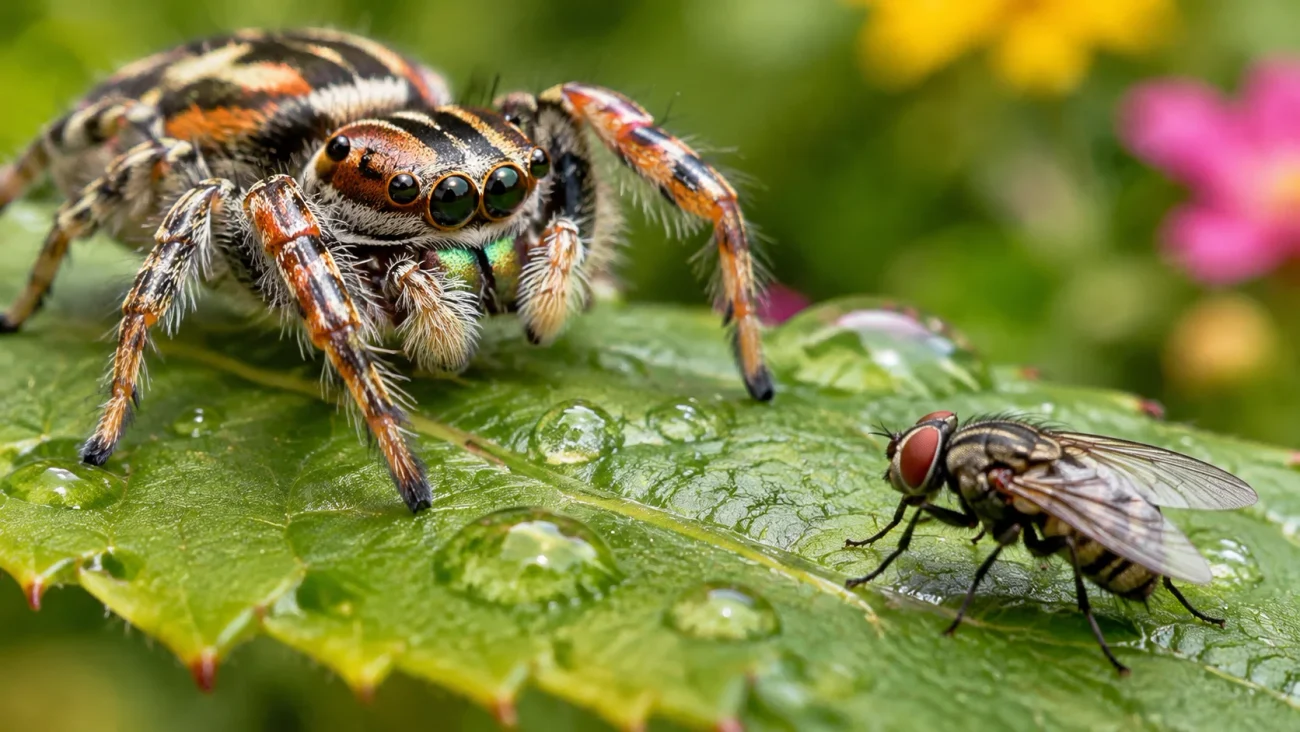
- Flies and mosquitoes
- Gnats and small moths
- Ants and tiny beetles
- Other small spiders
Because they rely on vision and speed, they stalk and pounce instead of waiting in a web. A jumping spider can take down prey two to three times its own size, pinning it with a quick leap and a bite. They are opportunists and will eat whenever a good meal walks by, though adults often go days between meals and can last weeks without food when they must.
There is a surprising footnote to their diet. Jumping spiders sometimes sip nectar and the juice from soft fruit, and one tropical relative, Bagheera kiplingi, eats mostly plant matter. People who keep them as pets usually feed flightless fruit flies to small spiders and move up to crickets, mealworms, or bottle flies as the spider grows.
If you keep one as a pet, these are the usual feeder insects:
- Babies (spiderlings): flightless fruit flies
- Juveniles and adults: houseflies, blue and green bottle flies, small crickets, small dubia roaches, and the occasional mealworm
A simple feeding rule keeps a pet jumper safe: never offer prey bigger than the spider’s own body. Match the bug to the abdomen and you are fine. Adults do well eating every two to four days, while babies eat more often. A round, full abdomen means a well-fed spider, and a roaming, movement-watching spider with a thinner belly is usually hungry. They also drink, so a tiny water droplet on the enclosure wall or a damp cotton tip is enough.
How big do jumping spiders get?
Not very. Across the family, body length runs from about 1 mm up to roughly 22 mm, and the species you meet around the house mostly land between 4 and 18 mm. So how big do jumping spiders get in real terms? Think grain of rice up to about the size of a pea, with the biggest females pushing close to an inch once you count the legs.
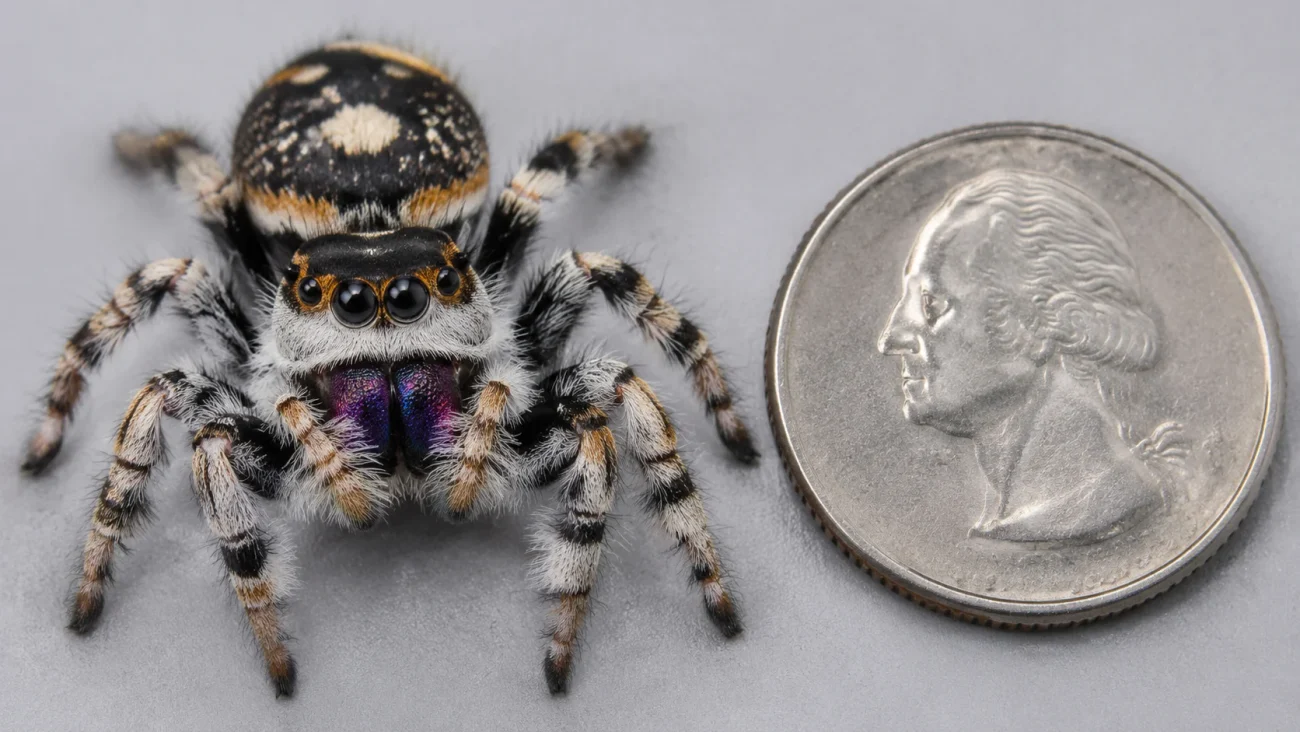
Size depends on both species and sex, and females are the larger ones:
- Regal jumper: the heavyweight, with big females reaching close to an inch long
- Bold jumper: females around 8 to 18 mm, males smaller
- Zebra jumper: tiny, usually 4 to 6 mm
For their size, their jumping is the real headline. A jumping spider can leap many times its own body length from a standstill. In a 2018 University of Manchester study, researchers trained a regal jumping spider named Kim and measured jumps several times longer than its body. The leap is powered by a rapid surge of hemolymph (spider blood) that extends the back legs, not by big muscles.
How long do jumping spiders live?
Most jumping spiders live about 6 months to 2 years, and some reach 3 years in captivity with good care. How long do jumping spiders live in the wild is usually on the shorter end, since weather and predators take a toll.
Two factors shape the number:
- Sex: Females outlive males. Females often reach 1 to 2 years, while males usually live 6 to 12 months.
- Molting and maturity: A jumping spider grows by molting and reaches adulthood after several molts, commonly within its first year. After that final molt it has roughly a year of adult life left.
Near the end, you may notice a spider climbing less, losing its grip, and slowing down. That is normal aging, not illness, and it is simply a short life lived fast.
Should you remove a jumping spider from your home?
Honestly, you usually should not. One or two jumping spiders indoors is a good sign, not an infestation. They are working for you, thinning out the insects you do not want.
If you would still rather it live outside, move it gently instead of squashing it. Guide it into a cup with a piece of paper, carry it out, and set it free on a sunny wall or in the garden where it can hunt.
To simply see fewer of them inside, reduce what draws their food in the first place:
- Turn off outdoor lights you do not need at night, since lights pull in the bugs spiders follow.
- Seal gaps around windows, doors, and screens.
- Keep other household insects in check, because fewer prey means fewer spiders. (Our guide on what attracts spiders breaks this down further.)
Final thoughts
After years of meeting these spiders on windowsills and fence rails, I have come to look forward to them. They are alert, oddly expressive, and about as harmless as a house guest gets.
If you came here wondering are jumping spiders poisonous, you can relax. They are harmless, helpful, and far more curious about you than dangerous. Watch it for a minute, let it be, or walk it outside. Either way, a jumping spider is a neighbor worth keeping.
Want to keep going? Our spider hub covers house spider identification by type and state.
Frequently asked questions
What happens if a jumping spider bites you? Usually very little. You might get mild redness, slight swelling, and some itching that clears within a day or two, much like a mosquito bite.
Is it okay to touch a jumping spider? Yes, if you are gentle. Let it walk onto your hand rather than grabbing it. Pinching or trapping one is the main reason a bite ever happens.
Is it bad to have jumping spiders in your house? No. They are harmless, do not damage anything, and eat the small insects you do not want. Most people are better off leaving them alone.
Will a jumping spider bite me if I pick it up? Rarely. A calm spider will explore or hop away. Bites come from rough handling, not from being picked up carefully.
How big do jumping spiders get? Most are 4 to 18 mm long, from a grain of rice up to about a pea. The largest, the regal jumper, can get close to an inch.
How long do indoor jumping spiders live? About 6 months to 2 years, sometimes 3 in captivity. Females live longer than males.
How can you tell if a jumping spider is dying? It moves less, struggles to grip surfaces, and grows sluggish. That is normal old age for a spider near the end of its life.
What kills a jumping spider? Age, cold weather, lack of food, and predators in the wild. Indoors, most simply reach the end of a short natural lifespan.
Are jumping spiders poisonous or venomous?
Venomous, not poisonous. The venom is made for small insects and has no meaningful effect on humans, barring a rare allergy.
References
Penn State Extension: https://ento.psu.edu/extension/factsheets/jumping-spiders
University of California: https://ipm.ucanr.edu/PMG/PESTNOTES/pn7442.html