Are boxelder bugs harmful? What they eat and Whether they really bite
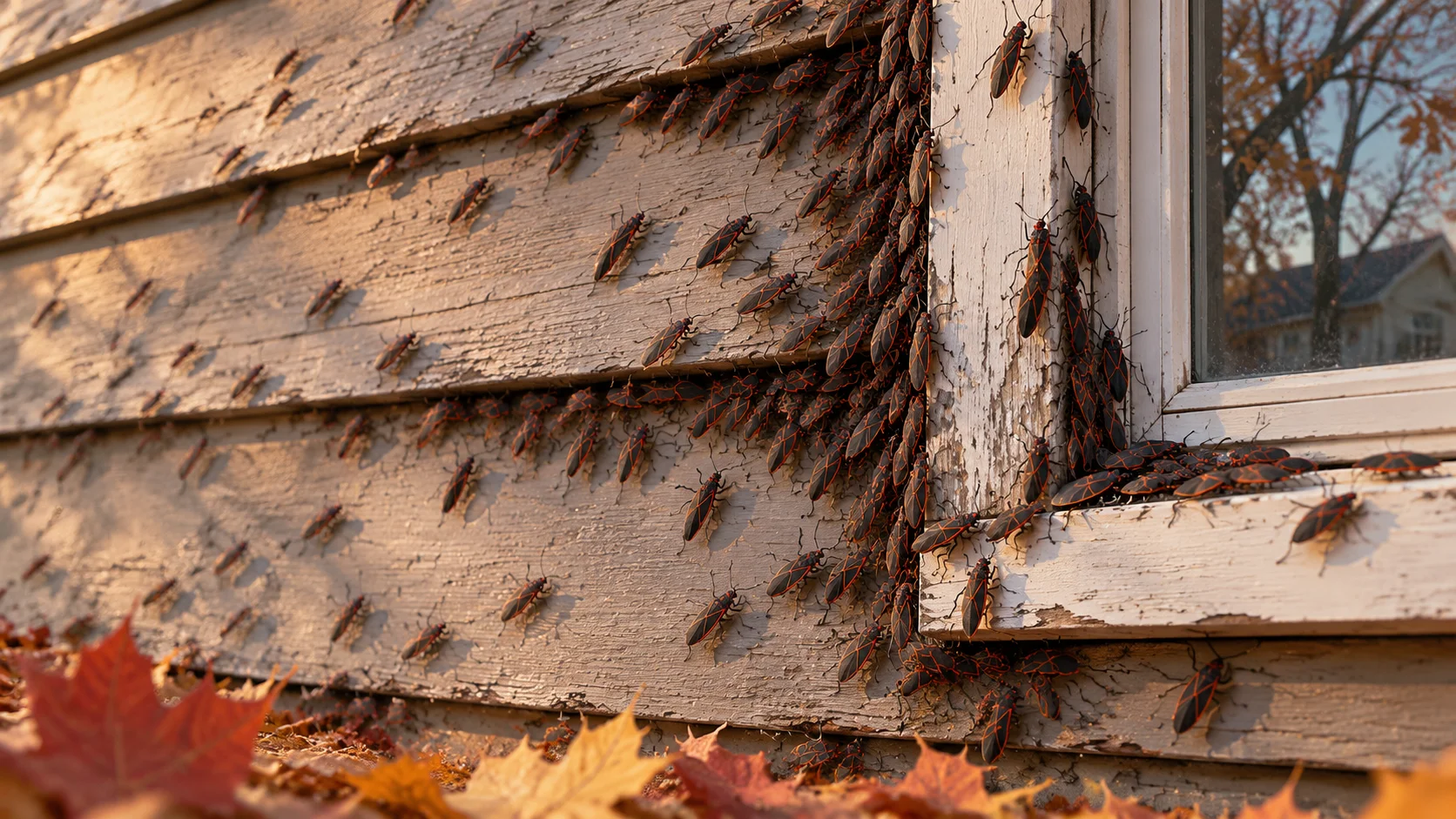
Table of Contents
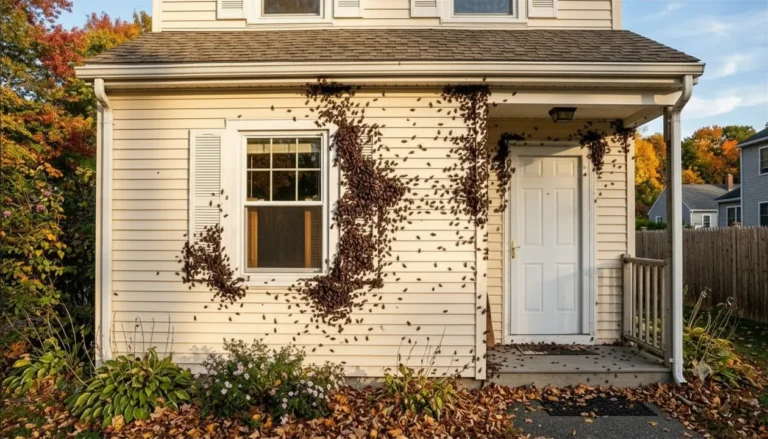
You walked out to the car on a warm October afternoon and the south wall of your house was moving. Hundreds of them. Black, flat, with those thin red lines, packed into the siding seams and the window frames and the gap under the garage trim.
That is the moment most people go looking for answers and ask – are boxelder bugs harmful? Half the internet says boxelder bugs are completely harmless. Then you scroll into a forum thread where someone swears their whole family got bitten and it hurt for days.
Both of those things are closer to true than either side admits. This article sorts it out using what entomologists at land-grant universities and the USDA actually publish, and it tells you plainly where the research disagrees with itself.
Are boxelder bugs harmful?
The short version is that boxelder bugs are a nuisance pest and nothing more. But “nuisance” covers a lot of ground, so here is the breakdown by what you are actually worried about.
Are they harmful to people?
So are boxelder bugs harmful to people? No. The University of Kentucky’s entomology fact sheet ENTFACT-444, states that boxelder bugs have not been reported to cause harm to humans, pets or livestock in any way, and that they are unlikely to transmit any disease to humans, animals or plants. The National Pesticide Information Center, which is run out of Oregon State University, says the same: they do not sting or transmit disease.
That matters because the bug most people confuse them with does carry disease. More on that shortly.
Are they harmful to pets?
Are boxelder bugs harmful to pets? Not meaningfully, and dogs and cats usually sort this out themselves.
When a boxelder bug is disturbed or crushed, it releases a pungent, foul-tasting compound. That is its entire defense, and it works on pets. The common outcome, reported by Terro and echoed by pest operators, is a dog or cat that eats one and then drools heavily or throws it up. One Reddit commenter put it more simply: their cats will not even chase them.
So a pet that eats a boxelder bug is dealing with a bad taste, not a poisoning. If a pet eats a large number and seems unwell, call your vet, same as you would with any insect.
Are they harmful to your house?
Are boxelder bugs harmful to your house? Not structurally. They do not chew. ClearDefense puts the list plainly: boxelder bugs do not eat structural lumber, drywall, insulation, clothing, carpet or stored food. They also cannot bore through siding or make a hole in a foundation, which means every bug inside your house came through an opening that was already there.
What they do cause:
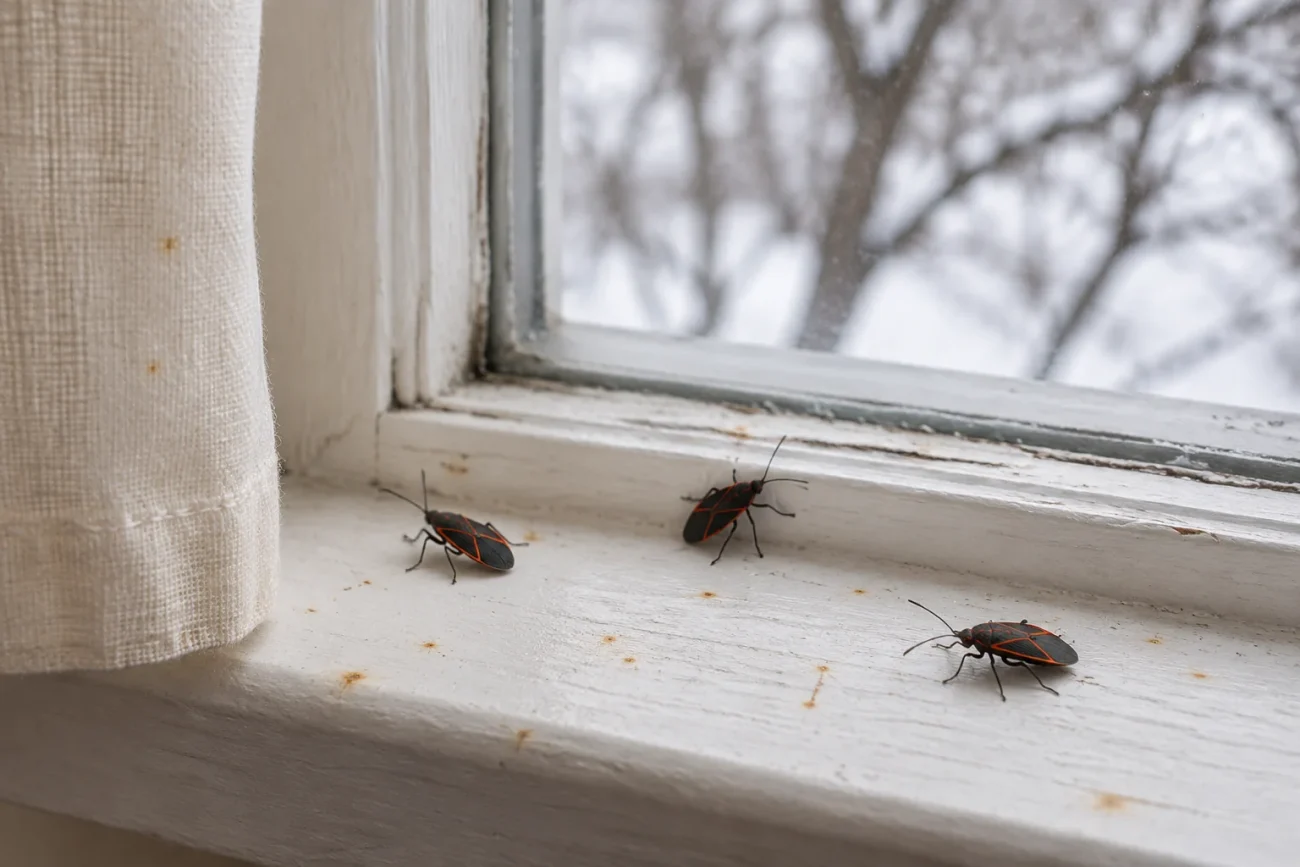
- Staining. This is the real complaint. Their droppings leave reddish or rust-colored spots. The National Pest Management Association notes fecal material staining curtains, drapes and clothing, and the University of Minnesota confirms excrement staining walls, curtains and other indoor surfaces. Outdoors it shows up on siding, which is the complaint you see constantly from homeowners in warm-fall states.
- Smell. Crush one and you get the odor. Terro makes a useful distinction: during normal activity they give off no smell at all. It only happens when they are disturbed or smashed, which is the single best argument for vacuuming instead of swatting.
- Sheer numbers. The USDA’s Forest Insect and Disease Leaflet 95 notes that thousands may congregate in and around homes in autumn.
One thing you can stop worrying about: they do not breed indoors. The University of Minnesota is clear that boxelder bugs do not reproduce inside homes, and every bug you see indoors during winter and spring entered the previous fall. Individual adults only survive a few days to a week inside. Nobody is multiplying in your walls.
The second-order problem almost nobody mentions
There is a second way boxelder bugs cause harm, and it is indirect: through the beetles their bodies attract.
Boxelder bugs die in wall voids and attics by the thousands, and those bodies become food for scavenger beetles. Iowa State Extension says carpet beetles commonly feed on dead insects in wall voids and attics, and names boxelder bugs directly in its warehouse and cabinet beetle guidance: these beetles feed on dead insects including dead flies, boxelder bugs and ladybugs in wall voids and attics. University of Wisconsin Extension says the same about larder beetles, listing dead cluster flies and boxelder bugs among their protein sources.
So if you had a big boxelder year and now you are finding small fuzzy larvae or little beetles at your windowsills in spring, those two things are probably connected. The boxelder bugs are harmless. The beetles that come to eat their bodies can damage wool, silk and animal-fiber textiles.
Are they harmful to plants, trees and fruit?
Are boxelder bugs harmful to plants? Barely. This is the most consistent finding across every source.
The USDA leaflet states that boxelder bugs generally do not injure host plants beyond reducing viable seed or damaging fruit. The University of Minnesota says feeding on maple or ash causes no noticeable injury. UC IPM reports little damage to ornamental trees. Utah State calls the insect more of a nuisance than a plant pest. UNH says plant damage is not considered serious.
Where damage does show up, it is cosmetic and it is on ripe fruit:
- UC IPM notes occasional puckering or distortion on pear and kiwi in commercial orchards, and says feeding punctures deform grapes.
- Utah State reports soft areas on ripe fruit, most notably on peaches in Utah.
- UNH says that in heavily infested areas they may attack ash and maple and the fruits of raspberry and strawberry plants.
- Oregon State documented growers reporting large congregations on pear trees in the Hood River Valley, and still concluded that even at those unusually high populations a spray may not be warranted if damage is not widespread.
Oregon State also offers the single most useful identification tip in the orchard literature: you will not see salivary sheaths on fruit fed on by boxelder bugs. That is how you tell their damage from stink bug damage.
Garden vegetables are rarely affected. And Colorado State Extension settles a question that gets answered wrongly elsewhere: indoors, they may attempt to feed on house plants but do not cause any damage.
Can boxelder bugs cause allergies?
Are boxelder bugs harmful to people with allergies? There is one documented case worth knowing about, and it deserves honest handling rather than either hype or silence.
In 2019, University of Utah Health published an account of Dr. Jamie Zussman, a dermatologist who developed hay fever and asthma after moving to Utah. Her symptoms came back every fall and winter and faded in spring, and she eventually noticed the flares lined up with boxelder bugs appearing in her home. She collected and froze bugs from the house, and allergist Dr. Gerald Gleich made a solution from the bug parts for a skin prick test. Her skin reacted within a minute. Three control subjects were tested with the same solution and none of them reacted. After she had the exterior of her home sprayed in following autumns, her symptoms stopped and she no longer needed antihistamines.
The article, dated September 6, 2019, notes two earlier studies that had linked boxelder bugs to asthma attacks, and the findings were published in the Allergy and Immunology Journal of Clinical Communications.
Now the caveats, which matter:
- This is one patient plus three negative controls. It is a case report, not a population study.
- It demonstrates correlation, not proven causation.
- Nobody knows how many other people this affects.
- A skin test is currently the only way to confirm this kind of sensitivity.
So the responsible answer is: for almost everyone, no. If you have unexplained allergy or asthma flares that start when the bugs show up every autumn and clear up in spring, that pattern is documented in the medical literature and worth raising with an allergist. Do not self-diagnose from a blog post, including this one.
Do boxelder bugs bite?
This is where the internet falls apart, so let us do it properly.
Why the sources disagree
Ask eight respected sources and you get six different answers:
| What they say | Who says it |
|---|---|
| They do not bite or sting people or animals | University of Kentucky (ENTFACT-444); University of Maryland Extension |
| Not known to bite, but their piercing-sucking mouthparts can occasionally puncture skin and leave a red spot like a mosquito bite | National Pest Management Association |
| Generally not known to bite, though there are rare reports of defensive biting | National Pesticide Information Center (Oregon State) |
| Reported to bite humans on rare occasions | Colorado State Extension; Montana State Extension |
| Reports exist, but it is apparently very rare | UConn |
| If handled, they occasionally bite, which can irritate the skin and in some cases cause a small ulcer-like lesion | Clemson HGIC |
That Clemson line is the one nobody quotes, and it is the reason the forum threads exist. A land-grant university says a handled boxelder bug can leave a small lesion. People who experienced that and then read “they don’t bite” on five websites reasonably conclude they are being told nonsense.
What a boxelder bug actually does to skin
The confusion clears up once you understand the anatomy.
Boxelder bugs are true bugs, order Hemiptera. They have no mandibles. No jaws, no chewing parts. Terro explains it well: as true bugs they evolved to suck nutrients from food rather than biting and tearing it. What they have instead is a rostrum, a needle-like beak built to pierce a seed coat and drink the fluid inside.
So in the strict entomological sense, a boxelder bug cannot bite you. It can jab you. When one gets pressed against your skin, caught in clothing or picked up roughly, it may probe defensively with that beak. No venom goes in. There is no stinger anywhere on the insect. Usually you get a small red mark that fades. Occasionally, per Clemson, you get something that irritates longer.
One widely-shared claim is simply wrong: that boxelder bugs lack the mouthparts needed to pierce human skin. An insect whose mouth is built to punch through a maple seed pod is not stopped by skin. The honest answer is that they rarely try, not that they cannot.
What probably bit you instead
If you were bitten by something in your house and it hurt like a sting, swelled, and stayed sore for days, that is not boxelder bug behavior. Three indoor insects fit that description much better, and all three get misidentified as boxelder bugs or as kissing bugs.
Masked hunter (Reduvius personatus). An assassin bug that lives indoors and hunts other insects, including bed bugs. University of Minnesota Extension says it bites to protect itself if disturbed or picked up, and that the bite feels like a bee sting followed by numbness and swelling. Penn State says it is about as painful as a honey bee sting and takes up to a week to heal. It is active at night and hides during the day, and its nymphs camouflage themselves by sticking dust and lint to their bodies. Michigan State Extension reported three people contacting them in a single month about masked hunters found indoors, and two of them believed they had discovered kissing bugs.
Wheel bug (Arilus cristatus). North America’s largest assassin bug, with a cogwheel crest on its back. Texas A&M confirms it produces a painful bite if handled recklessly.
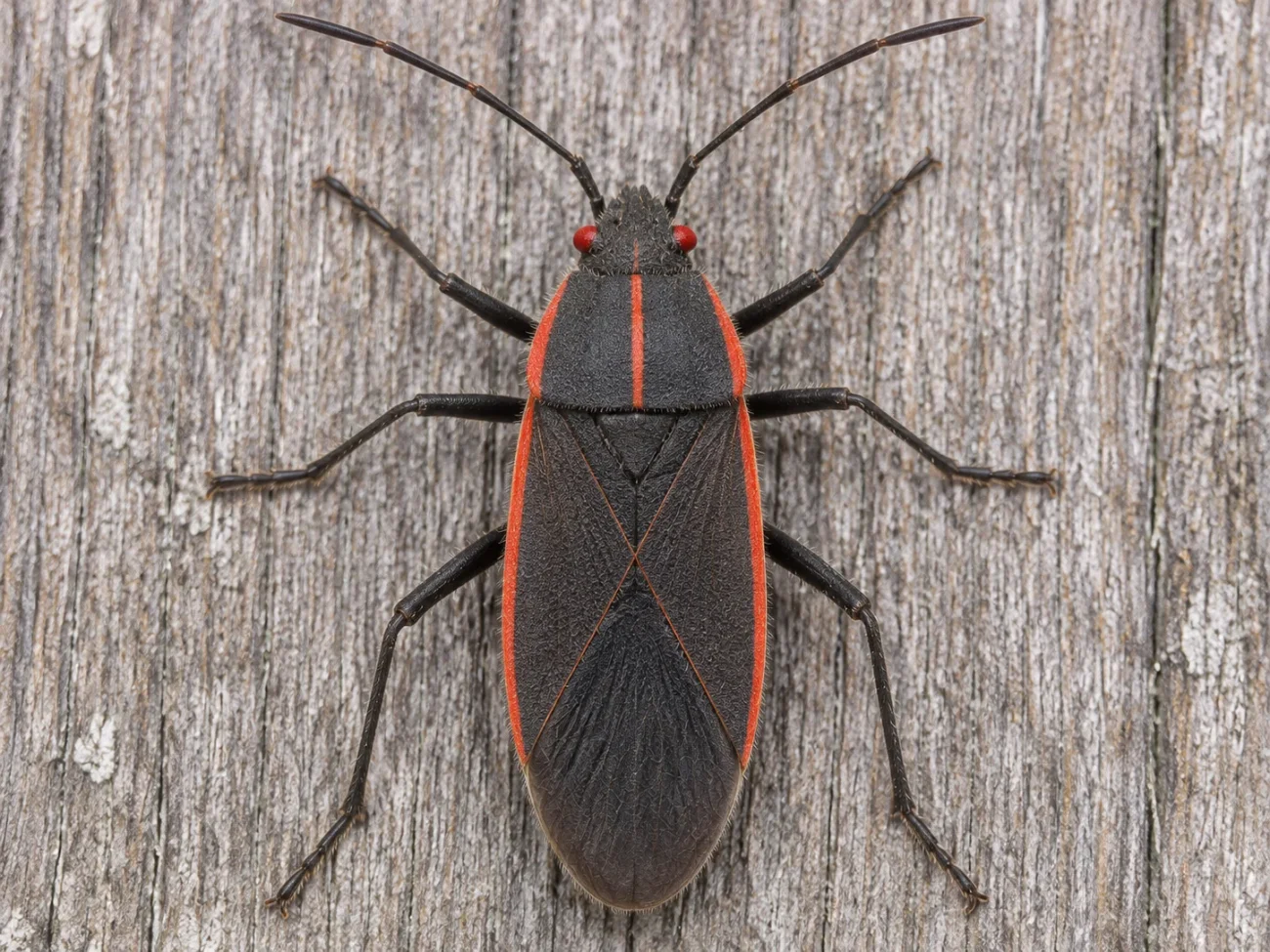
Bloodsucking conenose, or kissing bug (Triatoma sanguisuga). This is the one that actually matters medically, because kissing bugs can transmit Chagas disease. Ohio State’s BYGL has documented how often boxelder bugs, red-shouldered bugs and wheel bugs get reported as this species because of their reddish markings. The tells: a kissing bug has a narrow, cone-shaped head that tapers to a point, black eyes, and reddish-orange stripes along the sides of the abdomen. A boxelder bug has a wide flat head, bright red eyes, and red lines running lengthwise along the wing edges. Kissing bugs are also noticeably bigger, often over an inch, against a boxelder bug’s half inch.
If you have a painful bite and an insect you cannot confidently identify, bag the specimen and take it to your county extension office. Free identification is one of the most underused services in the country, and in a case like this it is the right move.
Do boxelder bugs bite dogs or cats?
Are boxelder bugs harmful to dogs or cats through biting? No source reports boxelder bugs biting pets and the University of Kentucky states they have not been reported to harm pets or livestock in any way. The pet risk here runs the other direction: your dog eats the bug, dislikes the taste, and drools or vomits.
What do boxelder bugs eat?
The seeds of female boxelder trees
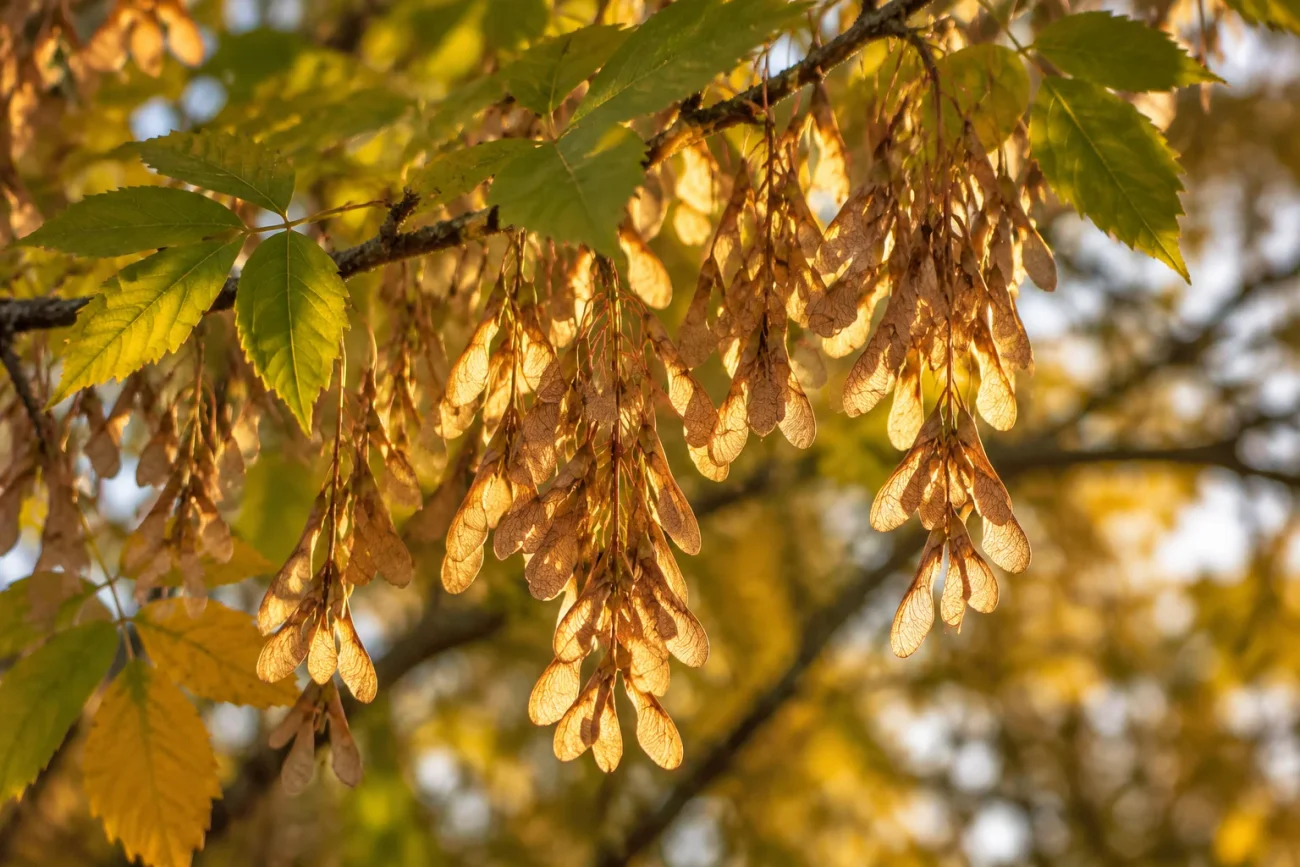
Boxelder bugs are named for their host, the boxelder tree, Acer negundo, which is a native North American maple also called ash-leaf maple, three-leaf maple, or in Canada the Manitoba maple.
The thing to understand is that boxelder trees are either male or female, and only the females make seeds. Those seeds hang in clusters of winged pods, called samaras, the same “helicopters” you remember from maples as a kid. The seed inside is the food.
The University of Kentucky explains the consequence: boxelder bugs stay on female fruit-producing trees and are rarely found on males. UNH confirms the insect primarily feeds on pistillate, seed-bearing boxelders.
That single fact explains something that confuses neighbors. Two houses on the same street, one swarmed and one clear, often comes down to whether the tree nearby is a female.
Other trees they feed on
- Maples (Acer species), particularly silver maple. The USDA leaflet and the University of Minnesota both list other maples as hosts, with Minnesota noting no noticeable injury to those trees.
- Ash (Fraxinus species). A regular secondary host across the extension literature.
- Cottonwood and blackberry. UC’s pear guidelines note western boxelder bug adults overwintering on boxelder, maples and cottonwoods in riparian corridors, and recommend checking nearby blackberries.
Do they eat fruit?
Occasionally, mostly late in the season, and the damage is cosmetic. Pulling the host lists together across sources:
| Fruit | Source |
|---|---|
| Apple, plum, peach, cherry, almond, grape | UC IPM |
| Pear, nectarine, apricot (ripe fruit) | Utah State Extension |
| Peach (most notable in Utah) | Utah State Extension |
| Pear, kiwi (puckering, distortion) | UC IPM |
| Raspberry, strawberry (heavy infestations only) | UNH Extension |
| Fruit and nut trees, grapes, strawberries; pistachios and almonds for the western species | USDA FIDL-95 |
What that looks like on the fruit: dimples, scarring, soft spots, corky tissue, deformation, sometimes premature drop. Serious orchard damage is rare, and Oregon State states flatly that they are not listed as orchard pests and economically meaningful damage in commercial pear orchards is rarely seen.
What boxelder bugs do not eat
This is usually the question behind the question, so here it is directly.
| They eat | They do not eat |
|---|---|
| Boxelder seeds (samaras) | Wood, lumber, framing |
| Maple and ash seeds | Drywall and insulation |
| New leaves and soft shoots | Clothing, carpet, upholstery |
| Fallen seeds on the ground | Pantry and stored food |
| Ripe fruit, occasionally | Blood, human or animal |
| Plant fluids | Other insects, including aphids |
They cannot eat other insects even if they wanted to. They are fluid feeders with no chewing mouthparts, so predatory feeding is physically impossible for them.
How they feed
They pierce and drink. The beak goes into the seed or soft tissue and the insect draws out the fluid. Think drinking straw rather than teeth. Utah State notes that both adults and nymphs feed this way.
This is why their feeding does so little harm to a healthy tree, and why they cannot damage anything in your house.
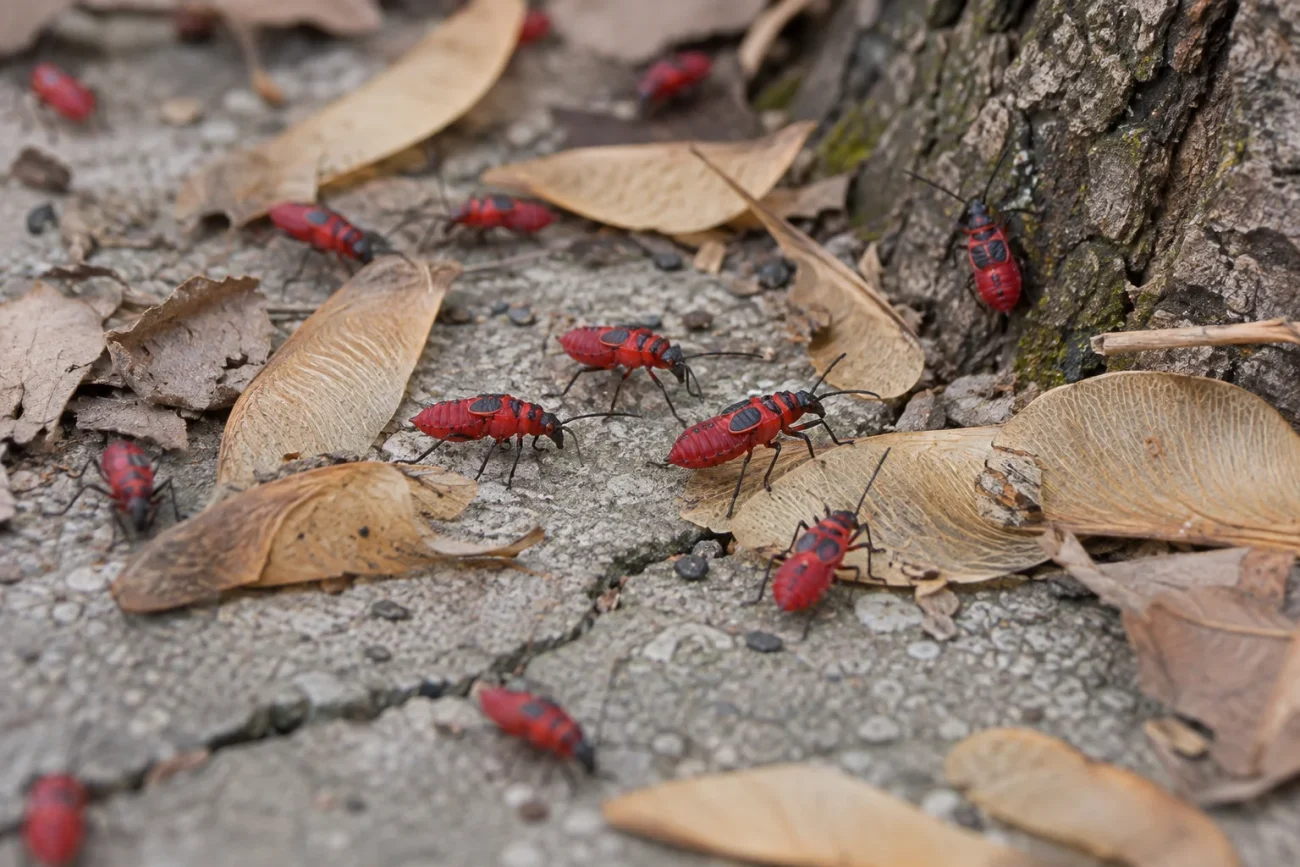
What eats boxelder bugs?
Here the popular story and the science part ways, and the science is more interesting.
The story you will read everywhere: nothing eats them, because their red-and-black coloring warns predators they are toxic and foul. That coloring is real, and it is called aposematism. The Canadian Encyclopedia describes eastern boxelder bugs as aposematic, with bright red coloration signaling to predators that they are distasteful, backed up by pungent, foul-tasting compounds released when disturbed.
But the Missouri Department of Conservation complicates it in a way worth reading carefully: the red markings would seem to warn predators that boxelder bugs are distasteful, but many predators, such as praying mantises and some spiders, readily eat them anyway. And with their bland diet of box elder sap, boxelder bugs are probably not toxic. Missouri contrasts them with milkweed bugs, which look similar but feed on toxic milkweed sap and genuinely are distasteful to predators.
In other words, the warning colors are closer to a bluff. The lookalike is the genuinely poisonous one.
Predators that are actually documented:
- Spiders. The most consistently supported predator, and a minor one. The Canadian Encyclopedia notes boxelder bugs have been observed being eaten by spiders despite their defenses.
- Praying mantises. Named by Missouri Department of Conservation and by the National Pest Management Association.
- Wheel bugs. The City of Brampton describes one of the few insect predators injecting prey with enzyme-laden saliva to immobilize it, then sucking out the body fluids.
What you should not count on: no source supports importing a predator to solve a boxelder bug problem. The Prairie Ecologist and extension sources agree that few birds or other animals make a habit of eating them, and population swings track weather more than predation. The University of Minnesota notes they are most abundant after hot, dry summers followed by warm springs.
What actually works, and what does not
You did not come here for a control guide, but if you still ask are boxelder bugs harmful enough to spray for, the harm question and the treatment question are tangled together so here is the honest short version.
Start with the fact that nearly ends the conversation about sprays. Two independent sources say chemicals are a weak tool here. The USDA leaflet states that boxelder bugs have developed resistance to many commercial insecticides and that chemical control is rarely needed and a last resort. Montana State Extension says the same in plainer language: these insects are resistant to many insecticides, and most insecticides for the exterior of homes are not very effective against the boxelder bug. UC IPM’s verdict is four words long: insecticide use is rarely justified.
What the research supports:
- Seal before the end of August. The University of Minnesota says make repairs before late August and seal openings an eighth of an inch or larger. UNH sets its deadline at September 10. Do not seal the weep holes in brick or stone veneer, which are there for drainage. Use ventilation plugs instead.
- Water. A forceful hose spray knocks them off walls and trunks, and they drown easily. Clemson adds that water between 165 and 180 °F kills them, with sensible warnings about scalding yourself and damaging plants.
- Soap. The USDA leaflet gives a formula: 5 tablespoons of liquid detergent or half a cup of dry laundry detergent per gallon of water. It only kills on contact, needs repeating, and will damage foliage.
- Vacuum indoors. The only practical indoor control. Empty or freeze the bag promptly. Vacuuming avoids both the stain and the smell that crushing produces.
- Clear the foundation. UC IPM recommends raking leaves and clearing weeds and debris from a 6 to 10 foot strip around the foundation, especially the south and west sides, and sweeping up fallen seeds.
- Plant ‘Baron’. If you want a boxelder in your yard, the USDA leaflet names the seedless cultivar ‘Baron’, which boxelder bugs are not attracted to. This is the only truly preventive recommendation in the literature.
What does not work, per the University of Minnesota: treating wall voids, spraying indoors once they are inside (they die quickly anyway), spring indoor spraying, and spring outdoor spraying, since bugs leaving your walls are not entering and treating them has no effect on next fall’s numbers.
On cutting down the tree: tempting, and mostly futile unless you also control what your neighbors grow. Adults fly several blocks and may travel as far as two miles, so a cleared yard refills from elsewhere. UC IPM calls removing female trees the most effective control while acknowledging bugs will still arrive from neighboring trees. Minnesota argues the tree’s benefits generally outweigh the occasional problem. The USDA notes some municipalities prohibit planting female trees outright.
On essential oils, since this comes up constantly: peppermint, lavender, citrus, cinnamon, clove, tea tree and the rest are recommended all over the web, and not one extension or government source supports any of them as an effective boxelder bug repellent. Every page making the claim cites another page making the claim. Save your money and seal the gaps instead.
Frequently asked questions
Should I be concerned about boxelder bugs? If you mean are boxelder bugs harmful, not about danger. They do not bite meaningfully, sting, spread disease or damage your house. Be concerned about two practical things: staining from their droppings, and the openings they are using to get in, which other pests use too.
What happens if a boxelder bug bites you? Usually nothing more than a small red mark like a mosquito bite, since it is a defensive jab from a feeding beak, not a true bite. Clemson notes it can occasionally irritate the skin or leave a small ulcer-like lesion. There is no venom and no disease risk. If a bite was severely painful and swelled for days, suspect a masked hunter, wheel bug or other assassin bug instead.
Where do boxelder bugs go at night? They tuck into sheltered spots and stay put. Outdoors that means leaf litter, bark fissures, and spaces under rocks, steps, decking and sidewalks. Around a house it means siding seams, window and door casings, foundation cracks, wall voids and attics. They are daytime sun-baskers, which is why you see them massed on warm walls in the afternoon and not at night.
Will boxelder bugs go away on their own? Yes. The ones indoors die within days to weeks and cannot reproduce inside, so an indoor population always dies out. The outdoor wall-clustering ends when cold weather sets in. In spring, survivors head back outside toward the trees. The catch is that the cycle repeats next autumn unless you seal the entry points, and the University of Minnesota notes they are not a serious problem every year, with the worst years following hot dry summers.
Does anything eat boxelder bugs? Spiders, praying mantises and wheel bugs, but none in numbers that control a population. Missouri Department of Conservation notes mantises and some spiders eat them readily despite the warning coloration, and that the bugs are probably not actually toxic.
What do boxelder bugs hate? Cold, and being unable to find a gap. There is no extension-backed evidence that any scent repels them. What demonstrably works against them is exclusion, a forceful water spray, soapy water on contact and a vacuum.
What do boxelder bugs eat in the winter? Almost nothing. They are inactive and living on stored fat. On warm days overwintering adults may feed lightly on dry plant material or houseplants, without causing damage.
Do boxelder bugs eat aphids or other insects? No. They are fluid feeders with no chewing mouthparts, so eating another insect is physically impossible for them.
Are boxelder bugs poisonous? No. They have no venom and no stinger. They release a foul-tasting compound as a defense, which is what makes a pet drool or vomit after eating one. Missouri Department of Conservation suggests that given their plain diet of boxelder sap, they are probably not toxic at all.
Do boxelder bugs damage trees? Not meaningfully. The USDA concluded they do not injure host plants beyond reducing viable seed or marking fruit, and Minnesota reports no noticeable injury to maple or ash.
Are boxelder bugs invasive? Not in North America. Both species are native here. They have been introduced elsewhere. They have been introduced to Chile, where they are considered invasive.
Why are they all on one side of my house? They are chasing warmth. Across the literature they gather on south and west facing walls where the sun hits. Worth knowing: a widely repeated claim says they prefer white or light-colored houses, but the University of Minnesota’s fact sheet states color does not appear to influence them and they are found on buildings of all hues. Sun exposure is the factor that holds up.
References
University of Kentucky – https://entomology.mgcafe.uky.edu/ef444
University of Minnesota Extension https://extension.umn.edu/yard-and-garden-insects/boxelder-bugs