
The Ultimate Silverfish Identification Guide
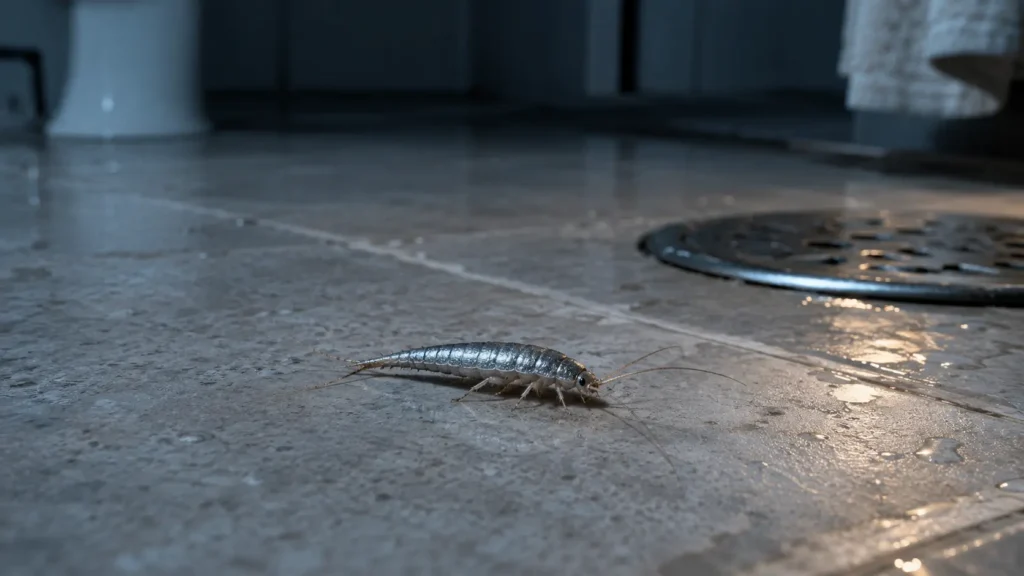
It was 11 PM when I flipped on my bathroom light and watched something silver dart across the floor toward the drain. My heart jumped. I had no idea what I was looking at, and that feeling of not knowing felt worse than the bug itself.
After years of studying household pests, I can tell you that silverfish are one of the most misunderstood insects in the American home. They will not hurt you, but I have personally watched them silently destroy a shelf of books and ruin family photographs, all because no one recognised the early signs. This guide will show you exactly what silverfish are, how to identify them, and why they showed up in your home.
At a Glance What You Need to Know AboutSilverfishh
| Common name | Silverfish (also: moth, carpet shark insect) |
| Scientific name | Lepisma saccharina |
| Size | ½ to ¾ inch long |
| Color | Shiny silver-gray |
| Key features | 3 bristle tails, 2 long antennae, no wings, fish-like movement |
| Active hours | Nocturnal — most active after dark |
| Dangerous? | No bites, no stings, no disease — but damages property |
| Found in | Bathrooms, basements, attics, kitchens, laundry rooms |
| Main food sources | Paper, glue, starch, grains, fabrics |
| Attracted by | High humidity (75–95% RH) and temperatures of 70–80°F |
| Found across the USA? | Yes — all 50 states |
What Is a Silver fish? (The “Silver Fish” Confusion Solved)
Many people search for “silver fish“ as two words. They often think they may have spotted a tiny water creature. But a silverfish is not a fish at all; it is a wingless insect that lives entirely on land.
as barely changed in all that time.
Silverfish go by several other names too. Some people call them fishmoths because of the way they dart and wriggle. Others call them carpet sharks or tasseltails. A closely related species, the urban silverfish (Ctenolepisma urbanum), shares many of these same common names. No matter what you call them, they are all part of the same ancient group of wingless household insects.
What Does a silverfish Look like ?
Silverfish are easy to identify once you know what to look for. Here are the key physical traits.
Body shape: Silverfish have a flat, elongated body. It tapers from head to tail like a teardrop or a tiny carrot. That shape gives them their fish-like profile.
Colour: Their bodies are covered in fine metallic scales. Those scales give them a shiny silver or grey look, which is exactly where the name comes from.
Size: Adults grow to about ½ to ¾ of an inch long. Think of a small paperclip. That is roughly how big they are.
Antennae: They carry two long, thin antennas on their heads. These can stretch nearly as long as the body itself.
Tails: At the rear end, silverfish have three long bristle-like tails called cerci. They point outward like a tiny trident. This three-tailed feature is one of the quickest ways to confirm what you are looking at.
Movement: Silverfish move fast. They dart in quick, unpredictable bursts. Disturb one, and it will race straight for the nearest dark corner.
Wings: Silver fish have no wings at all. They cannot fly and they cannot jump.
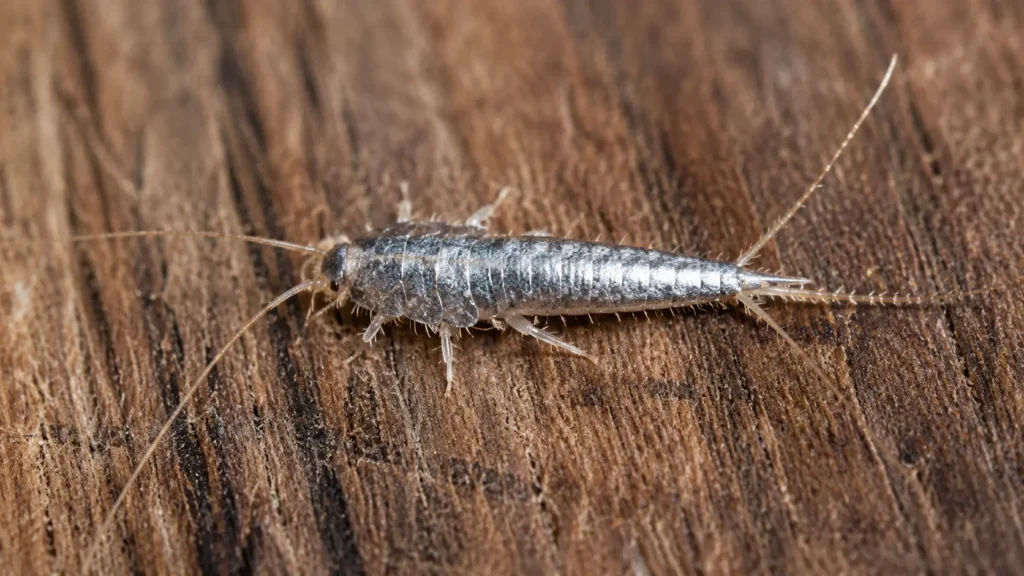
Quick ID Checklist:
Shiny silver-gray color
Flat, teardrop-shaped body
½ to ¾ inch long
Two long antennae
Three bristle tails at the rear
No wings
Very fast, fish-like movement
Silver fish vs. Look-Alike Bugs: How to Tell the Difference
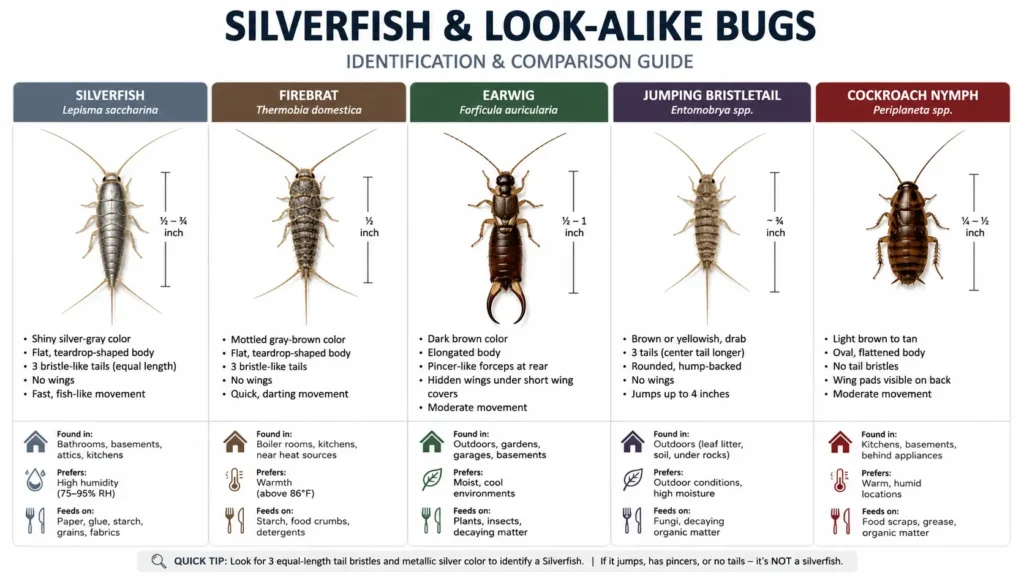
Silverfish get mistaken for other insects all the time. Here is a straightforward comparison to help you figure out what you actually found.
| Feature | Silverfish | Firebrat | Earwig | Jumping Bristletail | Cockroach Nymph |
| Color | Shiny silver-gray | Mottled gray-brown | Dark brown | Brown or yellowish, drab | Light brown to tan |
| Size | ½–¾ inch | ½ inch | ½–1 inch | ~¾ inch | ¼–½ inch |
| Tails | 3 bristles, equal length | 3 bristle tails | 2 curved pincers | 3 tails, the centre one longer | None |
| Wings | None | None | Yes, hidden under a shell. | None | None, still developing |
| Can jump? | No | No | No | Yes — up to 4 inches | No |
| Preferred temp | Cool to moderate | Hot, near ovens and dryers | Variable | Outdoor temperatures | Warm |
| Where found | Bathrooms, basements | Boiler rooms, kitchens | Outdoors, garages | Leaf litter and rocks outside | Kitchen, basement |
Jumping bristletails catch a lot of people off guard. They have three tails and move in a way that looks almost identical to silverfish. But there is one dead giveaway: if the bug you saw jumped, it was not a silverfish. Silverfish cannot jump at all. Jumping bristletails can leap up to 4 inches. They are also brownish-yellow instead of silver, and they carry a visible hump on their back. They live outdoors and rarely come inside. If you found the bug in your home, a silverfish is far more likely.
The firebrat (Thermobia domestica) is the most common indoor mix-up. It shares the same body shape and three-tailed look. The difference is colour and location. Firebrats are brown and mottled rather than silver, and they love heat. Look for them near furnaces, water heaters, and hot pipes — not in cool, damp bathrooms where silverfish live.
Earwigs are easy to rule out. They have two curved pincer-like claws at their rear end. Silverfish have three soft bristle tails. If you see pincers, it is an earwig, not a silverfish.
Cockroach nymphs may cause brief confusion too. But they are thicker in shape; they have no tail bristles, and they develop small wing pads along their back as they grow. That is a reliable way to separate them.
Types of Silverfish Found in the USA
Not all silver fish are the same species. A few types show up in American homes, and knowing the difference matters.
The common silver fish (Lepisma saccharina) is the one most people encounter. It is found all across the United States with no regional preference. Its body is a uniform silver-grey with no markings of any kind.
The grey silver fish (Ctenolepisma longicaudata) is larger and tougher than the common silverfish. It shows up most often in southern states where indoor humidity stays high year-round. It can survive for months without food, which makes it especially hard to get rid of once it has settled in.
The four-lined silverfish (Ctenolepisma lineata) has four faint lines running down the length of its back. It is less common in homes but does turn up in certain regions. Most homeowners will never encounter this species.
A firebrat (Thermobia domestica) is technically a close relative rather than a true silverfish. Pest professionals often group them together because they share similar habits and habitats. Firebrats prefer temperatures above 90°F and cluster near furnaces, boilers, and heating pipes.
Signs of Silver fish Even Before You See One
Silverfish are nocturnal. They hide all day and come out at night. Because of that, most people spot the damage silverfish leave behind long before they ever see the actual insect. Here is what to look for.
Irregular holes or etchings are the most common sign. Silverfish scrape and chew across the surface of paper and fabric. The damage looks like jagged little holes or scraped-out patches. Check the pages of books, the surface of wallpaper, and any stacked cardboard boxes in storage areas.
Yellow stains show up on fabric, linens, and paper. These come from silverfish droppings and the scales they shed as they move around. If you find faint yellowish marks on clothing or book pages with no obvious explanation, silverfish may be the cause.
Pepper-like droppings are tiny and easy to miss. They look like small black or dark brown specks, similar to ground pepper.
The outer skin regularly even after reaching adulthood. You might come across small, thin, translucent skins tucked into quiet corners, behind stored items, or near baseboards.
Holes in starched clothing are a specific and often overlooked sign. Silverfish do not eat fabric directly; they eat the starch applied to it. If you find unexplained holes in dress shirts, linen blouses, or starched garments, silverfish could be working through your closet at night.
Where to Find Silverfish in Your Home: Room by Room
Knowing what silverfish look like is step one. Knowing where to actually look for them is step two.
Silverfish stick to dark, undisturbed spaces with high humidity. They are active at night, so the best time to check is after dark when the house is quiet. Here is where to start.
Bathrooms are the number one hotspot in most homes. Moisture from daily showers and baths keeps humidity levels high enough for silverfish to thrive. Check under the sink, behind the toilet, inside cabinet corners, and along the base of the bathtub. Also look up. Silverfish can cling to walls and ceilings and have been known to drop from recessed light fixtures.
Basements and crawl spaces are prime silverfish territory. They are dark, cool, damp, and rarely disturbed — everything silverfish need. Walk the perimeter and check behind stored boxes, under old furniture, and near exposed pipes or floor drains. Cardboard boxes are particular. If your basement holds stacks of old newspapers, magazines, or books, start there.
Attics may surprise you, but they are a very common silverfish location, especially in older homes. Silverfish can enter through small roof gaps and nest inside insulation. If you are noticing silverfish on your main floor ceiling,
or dropping from overhead light fixtures, the infestation may be directly above you in the attic.
Kitchens attract silverfish because of both food and moisture. Check under and behind the refrigerator, below the sink, inside pantry corners, and behind the stove or dishwasher. Unsealed flour, oats, and cereal are easy targets. If you find small holes chewed through food packaging, silverfish are likely feeding there at night.
Laundry rooms combine warm air, appliance moisture, and starchy clothing — a combination silverfish find very appealing. Check behind the washer and dryer, along floor joints, and inside any clothing left piled on the floor.
Garages and storage areas are often where silverfish establish a foothold before spreading further into the home. They hide inside cardboard boxes, old books, and stacked paper. If you are carrying boxes in from a storage unit or garage, inspect them carefully before bringing them inside.
Quick Tip: Turn off every light in the room and wait 15 minutes. Then flip them all on at once. If silverfish are active, you will catch them out in the open before they scatter. It is the fastest way to confirm whether a room has a problem.
Why Silver fish Show Up in Homes: The Real Root Causes
Silverfish do not wander inside by accident. Something in your home is drawing them in. Understanding the real reasons behind an infestation makes it much easier to stop one.
High humidity is the biggest trigger. Silverfish need moisture to survive. They cannot live in dry air for long. Homes with leaky pipes, poor ventilation, or persistently high indoor humidity give silverfish exactly what they need. Bathrooms, basements, and attics are the most frequent problem areas.
Food sources keep them there. Silverfish eat starch and carbohydrates. Paper, book glue, wallpaper paste, dried grains, flour, sugar, and even dead insects are all fair game. A pantry with unsealed food or a bookshelf full of old paperbacks is an easy, reliable food supply.
New construction is a hidden trigger. Freshly poured concrete and new drywall hold significant moisture as they cure. Newly built homes can develop silverfish problems within the first few months for exactly this reason.
Cardboard boxes bring them inside. Silverfish frequently hitchhike into homes inside moving boxes, secondhand books, and furniture brought in from storage units or thrift stores. This is one of the most common and most overlooked entry routes. Always inspect items from outside storage before carrying them in.
Cracks and gaps give them a way in. Silverfish squeeze through small openings around pipes, window frames, and foundation cracks. Attached garages are one of the most common entry corridors. They tend to settle in the garage first, then work their way into the main living areas of the home.
Seasons drive them indoors. Silverfish activity increases noticeably in late summer and early fall. As outdoor humidity peaks and nighttime temperatures start to drop, silverfish move inside looking for stable warmth and moisture. If you are suddenly seeing them in August or September, the weather outside is likely pushing them in.
The Exact Conditions That Attract silverfish
Silver fish need very specific conditions to thrive, and knowing the numbers gives you a real advantage.
- Temperature: 70°F to 80°F is their ideal range. Development slows significantly below 60°F.
- Humidity: They thrive between 75% and 95% relative humidity. They cannot survive long-term below 50% relative humidity.
A dehumidifier is one of the most effective tools you can use against silverfish. Drop indoor humidity below 50% and you make your home hostile to them – even if food is still available. Pick up a basic hygrometer for under $15 at any hardware store and start monitoring the humidity in your basement and bathrooms.
The silverfish Life Cycle: No Metamorphosis at All
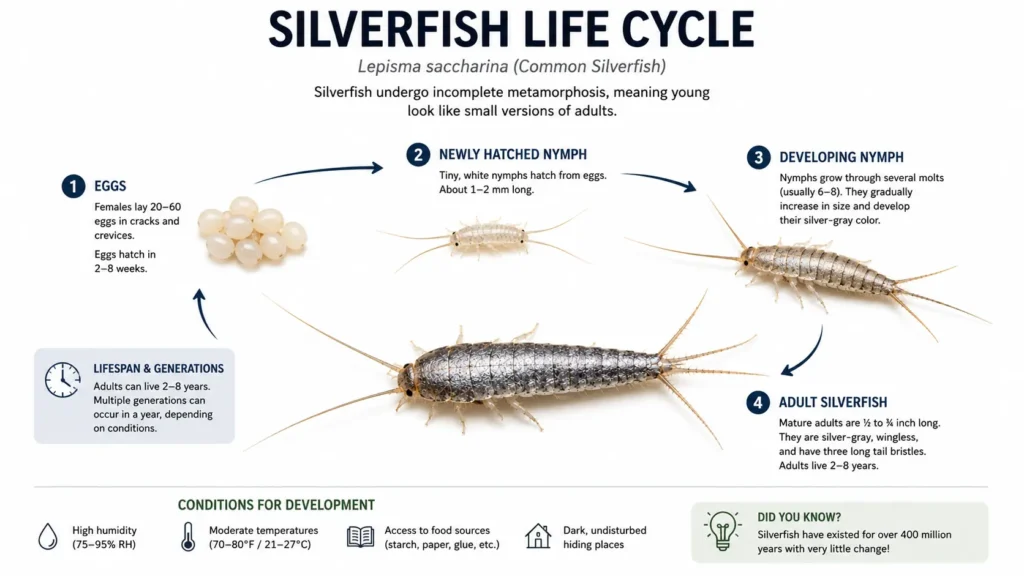
Most people are surprised to learn that silverfish go through no metamorphosis whatsoever. Butterflies, beetles, and most familiar insects transform dramatically from egg to larva to adult. Silverfish skip all of that.
The process is called ametabolous development. A baby silverfish hatches looking like a tiny version of the adult: same body shape, same three tails, same overall form. The only difference is size. There are no grubs, no larvae, no cocoons. What hatches is already recognisable as a silverfish.
Here is how the full life cycle plays out.
- Eggs: A female lays between 2 and 20 eggs at a time, hidden inside dark cracks and crevices around the home. Eggs hatch in 19 to 60 days depending on temperature and humidity. Warmer and wetter conditions speed up the process considerably.
- Nymphs: Hatchlings emerge white and soft. Over several moults they develop the silver metallic colour that makes adults easy to identify. They look like miniature adults from the very start.
- Adults: Silverfish reach full adulthood anywhere from 3 months to 3 years after hatching. The timeline depends heavily on temperature, humidity, and available food. Adults continue moulting for the rest of their lives, something almost no other insect does.
- Lifespan: Silverfish live a long time. Most reach 2 to 8 years of age, which is remarkable for a small insect.
One more detail worth knowing: silverfish can survive several months without food and up to 300 days if moisture is still available to them. Without humidity, however, they die quickly. This is why controlling moisture is more effective than simply removing food sources alone.
Are silverfish dangerous? Health and Allergy Risks
Silverfish do not bite. They do not sting. They do not carry diseases that affect people or pets. On that front, they are genuinely harmless.
But they are not entirely without risk either.
Allergies are a real concern in heavily infested homes. Silverfish constantly shed tiny scales as they move around. Those scales become airborne over time. In sensitive people, this can trigger sneezing, a runny nose, and skin irritation. People with existing asthma or dust allergies may notice their symptoms getting noticeably worse.
Property damage is where silverfish cause the most real harm. Books, important documents, old photographs, wallpaper, and delicate fabrics are all at risk. The damage builds slowly and quietly — which is why so many infestations go unnoticed for months or even longer.
Food contamination is also a concern. Silverfish chew through cardboard packaging to reach grains, flour, oats, and cereal. Any food they have accessed should be thrown away. They leave droppings behind in food that you do not want to consume.
The honest bottom line: silverfish will not hurt you directly. But left unchecked, they will damage things you care about and may worsen allergies in your household over time.
Frequently Asked Questions
Q: Is “silver fish” (two words) the same as “silverfish”?
Yes. “Silver fish” and “silverfish” are the same insect. Many people type it as two words out of habit. Either way, the search leads to the same household bug Lepisma saccharina.
Q: Why do I suddenly have silver fish in my home?
A sudden appearance usually means something changed with moisture levels in your home. Check for leaking pipes under sinks, poor ventilation in the attic or basement, or recent changes like a move or renovation. New cardboard boxes and secondhand items can also bring them in.
Q: Do silver fish bite humans?
No. silverfish cannot bite people or pets. They simply do not have the mouthparts for it. They are a nuisance pest — not a physical threat.
Q: Can silver fish cause allergies?
Yes, in some people. The tiny scales silverfish shed constantly can become airborne allergens. People with existing respiratory sensitivities or asthma may notice increased irritation in a home with a heavy infestation.
Q: What do silver fish eat in my house?
Silver fish eat anything that contains starch or carbohydrates. That includes paper, book glue, wallpaper paste, clothing, flour, oats, cereal, sugar, and even dead insects. They are not picky feeders.
Q: How long do silverfish live?
Most silver fish live between 2 and 8 years. They also continue moulting throughout their entire adult lives — which is genuinely unusual among insects.
Q: What do baby silverfish look like?
Baby silver fish look exactly like small adults from the moment they hatch. They start out white and soft, then develop their silver colour after a few moults.
Q: Where are silver fish most commonly found in US homes?
Bathrooms, basements, attics, laundry rooms, and kitchens are the most common locations. They prefer dark, damp, undisturbed spaces where food sources are close by.
Q: Are silver fish found all across the USA?
Yes. Silverfish live in all 50 states. They are especially common in warm, humid southern states like Florida, Texas, and Louisiana, where indoor humidity stays high. In drier climates, they tend to cluster near moisture sources like pipes and HVAC systems.
Q: Can silver fish spread between apartments?
Yes, they can. Silverfish move through shared wall voids, pipe gaps, and electrical conduits between connected units. A neighbouring infestation can easily reach your apartment. This is one reason apartment problems are often harder to fully eliminate than those in standalone homes.
Q: What kills or deters silver fish most effectively?
Reducing indoor humidity below 50% is the single most effective step. Beyond that, storing dry food in airtight containers, clearing cardboard clutter, and sealing cracks around pipes and baseboards removes both their shelter and food supply. For active infestations, diatomaceous earth applied into crevices is a widely recommended starting point before considering professional treatment.
What I Have Learned About silver fish And What You Should Take Away
When I first started studying household pests, silverfish were the last insects I took seriously. They do not bite, they do not spread disease, and they vanish the moment a light comes on. That attitude cost me time and I have watched it cost homeowners far more.
Here is what years of experience taught me: silverfish are not a crisis, but they are always a signal. One silverfish in your bathroom means conditions somewhere in your home are right for them to survive and multiply. Catch it early, and the fix is often simple.
I have seen homeowners solve a silverfish problem with nothing more than a dehumidifier and a few sealed food containers. I have also seen infestations buried deep inside wall voids and insulation that no DIY spray could ever reach. The difference between those two situations is almost always how quickly the problem was identified.
You now know the shiny silver body, the three bristle tails, and the damage signs that show up before you ever see the bug itself. You know which rooms to check, which exact conditions to fix, and what draws them inside your home in the first place. That knowledge puts you well ahead of most people sharing their space with these 400-million-year-old survivors.