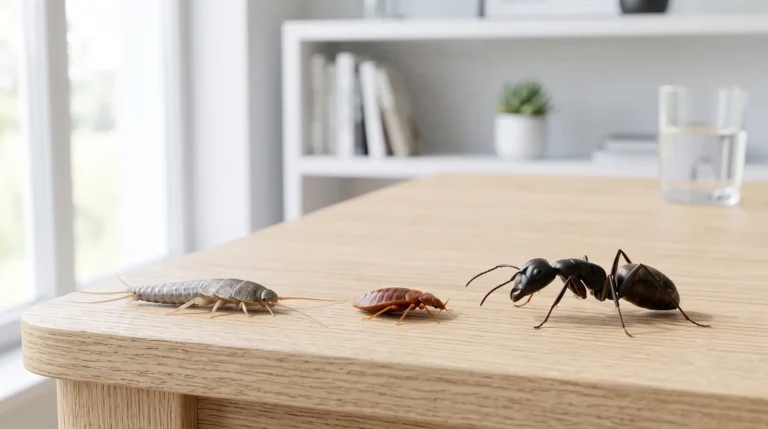
How to Get Rid of Cockroaches: Baits, Killers, and When to Hire an Exterminator (2026)
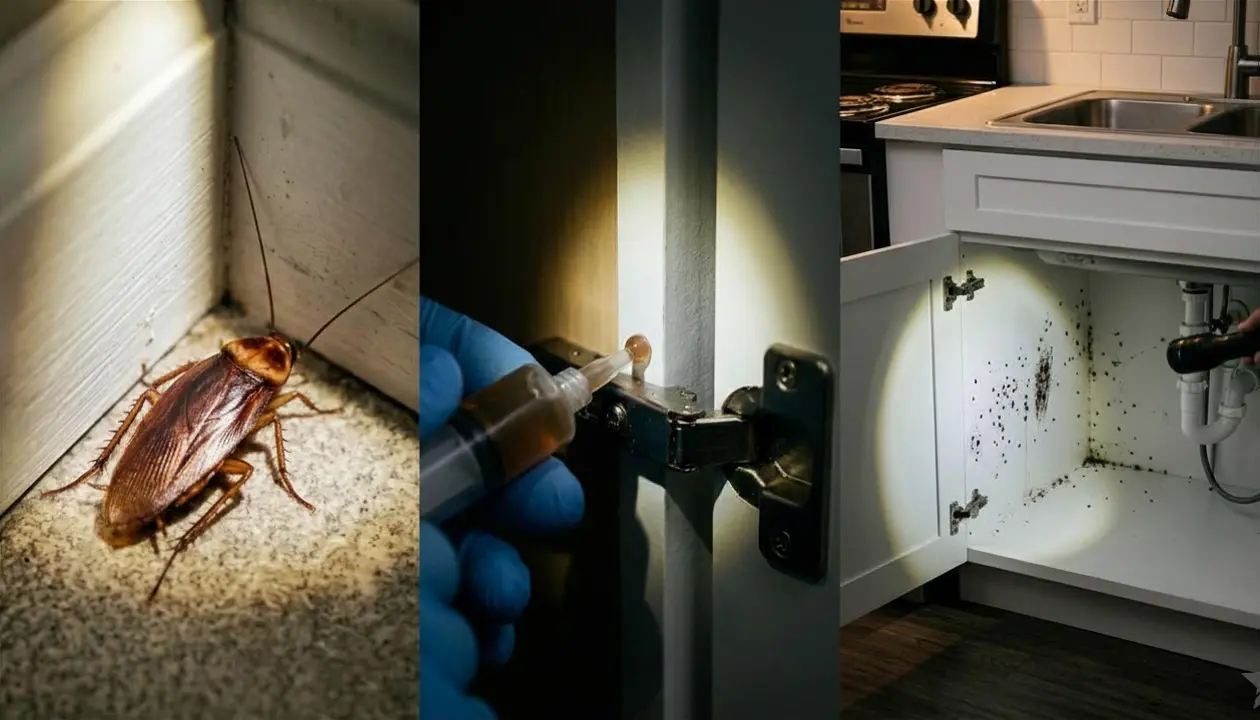
The most effective way to get rid of cockroaches is a multi-step approach: start with a cockroach gel bait like Advion, add boric acid in wall voids and behind appliances, and layer in an insect growth regulator (IGR) to stop reproduction. If you’re still seeing roaches after 3–4 weeks of consistent treatment, or if you spot them during the day, it’s time to call a professional exterminator.
It is very important to get rid of Advion cockroach gel bait.
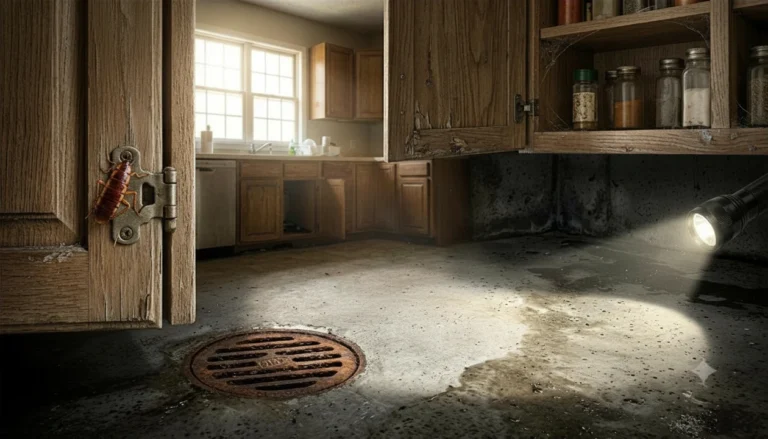
I still remember the first time I opened a kitchen cabinet at a rental apartment and watched three cockroaches scatter in different directions – that instant mix of disgust, panic, and complete helplessness. I grabbed a can of Raid, sprayed every surface I could see, and thought I’d handled it. Two days later they were back, and a week later there were more of them than before.
That experience is exactly what brings most people to this page. Over time, working alongside licensed pest control operators and studying the entomology behind why certain products succeed while others fail, I learned that almost everything the average person does first – the foggers, the surface sprays, the roach bombs – is not just ineffective but often actively counterproductive. This guide exists to give you the right approach from the very first step, backed by evidence, professional input, and hard-won experience.
How to Assess Your Infestation Before You Buy Anything
Before you spend a dollar on any product, take ten minutes to actually understand what you’re dealing with. The treatment that works for three roaches under a sink is completely different from what a full-blown multi-room infestation needs, and guessing wrong means wasted money, wasted weeks, and a colony that keeps quietly growing while you think you’re handling it.
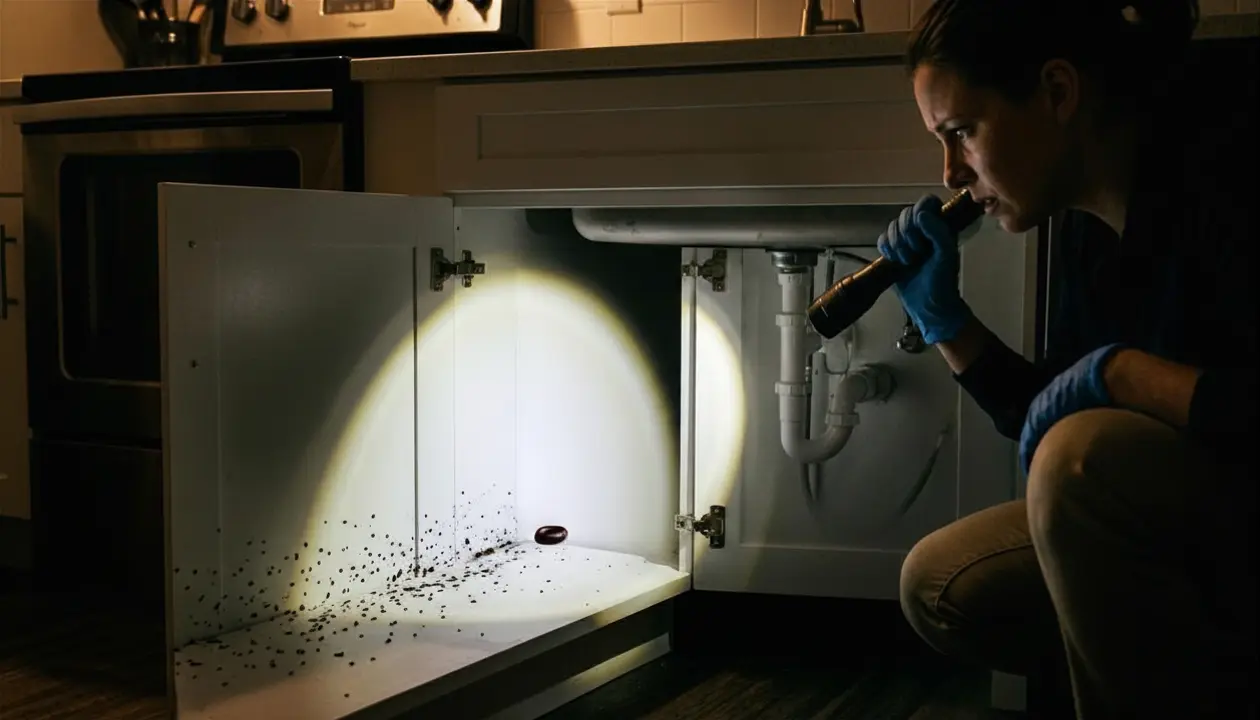
Grab a flashlight after dark and look for the real signs: fecal deposits (tiny dark specks or smear marks along baseboards), shed skins, and egg cases tucked behind appliances. What you find tells you far more than how many roaches you’ve actually spotted.
Minor Infestation: You’ve seen 1–5 roaches, always at night, always in one spot. No egg cases, no smell. This is the best-case scenario and very manageable with the right DIY approach.
Moderate Infestation: Roaches are showing up regularly at night across more than one room. You’ve found shed skins or dark smear marks and possibly an egg case or two behind the refrigerator or under the stove. Still very much DIY territory, but you need a real protocol — not just a product.
Severe Infestation: You’re seeing roaches during the day. That’s the line. Cockroaches are nocturnal, so when they’re out in daylight, it means the population has grown large enough that they’re being pushed out of their harborage zones by sheer numbers. You’re also noticing a faint musty or oily smell, finding egg cases in multiple locations, and spotting them in rooms beyond the kitchen and bathroom. At this point, DIY alone is unlikely to be enough.
German Cockroach vs. American Cockroach: Why It Changes Your Entire Strategy
Most guides treat all cockroaches as interchangeable. They’re not — and knowing which species you’re dealing with directly affects which products you prioritise and where you apply them.
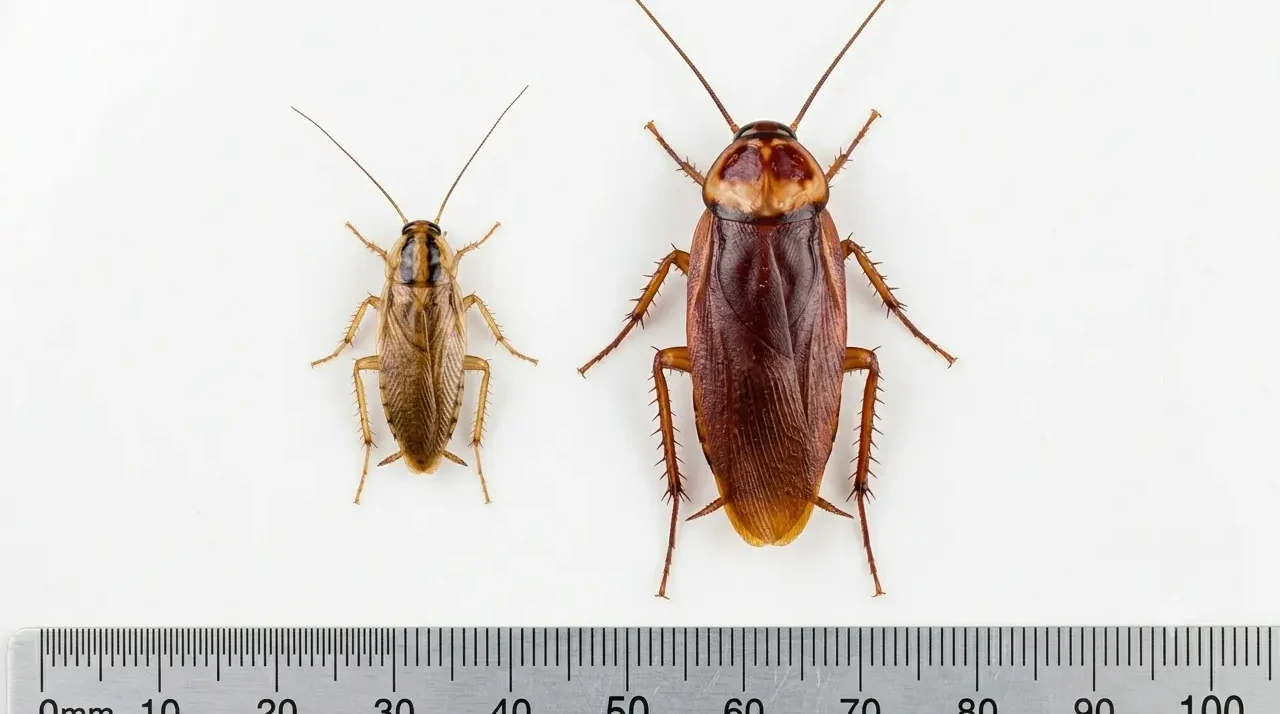
German cockroaches are small, tan, and have two dark stripes running behind their head. These are the ones taking over your kitchen and bathroom, and they are almost always an indoor infestation that arrived on a cardboard box, a bag of groceries, or a secondhand appliance. They reproduce at a staggering rate — a single female and her offspring can produce tens of thousands of descendants within a year due to their rapid 8–12 week life cycle. Gel bait placed precisely in cracks and crevices is your primary weapon here.
American cockroaches are much larger, reddish-brown, and typically around 1.5–2 inches long. They’re not really “house” roaches in the same way; instead, they come in from outside through drains, foundation gaps, and utility penetrations, and they prefer warm, damp areas like basements, crawlspaces, and sewer lines. If you’re only treating the inside of your home and dealing with American roaches, you’re missing half the problem. You need perimeter treatment with outdoor granules and barrier spray to cut off the entry points alongside whatever you’re doing inside.
Infestation Severity to Recommended Action: Quick Reference
| Severity Level | What You’re Seeing | Recommended First Action | DIY or Pro? |
|---|---|---|---|
| Level 1 Trace | 1–3 roaches, nighttime only, one room | Gel bait in kitchen + boric acid under appliances | DIY high success rate |
| Level 2 Minor | Regular nighttime sightings, 1–2 rooms, no egg cases | Gel bait + IGR + sanitation protocol | A DIY systematic approach required |
| Level 3 Moderate | Multiple rooms, shed skins, occasional egg cases, faint odor | Full 4-week protocol: gel bait + boric acid + IGR | DIY first, professional if no improvement in 4 weeks |
| Level 4 Severe | Daytime sightings, multiple egg cases, kitchen AND bedroom affected | Call an exterminator; DIY is unlikely to resolve | Professional treatment required |
| Level 5 Critical | Heavy daytime activity, widespread throughout home, allergy/asthma symptoms | Emergency professional treatment; do not delay | Professional only |
The Best Cockroach Killers: A Complete Product Guide
Walk into any hardware store and the pest control aisle will offer you about fifteen different options, all of which claim to eliminate roaches fast. Most of them won’t solve your problem. The right product depends entirely on your infestation size, the species you’re dealing with, and whether you have kids or pets in the home, and knowing which tool does what is what separates a resolved infestation from a recurring one.
Cockroach Gel Bait: The Most Effective DIY Product Available
Ask any pest control professional what the single best consumer product for cockroach control is, and almost all of them will say gel bait. Not because it kills roaches the fastest (it doesn’t), but because it’s the only product that reaches the colony you can’t see.
Here’s why it works when everything else doesn’t: roaches eat the bait, return to the colony, and spread the active ingredient to dozens of other roaches through contact, droppings, and cannibalism before they die. That cascading secondary kill effect is what wipes out the hidden population, not just the individuals you happen to spot.
The delayed kill is not a flaw. It’s the entire mechanism. A roach that dies within minutes never makes it back to the nest. The goal is a slow-acting insecticide that gives an exposed roach enough time to infect the rest.
Top Gel Bait Products Compared:
| Product | Active Ingredient | Best For | Price Range | Pet Safety |
|---|---|---|---|---|
| Advion Cockroach Gel Bait | Indoxacarb 0.06% | All species, bait-averse roaches | $30–$40 (4 tubes) | Low toxicity when placed correctly |
| Combat Max Defense Gel | Fipronil | German cockroaches in apartments | $10–$15 | Low toxicity in small placements |
| Invict Gold Cockroach Gel | Imidacloprid | German roaches, resistant populations | $25–$35 | Low toxicity when placed correctly |
| Maxforce FC Magnum | Fipronil | Heavy infestations, commercial use | $35–$50 | Use with caution around pets |
Advion Cockroach Gel Bait: Full Deep Dive
Advion is the product that comes up most consistently among both pest control professionals and experienced DIYers, and it earns that reputation. Its active ingredient, indoxacarb (0.06%), works through a mechanism called ‘bioactivation’. Once a roach ingests it, its own digestive enzymes convert it into a more potent form that disrupts the nervous system, causing paralysis and death within 24–72 hours. That lag is what makes it so effective at colony elimination. Research has shown that a single roach exposed to Advion can kill up to 54 additional roaches through secondary transmission before dying.
How to apply it correctly, because this is where most people go wrong:
Bigger is not better with gel bait. You want precise, small placements in the exact spots where roaches travel, not open areas where the gel dries out in hours and never gets found.
- Apply pea-sized dots (roughly 0.5g, about ¼ inch across) directly into cracks, crevices, and tight edges, not on open surfaces.
- Light to moderate infestations: 1–3 dots per 10 linear feet
- Heavy infestations: 3–5 dots per 10 linear feet
- Best placement locations: inside cabinet hinges, along the back wall of under-sink cabinets, behind the refrigerator, inside the motor housing of appliances, along the seam where the stove meets the wall, and behind outlet covers in kitchens and bathrooms
- Never spray anything near the bait. Pyrethroid-based sprays leave a repellent residue that drives roaches away from the treatment area entirely; it’s one of the most common reasons gel bait fails.
- Clean surfaces with water only before applying chemical cleaners; leave residue that competes with the bait’s attractant. The bait needs to be the most appealing thing in that cabinet.
- Check placements every 12–24 hours in the first week. ‘Consumed bait’ means roaches are feeding and the treatment is progressing; reapply immediately. Bait that hasn’t been touched after a few days usually means wrong placement or a nearby competing food source.
What to expect: Dead roaches start appearing within 24–48 hours. Visible population reduction usually happens within 3–7 days. Complete colony elimination for a moderate kitchen infestation typically takes 2–4 weeks. One four-tube box is usually enough for a single-room moderate infestation. For multi-room problems, grab two.
Opened tubes stay effective for up to 12 months stored in a cool, dry place. Sealed tubes last 2–3 years.
Boric Acid: Old-School, Underrated, and Incredibly Effective
Boric acid has been used for cockroach control since the 1940s, and it still belongs in any serious treatment protocol, but only if you apply it correctly. Most people who write it off as ineffective applied it incorrectly.
When cockroaches walk through boric acid dust, the particles cling to their bodies, penetrate the exoskeleton, and disrupt both the nervous system and digestive tract. Contaminated roaches bring it back to the harborage, where grooming spreads it to the rest of the colony. A 2004 study published in the Journal of Economic Entomology found that boric acid solutions achieved up to 95–100% mortality in German cockroach populations under laboratory conditions.
The application rules that actually matter:
- The dust layer should be almost invisible to the naked eye. If you can see a white powder, you’ve put down too much. Thick piles are actually repellent to cockroaches, which is exactly the opposite of what you want.
- Use a bulb duster or puffer bottle for controlled, precise application into wall voids, behind appliances, and along the inside of cabinet bases.
- Keep it dry. Moisture destroys its effectiveness completely.
- Best locations: inside wall voids around pipe penetrations, under and behind the stove and refrigerator, inside the hollow legs of kitchen cabinets, and in crawlspaces
- Keep it well away from any surface pets or children can reach
One honest limitation: boric acid doesn’t affect eggs. As new nymphs hatch, you’ll need to maintain the treatment. It works best as a complementary layer alongside gel bait, not as a standalone solution.
Insect Growth Regulators (IGRs): The Most Underused Tool in Consumer Pest Control
This is the category that almost no mainstream consumer advice talks about, and it’s the difference between a treatment that works long-term and one that keeps cycling through the same problem every few months.
IGRs don’t kill roaches directly. What they do is far more strategically powerful; they mimic the juvenile hormones that regulate cockroach development, preventing nymphs from ever maturing into reproductive adults. Exposed nymphs either die during moulting, develop into sterile adults, or produce non-viable eggs. The reproductive cycle collapses. Combined with gel bait that’s killing the current adult population, an IGR cuts off the next generation at the same time, and that combination is what makes a treatment stick.
Products worth using:
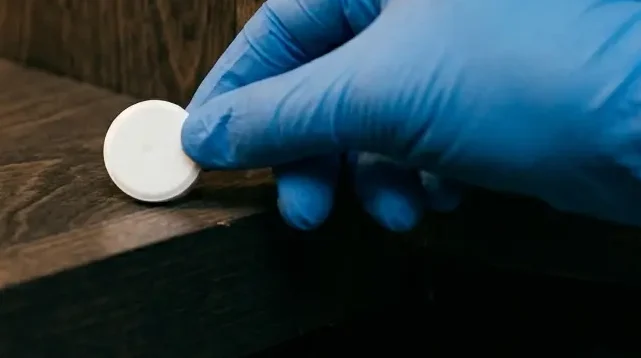
- Gentrol Point Source IGR (hydroprene) small discs placed inside cabinets and under appliances; effective for around 3 months with no mixing or spraying required.
- Nylar (pyriproxyfen) spray applied directly into cracks, voids, and harborage areas.
- Zoecon Precor IGR (methoprene) liquid concentrate mixed with water and sprayed into cracks and crevices.
For any infestation beyond trace level, pairing an IGR with your gel bait should be standard practice. It’s the step that most DIYers skip, and it’s frequently the reason their treatment works initially but doesn’t hold.
Cockroach Sprays, Dusts, and Bait Stations: When to Use Each
Residual sprays like Ortho Home Defense or Suspend SC lay down a treated surface that kills roaches on contact for weeks to months. They’re useful for perimeter treatment around exterior entry points, along baseboards in non-kitchen areas, and in garages. The critical rule: never apply them in the same zones where your gel bait is placed. The repellent properties will drive roaches away from the bait and undermine everything else you’ve done.
Bait stations like Combat Max or Raid Double Control house pre-loaded gel inside a plastic shell. They’re convenient and safer around children than exposed gel, but the housing limits roach access and makes them significantly less effective than direct crack-and-crevice application. Use them as a supplement in lower-traffic areas or as a maintenance tool once the primary infestation is resolved.
Food-grade diatomaceous earth works through the same physical mechanism as boric acid, damaging the exoskeleton and causing dehydration, but it’s completely non-toxic to mammals, making it a solid choice in pet-heavy homes. Apply the same way as boric acid: near-invisible thin layer in concealed areas only.
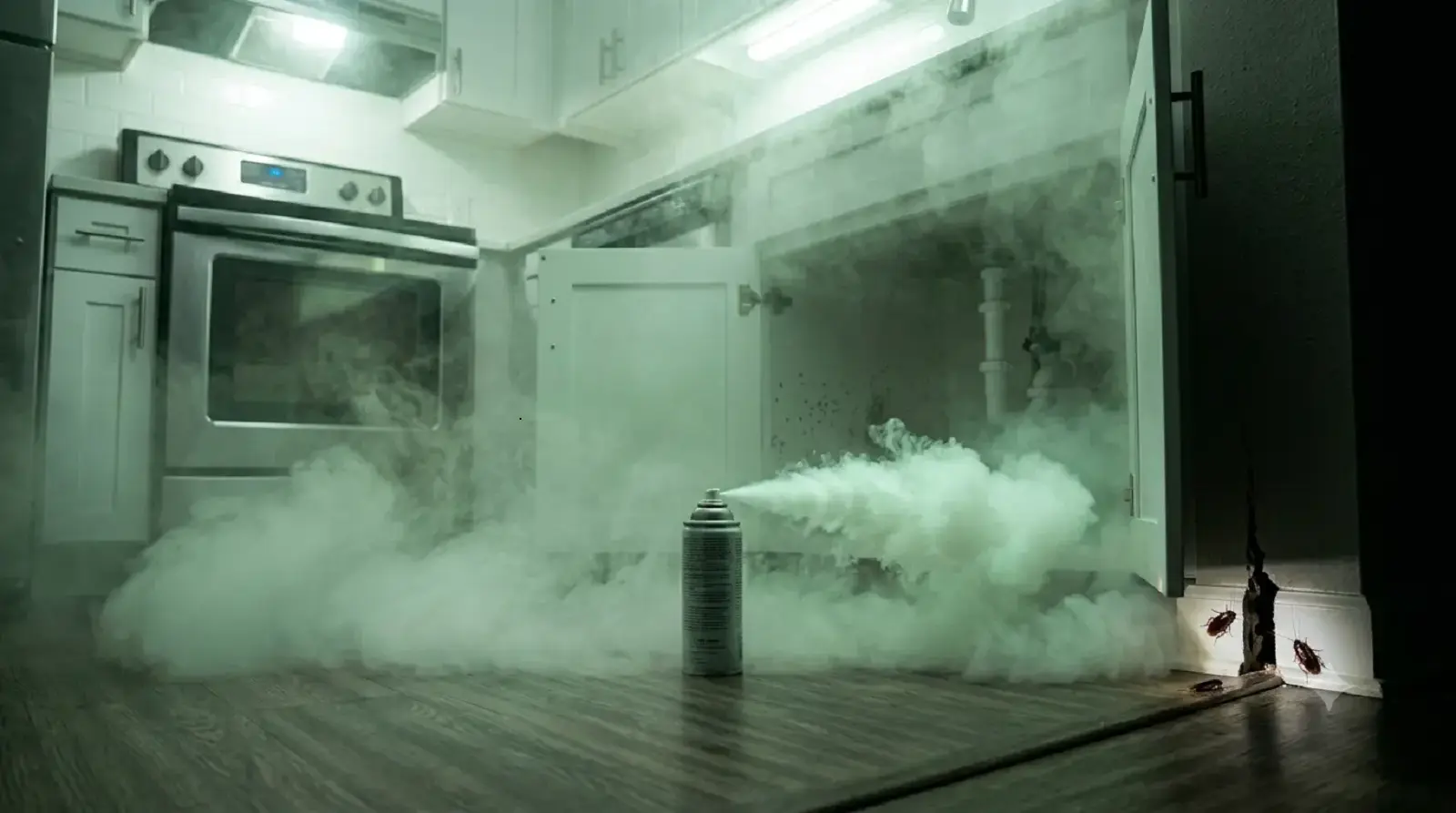
Foggers and roach bombs just don’t work. When cockroaches sense the chemical fog, they retreat deeper into wall voids and harborage areas, completely out of reach of the product. The fog dissipates, the roaches come back out, and you’ve now contaminated your kitchen surfaces with pyrethroid residue that will repel any gel bait you try to place afterwards. They don’t address the colony. They make the problem harder to treat. In apartments, they can push roaches through wall voids into neighbouring units.
Best Cockroach Killer for Homes with Pets and Kids
This question comes up constantly, and most articles give it a one-sentence answer. Here’s a proper breakdown.
Safest options, ranked:
- Food-grade diatomaceous earth: No chemical toxicity to mammals at all. Safe near pets when applied as fine dust in enclosed, inaccessible spaces.
- Boric acid (placed correctly and out of reach): Low mammalian toxicity at the tiny quantities used in pest control. Keep away from pet feeding areas and any floor surface pets walk on frequently.
- Advion gel bait (correctly placed): The EPA classifies indoxacarb at 0.06% as reduced-risk. The safety is entirely in the placement: tiny dots inside cabinet hinges, inside appliance housings, in crevices that pets and children physically cannot access.
- Gentrol IGR discs: Very low mammalian toxicity. Place inside enclosed cabinets and leave them.
- Bait stations: The plastic housing significantly reduces the chance of direct contact versus open gel placements.
Avoid around pets and children: concentrated pyrethrin and pyrethroid sprays, fipronil in any open application format, and all foggers and bombs without exception.
The 4-Week DIY Cockroach Elimination Protocol
The biggest mistake people make is applying products randomly and hoping for the best. A structured approach where each step builds on the last is what actually resolves an infestation. Here’s the exact sequence.
Day 1–2: Preparation. Inspect the full kitchen and bathroom after dark with a flashlight. Map every harborage zone; look for fecal deposits, shed skins, and egg cases. Then remove every competing food source: wipe all surfaces with water only, seal dry goods in airtight containers, fix any leaking pipes under sinks, and clean the grease from the back of the stove. This step isn’t optional. Skipping it is the most common reason gel bait fails.
Day 3: Deploy Gel Bait. Apply your gel bait in pea-sized dots at every identified harborage point. Kitchen first: inside cabinet hinges, behind and under the refrigerator, along the back wall of under-sink cabinets, inside the stove drawer, and around the dishwasher. Do not spray anything else in these areas. Leave it alone.
Day 5–7: Add Boric Acid and IGR. Apply a near-invisible layer of boric acid dust into wall voids, behind large appliances, and anywhere gel bait can’t realistically be placed. Install IGR discs inside cabinets or apply IGR spray into cracks and crevices. Then check your gel bait placements. Consumed bait is progress; reapply immediately. Untouched bait needs to move closer to confirmed roach activity.
Week 2: Assess and Adjust. Roach activity should be visibly declining by now. If bait placements are still untouched, there’s a competing food source nearby, or the placement is too exposed. Move it into a tighter crack. Reapply all consumed bait and do a second sanitation pass under and behind appliances.
Week 3–4: Reinforce and Monitor. Refresh gel bait in active zones. Make sure boric acid in enclosed areas is still dry. Place sticky trap monitors along baseboards to track population decline; this tells you whether your treatment is working or plateauing. A successfully treated moderate infestation should show an 80–90% drop in activity by the end of week four.
If you’re still seeing significant activity at the end of week four, keep reading.
Why Your Gel Bait Might Not Be Working
This is one of the most searched questions in cockroach control, and none of the top-ranking articles address it properly. If your gel bait isn’t producing results, one of these five things is almost certainly the reason.
Competing food sources. This is the number-one cause of bait failure, and it’s entirely within your control. If roaches have access to grease behind the stove, crumbs under the refrigerator, or residue in the dishwasher filter, the bait is just another option, not the only one. Thorough sanitation before placement is non-negotiable.
Chemical contamination. Pyrethroid residue from a spray applied days or weeks ago can remain repellent for a long time. If you’ve recently sprayed the kitchen, roaches have been chemically trained to avoid that zone. Don’t try to place bait there. Move to untreated areas and let the residue dissipate.
Bait aversion. German cockroach populations with repeated exposure to glucose-based baits over generations can develop a genetic aversion to sweet attractants. If your infestation has been partially treated before with standard baits, this may be a factor. Switch to Advion or Invict Gold; both are formulated specifically to attract glucose-averse populations.
Wrong placement. Cockroaches have a strong behavioural tendency called ‘thigmotaxis’; they prefer tight spaces where their bodies touch surfaces on multiple sides. Bait placed on open shelves or in the centre of cabinet floors won’t get the same feeding activity as bait tucked directly into a hinge, crack, or crevice. Move every placement into a tighter spot.
The infestation is too large for bait alone. In a severe infestation, the colony can consume bait faster than you can replenish it, and the reproduction rate outpaces any secondary kill effect. If you’re going through bait at an unsustainable rate with no sign of population decline, that’s not a product problem. That’s a signal that professional intervention is the right next call.
When to Hire an Exterminator for Cockroaches: An Honest Decision Guide
Most articles mention calling an exterminator as a brief afterthought at the end, almost like a disclaimer. It deserves more than that because knowing when to stop DIY-ing is one of the most practical decisions you’ll make in this process.
5 Signs You Should Call a Professional
1. You’re seeing roaches during the day. This is the clearest signal available. Roaches are nocturnal. Daytime sightings mean the population has grown large enough that they’re being pushed out of their harborage zones by competition for space. That’s a dense colony.
2. Two full rounds of systematic DIY treatment haven’t moved the needle. If you’ve followed a proper gel bait, boric acid, and IGR protocol for four to six weeks and the infestation hasn’t clearly declined, you’re dealing with something consumer products can’t reliably reach, whether that’s a massive population, deep wall void colonies, or resistance issues.
3. Roaches are showing up in bedrooms. When cockroaches spread beyond the kitchen and bathroom, the harborage zones are overcrowded. Multi-room infestations indicate a large, well-established colony that has outgrown its original nesting area.
4. You’re regularly finding egg cases. A German cockroach ootheca holds 30–40 eggs and hatches in approximately 28 days. Finding multiple cases means the reproductive rate is actively outpacing your control efforts; the colony is growing faster than you’re eliminating it.
5. Someone in your household is experiencing worsening allergy or asthma symptoms. Cockroach allergens, shed skins, faeces, and decomposing body parts are a clinically documented asthma trigger, particularly in children. At this point, the infestation has crossed from a nuisance problem into a health problem, and professional elimination becomes the priority regardless of cost.
What Does a Professional Cockroach Exterminator Actually Do?
Most people assume exterminators just use stronger versions of the same sprays you can buy at the store. The reality is that the professional advantage is less about the products and far more about access and precision.
A licensed pest control operator (PCO) begins with a thorough structural inspection — inside wall voids using specialised equipment, under subfloor access points, inside electrical panels, and within appliance housings. That inspection locates the primary harborage zones that no homeowner can realistically reach or even see.
Then they treat those zones directly. A professional treatment typically includes the following: professional-grade gel baits applied to 50–100 precision-targeted locations throughout the entire structure; insecticidal dust injected directly into wall voids through drill holes or existing gaps; true non-repellent residual insecticides like Phantom (chlorfenapyr) or Termidor SC products that roaches cannot detect and walk straight through, carrying the active ingredient back to the nest; systemic IGR applications; and crack-and-crevice treatment with specialised injection tips that reach deep into voids no syringe tip can access.
The bottom line: a PCO treats the 90% of the colony that lives in places you cannot reach. That is the professional advantage.
Cockroach Exterminator Cost in 2026: What You’ll Actually Pay
| Infestation Level | Treatment Type | Typical Cost Range |
|---|---|---|
| Minor (1–2 rooms, early stage) | One-time treatment | $100–$300 |
| Moderate (multi-room, established) | One-time + follow-up | $300–$600 |
| Severe (whole home, long-term) | Multiple treatments | $600–$1,500 |
| Extreme (fumigation required) | Tent fumigation | $1,500–$7,500+ |
| Ongoing prevention plan | Monthly visits | $40–$80/month |
| Ongoing prevention plan | Quarterly visits | $100–$200/quarter |
A few things that push costs higher: larger square footage, multi-unit buildings, German roaches (which are significantly harder and more resource-intensive to eliminate than American roaches), and geography. Metro areas like New York, Los Angeles, and Miami typically run 20–30% above national averages.
Is it worth the money? For a minor infestation, honestly no, a $35 pack of Advion and a disciplined protocol will handle it. For moderate to severe infestations, the math shifts. Multiple rounds of DIY products, food that needs to be thrown out, and weeks of continued health exposure from an unresolved infestation frequently add up to more than a single professional treatment would have cost from the start.
One-Time Treatment vs. Ongoing Pest Control Plan
A one-time treatment makes sense when the infestation is clearly localised, you’ve identified and sealed the entry point, and there are no structural risk factors for reinfestation.
An ongoing plan is the smarter call when you’re in a multi-unit building where neighbouring units can keep reintroducing roaches; when you live in a warm, year-round climate like Florida, Texas, Louisiana, or Arizona, where cockroaches never really go dormant; or when you’ve had recurring infestations that keep returning after single treatments. Many national companies offer annual plans running $400–$1,100 that include quarterly visits and retreatments as needed. For high-risk homes, this is frequently more cost-effective than paying for repeated one-off treatments.
Terminix, Orkin, or a Local Exterminator: How to Choose
National chains like Terminix, Orkin, and Rentokil offer standardised protocols, easy online scheduling, and service guarantees that give you real recourse if the problem returns. The trade-off is that technician quality varies significantly between franchise locations, and you sometimes get a newer tech following a script rather than an experienced inspector reading your specific situation.
Local, independent PCOs often invest more time in the inspection, customise the treatment more precisely to your species and floor plan, and are generally more accountable because their reputation is local. For complex or severe infestations, a local specialist with specific cockroach experience is frequently the better call.
Regardless of who you hire, look for these non-negotiables: state licensing (verify through your state’s Department of Agriculture or Structural Pest Control Board), a written treatment plan provided before you sign anything, a service guarantee with clear retreatment provisions, and an IPM-based approach rather than blanket spraying. Get at least two quotes. On severe infestations especially, the cheapest option is rarely the most cost-effective one.
Cockroaches in Apartments: Why the Rules Are Different
If you’re in an apartment, condo, or any multi-unit building, the standard cockroach playbook needs a significant adjustment, and understanding this explains why so many apartment residents treat the same infestation on repeat without ever actually solving it.
The core problem is structural. Walls, plumbing chases, and utility conduits in multi-unit buildings physically connect your unit to every neighbouring one. Even a textbook-perfect DIY treatment that eliminates every roach in your apartment can be undone within weeks if a heavily infested neighbouring unit is pushing roaches through shared wall voids and pipe gaps. That’s not a treatment failure. It’s a building problem that no consumer product can permanently solve without coordinated, building-wide action.
That changes your goal. In a standalone home, you’re aiming for total elimination. In an apartment, the realistic and correct goal is continuous suppression and exclusion. Here’s what that looks like in practice:
- Maintain fresh gel bait placements monthly in the kitchen and bathroom indefinitely. Think of it as a permanent interception system rather than a one-time treatment. Any roach that enters from next door encounters the bait before it can establish a new presence.
- Seal every pipe penetration under sinks and behind toilets with fire-rated caulk or tightly packed steel wool before caulking. These penetrations are the primary roach highway between units in most buildings.
- Install door sweeps on your front door and on any door connecting to a shared hallway, laundry room, or utility space.
- Use sticky trap monitors along walls where pipes enter from neighbouring units. This tells you whether roaches are actively coming through so you know whether the problem is yours to manage or one that requires building management intervention.
- If you find active harborage in shared building areas, trash rooms, laundry rooms, and utility closets, document it and formally request building-wide treatment in writing. In most U.S. jurisdictions, shared-area pest control is a management responsibility.
On product choice for apartments: gel bait is specifically right for apartment use because it produces no aerosolisation, leaves no surface residue that could drift to neighbours, and does not require vacating the unit. Foggers and bombs are a particularly bad choice in apartment settings. Beyond being ineffective, they actively push roaches through wall gaps into neighbouring units and often violate lease terms.
Landlord vs. Tenant: Who Is Responsible for Cockroach Extermination?
This is one of the most searched questions among renters, and the answer isn’t always straightforward; it depends on your state, your lease, and the origin of the infestation.
The general legal framework: Most US states include pest control under the implied warranty of habitability, which is the landlord’s legal obligation to maintain a liveable rental unit. If cockroaches were present before you moved in, or if they’re entering through structural deficiencies in the building like broken pipe seals, foundation gaps, or infested neighbouring units, the landlord is responsible for the extermination cost.
When the tenant bears responsibility: If the infestation can be clearly traced to tenant behaviour, such as consistently leaving food out, failing to dispose of garbage, or bringing in infested furniture or boxes, a landlord can argue in some states that the tenant created the condition. In practice, this is difficult to prove and rarely pursued for a standard cockroach complaint.
Practical steps if you’re a renter dealing with this:
Submit a written notice to your landlord or property manager documenting the infestation. Include the date, photos, and a description of where and when you observed the roaches. Keep a copy for yourself. Written notice creates a legal record and starts the clock on the landlord’s response obligation. Most states require a response within 14–30 days for habitability issues.
If your landlord doesn’t respond within that window, most states offer remedies including rent withholding, rent escrow, or repair-and-deduct options, but the procedures vary significantly by state, so consult a tenant rights organisation or attorney before acting on any of them. Do not withhold rent without legal guidance regardless of how bad the infestation is. Improper rent withholding can expose you to eviction proceedings independent of the underlying issue.
If you’re in public housing or a federally subsidised unit and management is non-responsive to written notice, file a complaint with your local HUD field office.
In shared lease situations, if a roommate’s behaviour is the clear contributing cause, the tenant responsible typically bears the treatment cost under most standard lease agreements.
After Treatment: How to Prevent Cockroaches from Coming Back
Resolving an infestation and preventing the next one are two different jobs. Whether you handled it yourself or brought in a professional, cockroaches will return if the conditions that attracted them haven’t changed.
Cut off food and water. Fix every dripping faucet and pipe under sinks; moisture is often more attractive to cockroaches than food. Store dry goods like flour, rice, and cereal in sealed airtight containers. Clean grease from the stovetop and oven interior regularly. Empty pet food bowls overnight without exception.
Seal entry points. Use silicone caulk to seal gaps around pipes, electrical conduits, and plumbing penetrations. Add door sweeps to exterior doors. Check the seals around kitchen and bathroom windows, particularly where frames meet walls.
Keep a maintenance bait routine. Once the infestation is resolved, placing one or two fresh gel bait dots monthly under the sink and behind the refrigerator creates a permanent early-warning and interception system. Any stray roach that wanders in from outside encounters the bait before it can establish a colony.
Watch what you bring in. A large proportion of cockroach infestations start with an infested cardboard box, a secondhand appliance, or grocery bags from a store with its own problem. Inspect cardboard before it comes inside, and don’t store cardboard in kitchens or bathrooms where cockroaches are most likely to establish.
Frequently Asked Questions
Is Advion cockroach gel bait safe around pets and children?
Advion contains 0.06% indoxacarb, which the EPA classifies as reduced-risk. Mammalian toxicity at this concentration is very low. Safety comes down entirely to placing small dots inside cabinet hinges, appliance housings, and crevices that pets and children physically can’t access. Never apply it on open floors or food-contact surfaces.
Why are cockroaches not eating my gel bait?
The most likely reasons are competing food sources nearby making the bait less attractive, pyrethroid spray residue in the area driving roaches away, incorrect placement in open spaces rather than tight crevices, or glucose aversion in bait-resistant German cockroach populations. Try moving placements to tighter locations, ensuring thorough sanitation first, and switching to a non-glucose attractant formula like Invict Gold.
How long does Advion gel bait take to work?
First dead roaches typically appear within 24–48 hours. Visible population reduction usually happens within 3–7 days. Full colony elimination for a moderate infestation takes 2–4 weeks. Don’t stop treatment when the visible roaches disappear; continue the full protocol to address eggs and newly hatched nymphs.
How do I know if I need a professional instead of DIY products?
The clearest signals are roaches visible during the day, activity spreading to bedrooms, failed DIY treatment after four to six weeks, regularly finding egg cases, and household members experiencing worsening allergy or asthma symptoms.
Will one exterminator visit completely get rid of cockroaches?
For minor infestations, often yes. For moderate to severe cases, most PCOs schedule a follow-up 2–4 weeks after the initial treatment to address newly hatched nymphs and confirm colony elimination. Always confirm whether a follow-up is included before you pay.
What do professional exterminators use that you can’t buy yourself?
They often use the same active ingredients, such as fipronil, indoxacarb, and IGRs. What’s different is the access (drill-injection directly into wall voids), the application equipment (power dusters, precision crack-and-crevice injectors), the scale of placement, and true non-repellent products like Phantom (chlorfenapyr) and Termidor SC (fipronil) that require commercial licensing in some states.
How many tubes of Advion do I need?
One four-tube box (approximately 120g) handles a moderate single-room infestation in a standard home. For multi-room problems, plan for two boxes. Apply conservatively; small, precise dots outperform heavy application every time.
Should I clean before or after applying gel bait?
Before applying, wipe surfaces with water only; bleach and chemical cleaners leave repellent residue. Remove visible crumbs and spills. You want the bait to be the most attractive thing in that cabinet, which means removing everything competing with it first.
Can I use Advion gel bait in my kitchen near food prep areas?
Yes, with careful placement. Apply only inside cracks, crevices, and enclosed spaces inside cabinet hinges, under the lip of countertops, and inside appliance housings, never directly on food-contact surfaces, cutting boards, or near dishes and utensils. Precision placement is what makes it appropriate for kitchen use.
Final Thoughts: What I’ve Learned About Getting Rid of Cockroaches
Most people fail not because they chose the wrong product, but because they used the right product incorrectly. Advion gel bait and boric acid are tools professionals rely on every day, but I’ve personally watched homeowners apply gel bait on open shelves right after spraying a pyrethroid killer and wonder why nothing changed. Preparation, placement precision, and patience are what separate a result from a waste of money.
The single mental shift that changes everything is this: stop focusing on the roaches you can see and start targeting the colony you can’t. Every roach that disappears under your refrigerator represents a hidden harborage containing dozens more, and the entire goal of gel bait, boric acid, and IGRs is to penetrate that colony through transfer and reproductive disruption, not kill on contact.
On calling a professional, I’ll be direct about something most pest control avoids saying. I have seen homeowners spend six months and over $200 on DIY products treating an infestation that a licensed PCO resolved in two visits. If your infestation hasn’t clearly declined after four weeks of a systematic protocol, you are not failing; you are dealing with a structural access or population density problem that consumer products genuinely cannot solve.
The short version of what actually works, from experience: gel bait in cracks and crevices, not open surfaces; boric acid as a near-invisible dust layer in voids, not piled along baseboards; an IGR deployed alongside bait to collapse the reproductive cycle. Rigorous sanitation first, sealed entry points after, and honest self-assessment throughout because the highest cost in cockroach control is almost always the weeks lost to the wrong approach.
Cockroaches are ancient, adaptable, and capable of developing resistance faster than almost any other household pest. But they are not unbeatable, and with the right protocol, you don’t need six attempts to prove that.